



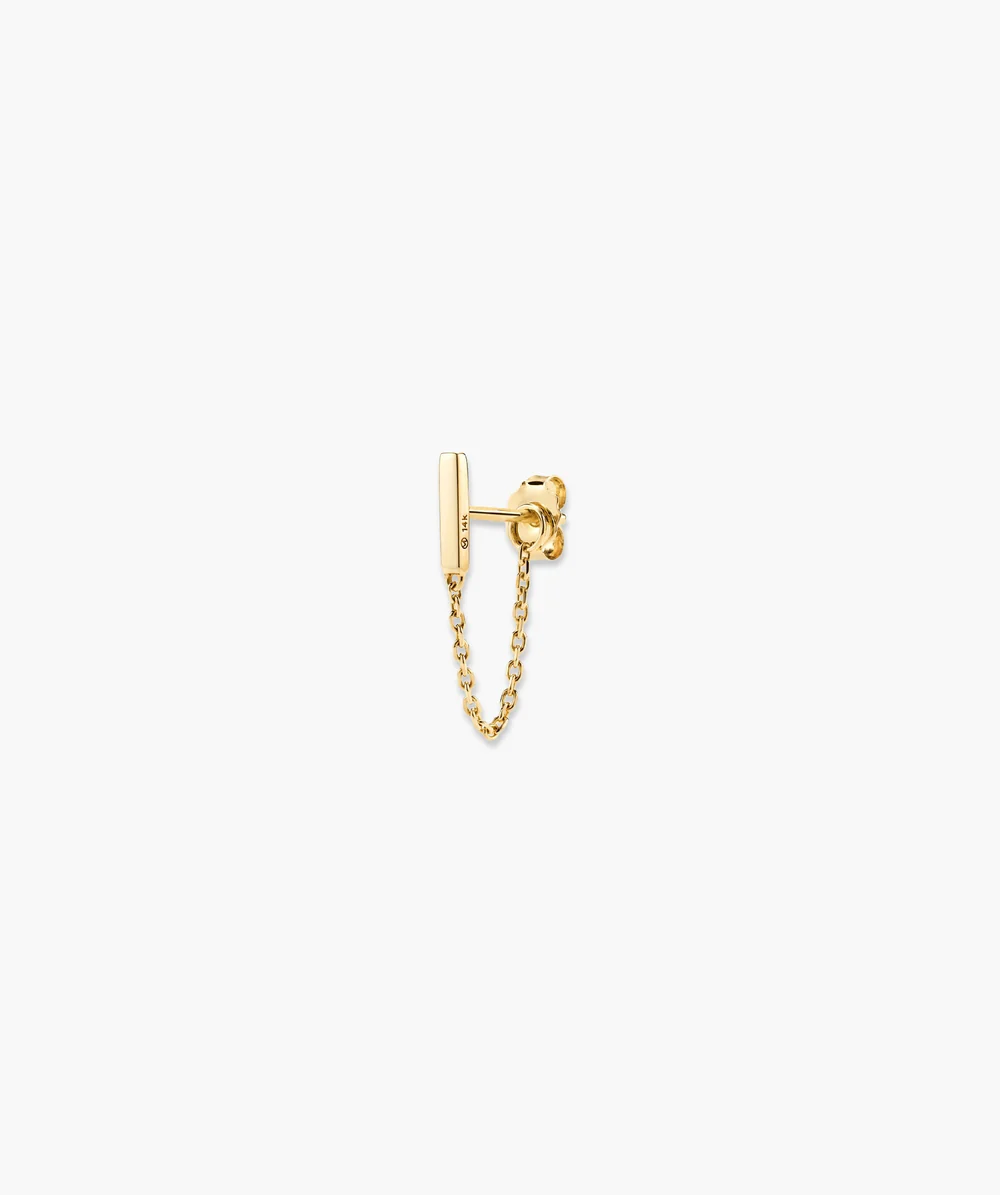
The Single Bar Chain Stud by Mejuri combines a slim polished-gold bar with a delicate 25 mm chain, creating an earring that can change its shape depending on how it is placed across the ear. Rather than behaving like an ordinary fixed stud, the chain can connect visually with an adjacent piercing or loop from the front toward the back of one piercing.
The bar measures 7 mm long and 1.7 mm wide, giving the design a clean linear focal point without overpowering a multi-piercing arrangement. One purchasing detail deserves particular attention: the Single Bar Chain Stud is sold individually rather than as a pair.
About Single Bar Chain Stud
Single Bar Chain Stud is designed primarily for flexible ear styling.
A conventional stud stays visually concentrated around one piercing. This design extends beyond that single point because the 25 mm chain adds movement and can interact with another piercing.
Mejuri specifically presents two styling configurations: the chain can be connected toward an adjacent piercing, or it can be looped from the front to the back.
That gives one small earring several possible appearances and makes it particularly useful for second-lobe, third-lobe, or other multi-piercing arrangements.
Single Bar Chain Stud Features
The current verified specifications include:
- Bar length: 7 mm
- Bar width: 1.7 mm
- Chain length: 25 mm
- Construction: Solid yellow gold
- Current indexed material options: 10k and 14k yellow gold, depending on market and selected listing
- Quantity: Sold individually
- Styling: Adjacent-piercing connection or front-to-back loop
- Manufacturer positioning: Water resistant and hypoallergenic
- Gemstones: None
Mejuri’s current 10k listing states that the piece uses 90% recycled 10k gold, while a currently indexed 14k listing states 94% recycled 14k gold. Availability and selected material can differ by region, so the exact variant shown at purchase should remain the final product specification.
Minimal Bar Design
The polished bar is deliberately simple.
At 7 mm long, it creates a visible horizontal or slightly angled line on the ear without becoming a broad geometric plate. Its 1.7 mm width keeps the profile narrow enough to work beside other earrings.
Because there are no gemstones, engraving, or decorative motifs, the design depends almost entirely on proportion and movement.
That simplicity is useful in an ear stack because the bar can provide structure beside round hoops, gemstone studs, or curved huggies without introducing another complicated shape.
25 mm Chain Detail
The 25 mm chain is the functional element that separates this piece from an ordinary bar stud.
It creates a fine line between piercing points and introduces movement as the ear and head move.
The chain is long enough to remain visible but short enough that the earring still reads as an ear-stack component rather than a conventional long-drop earring.
Exactly how much the chain drapes will depend on piercing spacing and ear anatomy.
Two people wearing the same earring may therefore see noticeably different chain curves.
Designed For Multiple Piercing Arrangements
Single Bar Chain Stud is particularly useful when more than one piercing is available.
One intended approach is to place the bar in one piercing and connect the chain toward another nearby piercing, creating a visible bridge between the two positions.
This works well when the surrounding jewelry is quieter.
A small huggie can anchor the first lobe while the chain stud occupies another position.
A tiny gemstone stud can add sparkle.
A plain gold ball stud can keep the overall ear stack more minimal.
The bar and chain already introduce two different visual elements, so every neighboring earring does not need to be decorative.
Front-To-Back Styling
The earring can also be looped from the front to the back rather than stretched between two separate piercings. Mejuri explicitly identifies this as an intended styling option.
This creates a smaller hanging curve around the ear and can make the chain more noticeable from the side.
The result is useful for someone who likes the look of chain earrings but does not necessarily want the chain extending between two different visible studs.
Piercing placement will influence the final effect, so the chain should sit naturally rather than being pulled into tension.
Sold Individually
This is one of the most important product details.
The Single Bar Chain Stud is sold as one individual earring, not a conventional two-piece pair.
That format makes sense because the design is intended for asymmetrical styling and multi-piercing arrangements.
Someone who wants one chain detail only needs to purchase one.
Someone who wants matching styling on both ears would need to account for the individual quantity when ordering.
The singular quantity should be made clear on an Erothots product page because the word “stud” does not always immediately communicate whether one or two earrings are included.
Solid Gold Construction
Unlike gold vermeil or ordinary gold plating, the current Single Bar Chain Stud variants use solid gold.
The U.S. Federal Trade Commission explains that karat markings indicate how much pure gold is contained within a jewelry alloy. Pure 24k gold is soft, so jewelry gold is commonly alloyed with other metals to improve practical durability.
For independent information about gold purity and jewelry terminology, see the FTC guide to buying gold jewelry.
This distinction matters because solid-gold jewelry has gold alloy throughout its structure rather than simply carrying a thin gold-colored surface layer.
10k Yellow Gold Version
Current Mejuri listings include a 10k yellow-gold Single Bar Chain Stud.
The manufacturer currently describes this version as solid gold and states that it uses 90% recycled gold. Its published measurements remain:
- 7 mm bar length
- 1.7 mm bar width
- 25 mm chain length
- Sold individually
Ten-karat gold contains less pure gold than 14k because a greater proportion of the alloy consists of other metals.
It should still be described as solid gold rather than gold plated.
14k Yellow Gold Version
A currently indexed Mejuri listing also shows a 14k yellow-gold version with the same bar and chain measurements.
That listing states that the 14k piece is made with 94% recycled 14k gold.
Fourteen-karat gold contains 14 parts gold out of 24.
The higher karat therefore contains a greater percentage of gold than 10k, although both remain alloyed metals designed for jewelry rather than pure 24k gold.
Because Mejuri’s regional availability can differ, Erothots should show the exact karat attached to the selected inventory rather than treating 10k and 14k as interchangeable.
Understanding Recycled Gold Claims
The recycled percentage describes the source of the material, not its karat purity.
For example, Mejuri’s current 90% recycled 10k gold claim does not mean that a 10k alloy is 90% pure gold.
Similarly, the 14k listing’s recycled-content percentage describes material sourcing rather than gold fineness.
The Responsible Jewellery Council’s Chain of Custody standard provides wider industry context for how responsibly sourced and recycled precious metals can be traced through jewelry supply chains.
Readers interested in this distinction can review the Responsible Jewellery Council Chain of Custody standard.
That framework explains precious-metal traceability generally and should not be treated as independent verification of Mejuri’s exact recycled percentage unless a product-specific certification is provided.
Understanding Gold Jewelry Terminology
Terms such as 10k, 14k, solid gold, gold vermeil, and gold plated should not be used as if they mean the same thing.
The FTC Jewelry Guides are intended to help consumers understand claims about precious metals, gemstones, origin, quality, construction, and other jewelry characteristics.
The FTC Jewelry Guides are a useful independent reference when comparing jewelry material descriptions.
For Single Bar Chain Stud, the important point is simple: the currently verified variants are solid-gold designs rather than vermeil versions.
How It Sits On The Ear
The bar provides the fixed visual point, while the chain introduces the softer portion of the design.
Depending on piercing position, the 7 mm bar may sit horizontally, slightly diagonally, or follow the natural angle of the ear.
The chain can then fall in a gentle curve.
Because ear anatomy varies, the exact silhouette cannot be predicted solely from the published 25 mm measurement.
Someone with closely spaced piercings may see a deeper chain curve, while greater spacing can make the chain appear straighter.
The earring should sit without putting uncomfortable tension on either piercing.
Comfort And Movement
The design is visually delicate because both the bar and chain are fine.
There is no large gemstone or heavy pendant hanging below the ear.
That can make it easier to incorporate into an everyday stack, although comfort will still depend on piercing placement and individual sensitivity.
If the chain is connected between two piercings, it should retain enough slack to allow natural movement.
Pulling the chain tight between piercing points is unnecessary and may make the earring less comfortable.
Building A Gold Ear Stack
Single Bar Chain Stud works particularly well as the linear element in an otherwise curved ear stack.
A possible combination could include:
A small huggie in the first lobe, the Single Bar Chain Stud in the second position, and a tiny plain stud in a third piercing.
This gives the ear three separate forms:
- rounded hoop
- straight bar and chain
- compact stud
The result can look more balanced than filling every piercing with similar hoops.
Pairing With Gemstone Studs
Because Single Bar Chain Stud contains no gemstone, it can sit beside many different stone colors.
White sapphire or diamond-style studs add a neutral point of light.
Black onyx introduces strong contrast.
Green sapphire or emerald adds color without competing directly with another gemstone in the chain earring.
Pearl can soften the sharp bar with a rounder, more organic form.
The plain gold construction gives the surrounding stones more room to stand out.
Pairing With Huggie Hoops
A huggie hoop is one of the easiest companions for a chain stud.
The hoop provides a stable circular shape while the chain adds movement.
If the huggie sits in the first lobe and the bar occupies a higher piercing, the difference in height also creates a natural progression up the ear.
Using hoops and studs in similar gold tones can make the arrangement feel connected even when their individual shapes differ substantially.
Asymmetrical Ear Styling
Because the piece is sold individually, asymmetry is part of its natural styling potential.
One ear can feature the Single Bar Chain Stud while the other uses a simpler hoop, solitaire stud, or completely different arrangement.
There is no need to reproduce the same chain effect on both sides.
For someone who prefers perfectly matched earrings, purchasing two individual pieces may create a more conventional balance.
For someone building an ear stack, one is often enough to become the distinctive detail.
Minimal Styling With One Piercing
Although the design is especially useful for multi-piercing arrangements, the front-to-back configuration can allow it to retain interest even when styled more simply.
The bar provides structure close to the piercing and the chain supplies movement behind or around the lobe.
This creates more visual interest than a plain bar stud without requiring an additional gemstone or long drop.
Best Occasions For Single Bar Chain Stud
The scale makes this earring easy to move between different settings.
It can work with:
- Everyday outfits
- Workwear
- Weekend styling
- Dinners
- Travel wardrobes
- Minimal event looks
- Multi-piercing jewelry stacks
- Mixed stud-and-hoop combinations
The absence of gemstones prevents it from feeling especially formal, while the solid-gold construction and polished finish keep it refined enough for dressier styling.
Manufacturer Hypoallergenic Claim
Mejuri currently describes Single Bar Chain Stud as hypoallergenic.
Hypoallergenic does not guarantee that absolutely every person will tolerate a jewelry alloy.
Nickel is one of the most common causes of allergic contact dermatitis associated with jewelry, and individual metal sensitivities can vary. The American Academy of Dermatology recommends choosing jewelry carefully when someone has a known nickel allergy.
For more information, see the AAD guidance on nickel allergy and jewelry.
If an earring repeatedly causes itching, redness, swelling, or soreness, discontinue wear rather than assuming irritation is normal.
Caring For The Fine Chain
The 25 mm chain is one of the most delicate parts of the earring.
Avoid pulling it while removing clothing, headphones, hats, or other accessories.
When taking the earring off, handle the solid bar or intended fastening point rather than tugging on the chain.
Fine chains can kink or stretch when unnecessary force is applied.
The earring should also be checked if it becomes caught on fabric rather than simply pulling it free.
Caring For Solid Gold
Solid gold is practical for regular jewelry wear, but it can still scratch and react to aggressive chemicals.
GIA advises protecting gold jewelry from chlorine, household cleaners, perfumes, lotions, hairspray, and other chemical exposure that may damage or discolor precious metals.
The GIA fine jewelry care guide provides useful independent advice about cleaning, chemical exposure, and safe storage.
A soft lint-free cloth is generally enough for routine wiping of this gemstone-free earring.
Cleaning Single Bar Chain Stud
Because the design contains no gemstones, routine cleaning is relatively straightforward.
Use a soft cloth to remove skin oils and cosmetic residue from the bar and accessible sections of the chain.
If deeper cleaning is necessary, keep the method gentle.
Avoid abrasive powders, harsh metal polishes, and hard brushes that may scratch the polished gold or catch within the fine chain.
Dry the earring completely before storing it.
Keep The Chain Away From Cosmetics
Hairspray, skincare, foundation, perfume, and other products can accumulate on fine jewelry.
Putting the earring on after beauty products have dried can reduce residue.
This is especially useful with a delicate chain because dried cosmetic material can collect between tiny links and make cleaning more difficult.
GIA specifically advises keeping jewelry away from unnecessary chemical exposure from cosmetics and household products.
Storage Between Wears
Store Single Bar Chain Stud separately rather than dropping it loose among rings, necklaces, and larger earrings.
Its fine chain can easily wrap around other pieces.
A small lined compartment or individual pouch is ideal.
Keeping the chain laid relatively straight also reduces the likelihood of knots.
GIA recommends separate or padded jewelry storage to help protect pieces from scratches and impact.
Why The Single Format Makes Sense
Selling this earring individually is more than a packaging choice.
Chain studs are often used to create intentional asymmetry.
A person may have three piercings on one ear and only one or two on the other. A matching pair would therefore be less useful for many ear-stack arrangements.
The single format allows the bar chain to occupy exactly the piercing where its movement and 25 mm length work best.
It also makes it easier to mix different earring types rather than building both ears around identical jewelry.
What Makes The Bar Chain Design Different
A basic stud gives one fixed visual point.
A hoop creates one continuous curve.
Single Bar Chain Stud combines a straight 7 mm bar with a moving 25 mm chain, giving it both structure and softness within the same small earring.
That contrast is the real strength of the design.
It can add interest to an ear stack without requiring gemstones, oversized proportions, or a long dangling earring.
Final Note
The Single Bar Chain Stud combines a polished 7 mm × 1.7 mm bar with a delicate 25 mm chain, allowing the earring to connect visually with an adjacent piercing or loop from front to back. It is sold individually, making it especially well suited to asymmetrical and multi-piercing styling.
Current indexed Mejuri listings show solid 10k and 14k yellow-gold versions, with material availability varying by region. The current 10k listing carries a 90% recycled-gold claim, while the currently indexed 14k version carries a 94% recycled-gold claim.
For Erothots shoppers, the strongest quality is flexibility. One small earring can create several different ear-stack arrangements while remaining simple enough to combine with hoops, huggies, gemstone studs, and other solid-gold pieces.
Reviews
There are no reviews yet.