



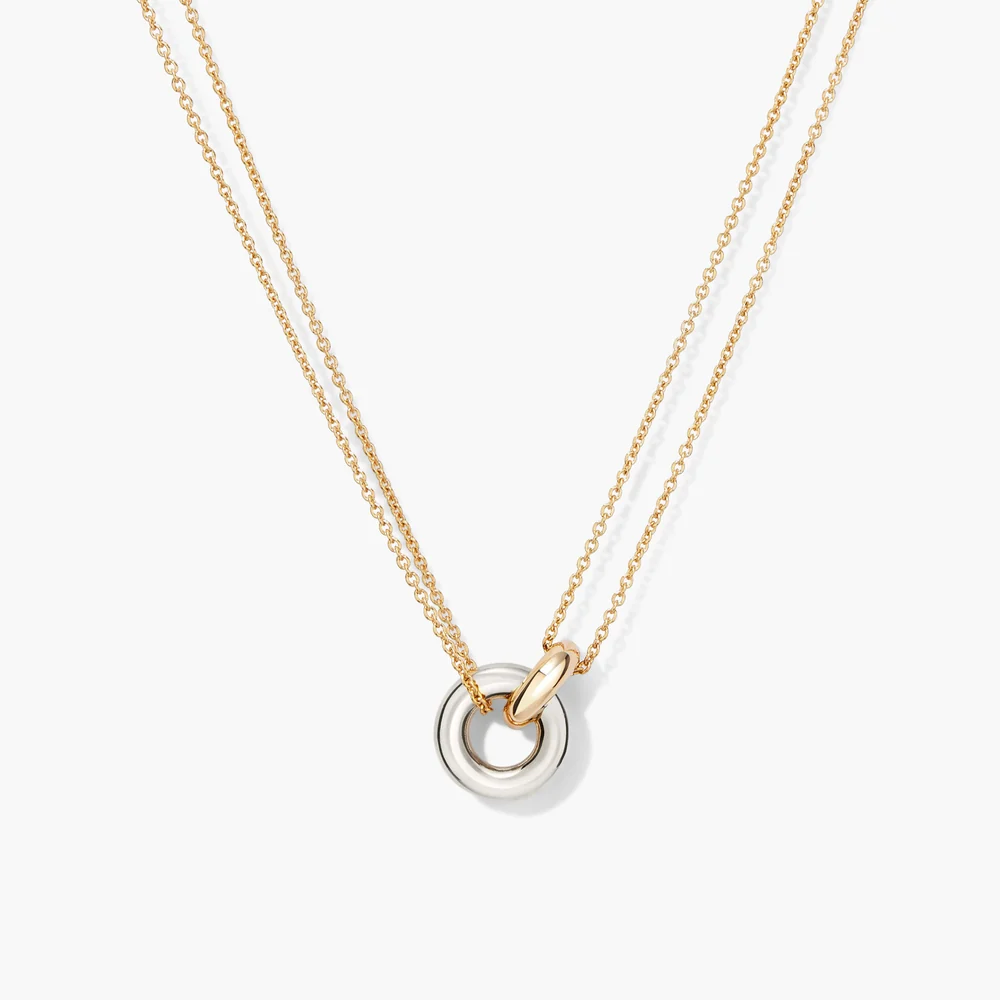
The Linked Two-Tone Necklace by Mejuri combines sterling silver and warm 18k gold vermeil in a sculptural pendant built around two interlinked forms. Instead of choosing between gold and silver, the necklace intentionally places both metals together, making it particularly useful for people who already mix different metal tones across rings, earrings, bracelets, or watches.
The current necklace adjusts from 16 to 18 inches and uses a fine 1.1 mm chain. Its linked centerpiece combines a 12 mm × 2.6 mm circular element with a smaller 9.15 mm × 7.5 mm oval element. Mejuri currently describes the necklace as hypoallergenic and states that the sterling-silver base material contains 91% recycled content.
About Linked Two-Tone Necklace
Linked Two-Tone Necklace takes a familiar pendant idea and gives it more dimension through two connected shapes rather than one fixed charm.
One element is circular, while the second has a more elongated oval form. Their different proportions prevent the centerpiece from looking mechanically symmetrical and give the necklace a slightly more sculptural character.
The contrasting metal finishes reinforce that effect. Polished silver provides a cooler highlight while gold vermeil introduces warmth, allowing each linked section to remain visually distinct even though both belong to the same pendant.
Mejuri presents the connected forms as a symbol of personal bonds and relationships. The design can certainly carry that meaning, but it also works simply as an abstract mixed-metal necklace for someone who prefers jewelry without a literal heart, letter, or gemstone motif.
Linked Two-Tone Necklace Features
The current design includes a 16-to-18-inch adjustable necklace length, 1.1 mm chain, mixed 18k gold vermeil and sterling-silver construction, a 12 mm circular component, and a 9.15 mm × 7.5 mm oval component.
Mejuri also identifies the silver as 925 sterling silver and describes the vermeil portion as a thick layer of 18k gold applied over sterling silver. The company currently states that its sterling-silver base material contains 91% recycled content.
These details give the necklace its main characteristics without relying on gemstones, engraving, or oversized decoration.
Mixed-Metal Design
The most important style feature is the deliberate combination of two precious-metal appearances.
Traditional jewelry styling often encourages people to keep gold with gold and silver with silver. A two-tone necklace changes that relationship because both colors already exist within one finished piece.
This makes it easier to wear a yellow-gold ring with a silver watch, or sterling-silver earrings with a warm-toned bracelet, without making the combination appear accidental.
The linked pendant becomes the point that visually connects those different metals.
That flexibility can be particularly useful for someone whose existing jewelry collection was built gradually and contains pieces in several finishes.
Two Interlinked Shapes
The centerpiece combines two different forms rather than repeating identical circles.
The larger circular section measures 12 mm across with a 2.6 mm profile, while the smaller oval measures approximately 9.15 mm × 7.5 mm.
Those proportions keep the pendant relatively compact while still making the linked construction easy to see.
Using differently shaped components also introduces subtle movement. Because the elements connect rather than forming one solid plate, their position can shift slightly as the necklace moves.
That gives the pendant a softer, more natural appearance than a rigid geometric charm.
18k Gold Vermeil Construction
The gold-colored portion of Linked Two-Tone Necklace is 18k gold vermeil, not solid 18k gold.
Mejuri describes its vermeil as a substantial layer of 18k gold over sterling silver.
For independent material context, the FTC guide to gold and silver jewelry explains that vermeil is a particular form of gold-plated jewelry in which the underlying metal is sterling silver.
That distinction is important because a necklace described as gold vermeil has a different construction from both solid-gold jewelry and ordinary gold-colored fashion jewelry.
The accurate description for this piece is therefore 18k gold vermeil and sterling silver, not solid 18k gold.
925 Sterling Silver
The silver sections and the underlying base of the vermeil component use 925 sterling silver.
The number 925 refers to silver purity. Sterling silver contains 92.5% pure silver, with other metals making up the remainder of the alloy. The FTC confirms this definition in its precious-metal consumer guidance.
Adding other metal to pure silver improves the practical qualities needed for jewelry because pure silver by itself is relatively soft.
The FTC Jewelry Guides also provide useful broader guidance on how sellers should accurately describe gold, silver, precious-metal coatings, gemstones, and other jewelry characteristics.
Understanding The 91% Recycled Silver Claim
Mejuri currently states that the necklace uses a 91% recycled sterling-silver base metal.
This percentage should not be confused with sterling-silver purity.
92.5% silver describes the composition required for the sterling-silver alloy.
91% recycled content describes Mejuri’s stated sourcing composition for the sterling-silver material used in the product.
These figures therefore measure two completely different characteristics.
For readers interested in how recycled precious metals can be traced through jewelry supply chains, the Responsible Jewellery Council Chain of Custody standard sets out a voluntary framework covering responsibly sourced and traceable gold, silver, and platinum-group metals.
That broader standard does not independently verify this particular necklace’s 91% figure, but it provides useful context for understanding what responsible-source and recycled-material systems involve.
Adjustable 16 To 18 Inch Length
Linked Two-Tone Necklace is currently offered at 16 to 18 inches, giving approximately two inches of adjustment.
That length range is useful because it can change where the pendant sits depending on neckline and layering.
At the shorter setting, the linked centerpiece can sit closer to the collarbone.
At the longer setting, it drops slightly lower and leaves more space above it for another necklace.
Exact placement will naturally differ with neck size, body proportions, and clothing.
The adjustable construction also makes the necklace easier to coordinate with different tops than a completely fixed-length chain.
Fine 1.1 mm Chain
The current chain measures 1.1 mm wide.
This relatively fine chain keeps the linked centerpiece visually dominant.
A much heavier chain would compete with the two sculptural rings, while an extremely fine chain could make the pendant appear disproportionately substantial.
The 1.1 mm proportion creates a useful balance between delicacy and visibility.
Because fine chains can be more vulnerable to twisting or tangling than thick links, careful storage is worthwhile when the necklace is not being worn.
Wearing The Necklace On Its Own
Linked Two-Tone Necklace does not need several other pieces around it to look complete.
The contrast between silver and gold already gives the pendant more visual complexity than a single-metal chain.
With a crew-neck T-shirt, knit, button-front shirt, or simple dress, the linked forms can provide the main jewelry detail around the neckline.
Keeping earrings understated can make the pendant stand out more clearly.
Small gold hoops, silver studs, or uncomplicated huggies all work because each repeats one of the necklace’s two metal tones.
Ways To Style Linked Two-Tone Necklace
One of the easiest approaches is to let the necklace act as the bridge between otherwise separate gold and silver accessories.
A sterling-silver watch can sit beside a yellow-gold ring.
Gold hoops can be combined with a silver bracelet.
A mixed-metal ring can strengthen the connection even further.
Because the necklace already establishes both colors as intentional, other pieces do not need to follow a strict matching rule.
The outfit itself can remain very simple because the two-tone pendant provides enough visual interest without gemstones or bright color.
Layering With A Shorter Necklace
The 16-to-18-inch adjustment also makes the necklace suitable for layering.
One approach is to wear Linked Two-Tone Necklace at its longer setting and place a shorter fine chain above it.
A simple chain without another large pendant usually creates the cleanest result because the linked centerpiece already acts as a focal point.
Another option is to use a very small gemstone or initial necklace higher on the neckline.
Leaving visible distance between each necklace helps the layers appear intentional rather than tangled into one visual line.
Layering With A Longer Chain
Linked Two-Tone Necklace can also become the upper piece in a layered arrangement.
At approximately 16 inches, it can sit above an 18-to-22-inch pendant or chain.
A longer necklace should ideally have a different chain weight or pendant scale so that the two pieces are distinguishable.
For example, the fine Linked Two-Tone Necklace can sit above a heavier plain chain or lower pendant.
This contrast in length and texture often works better than combining several nearly identical delicate necklaces.
Pairing With Gold Earrings
Gold earrings naturally pick up the warm vermeil portion of the necklace.
Small huggies provide a minimal combination, while larger gold hoops can make the overall look more noticeable.
A gold chain stud adds movement without introducing another strong shape.
There is no need for every piece to contain silver simply because the necklace does.
The existing silver component already provides the second metal tone and prevents the overall styling from looking strictly monochromatic.
Pairing With Sterling Silver Earrings
The opposite approach works equally well.
Sterling-silver studs or hoops emphasize the cooler section of the linked pendant, while the gold-vermeil detail remains the contrasting accent.
This is particularly useful when someone owns mostly silver jewelry but wants to introduce warmer gold gradually.
The necklace itself creates the transition instead of requiring a completely separate gold jewelry set.
Styling With Watches And Bracelets
Two-tone jewelry works particularly well around watches because many watches already combine polished steel, gold-tone details, or mixed hardware.
A silver watch can be paired with a gold bracelet while the necklace connects both tones higher on the body.
Alternatively, a yellow-gold bracelet can sit beside a steel watch without appearing unrelated.
If several bracelets are already being worn, keeping the necklace relatively simple prevents every area of the outfit from becoming equally busy.
Best Occasions For This Style
Linked Two-Tone Necklace is not strongly tied to formal or casual dressing.
Its compact pendant and fine chain work comfortably for everyday outfits, office clothing, dinners, travel, celebrations, and more polished evening looks.
The lack of gemstones keeps it understated enough for daytime.
At the same time, the interlinked forms have enough dimension to remain visible with a dress or tailored evening outfit.
That makes the necklace useful for someone who prefers jewelry that can remain in regular rotation rather than being reserved for special occasions.
A Symbolic Necklace Without A Literal Motif
Mejuri presents the linked shapes as representing connections between people.
That gives the necklace potential sentimental meaning without using an obvious heart, name, date, or engraved message.
For gift giving, this can be useful.
The recipient can attach personal meaning to the linked rings while still owning a necklace that looks like straightforward contemporary jewelry.
It can represent friendship, family, partnership, or another relationship, but it does not require that interpretation to work visually.
Understanding The Hypoallergenic Claim
Mejuri currently describes Linked Two-Tone Necklace as hypoallergenic.
That wording should not be understood as a guarantee that every individual will tolerate the jewelry without irritation.
Skin sensitivities vary, and reactions can depend on an individual’s sensitivity to particular alloy components.
If jewelry repeatedly produces redness, itching, or irritation where it touches the skin, discontinue wear rather than assuming discomfort is normal.
The material composition shown on the actual product packaging or retailer documentation should remain the final reference for shoppers managing a known metal sensitivity.
Caring For Mixed-Metal Jewelry
Mixed-metal jewelry should be cared for according to its more delicate finish.
The sterling-silver section can naturally develop tarnish, while the gold-vermeil surface can gradually show wear because its gold is applied as a layer over silver.
Aggressive polishing that might be appropriate for bare sterling silver should therefore not automatically be used across the entire necklace.
The GIA guide to caring for jewelry recommends protecting precious metals from chemicals including chlorine, household cleaners, perfume, lotions, and hairspray.
Putting the necklace on after beauty products have dried can reduce unnecessary chemical residue on the surfaces.
Cleaning Linked Two-Tone Necklace
For routine cleaning, begin with the gentlest method.
A soft, lint-free cloth can remove skin oils, fingerprints, and ordinary residue from the pendant and chain.
Avoid heavily abrasive metal polishes across the gold-vermeil portion because repeated abrasion can affect a plated surface.
If deeper cleaning is needed, use a mild jewelry-safe method and dry the necklace thoroughly afterward.
Particular attention can be given to the point where the linked components meet because small amounts of lotion or cosmetic residue may collect around overlapping areas.
Protecting The Vermeil Finish
Gold vermeil provides the appearance of gold over a precious sterling-silver base, but it still requires different expectations from solid gold.
Repeated rubbing, abrasive cleaning, chemical exposure, and contact with hard surfaces can gradually affect the outer gold layer.
Removing the necklace before swimming in chlorinated water or using strong household cleaners can help reduce unnecessary wear.
GIA specifically notes that chlorine and other chemicals can damage or discolor precious-metal jewelry.
This is particularly relevant with a mixed-metal piece where preserving the contrast between the gold and silver surfaces is part of the design.
Sterling Silver And Tarnish
Sterling silver can darken naturally over time due to chemical reactions at its surface.
That does not automatically indicate poor-quality metal.
Gentle cleaning can restore much of its brightness, but care should be taken when the silver sits immediately beside gold vermeil.
Using a soft cloth and cleaning only the area that needs attention gives more control than treating the entire necklace with an aggressive silver-cleaning product.
The two-tone design is best maintained when both finishes remain visibly distinct.
Storage Between Wears
Fine necklaces are prone to tangling, particularly when stored loose with other chains.
Keep Linked Two-Tone Necklace in an individual pouch, lined compartment, or separate section of a jewelry organizer.
If possible, fasten the chain before storing it. A closed chain is often easier to arrange without knots than one left completely loose.
GIA recommends separate or padded jewelry storage to reduce scratching and impact damage.
Separate storage is also useful for protecting the vermeil surface from constant rubbing against rings, bracelets, and heavier chains.
Understanding Precious-Metal Markings
Precious-metal terminology can become confusing when one necklace contains both sterling silver and a gold coating.
Official UK hallmarking guidance provides useful independent context on why precious-metal fineness matters and how hallmarking helps verify metal descriptions in markets where hallmarking laws apply.
The rules differ by country, but the underlying principle is useful anywhere: terms such as sterling silver, gold, and gold-plated silver describe specific material characteristics rather than simply a jewelry color.
For Linked Two-Tone Necklace, the clearest description remains 925 sterling silver combined with 18k gold vermeil over sterling silver.
Why Two-Tone Jewelry Is Easy To Rewear
The practical strength of a mixed-metal necklace is that it reduces the need to build every outfit around a single jewelry color.
Someone can change watches, rings, or earrings without immediately making the necklace feel mismatched.
The linked design also avoids relying on a seasonal color, gemstone, or highly specific fashion motif.
Its visual identity comes from shape and metal contrast, both of which can remain relevant across many wardrobes.
For someone building a smaller jewelry collection, that flexibility can make a two-tone necklace particularly useful because one piece can work alongside accessories that might otherwise belong to separate gold and silver groups.
Final Note
The Linked Two-Tone Necklace combines a fine 1.1 mm adjustable chain with two sculptural linked elements: a 12 mm × 2.6 mm circle and a 9.15 mm × 7.5 mm oval. Its 16-to-18-inch length provides enough adjustment for both solo and layered styling.
Its material construction is equally central to the design. Mejuri combines 925 sterling silver with 18k gold vermeil over sterling silver, creating the warm-and-cool contrast that defines the necklace.
For Erothots shoppers, its strongest quality is versatility. It can connect gold and silver accessories within one outfit, carry subtle symbolic meaning through its linked forms, and remain understated enough for frequent everyday wear.
Reviews
There are no reviews yet.