



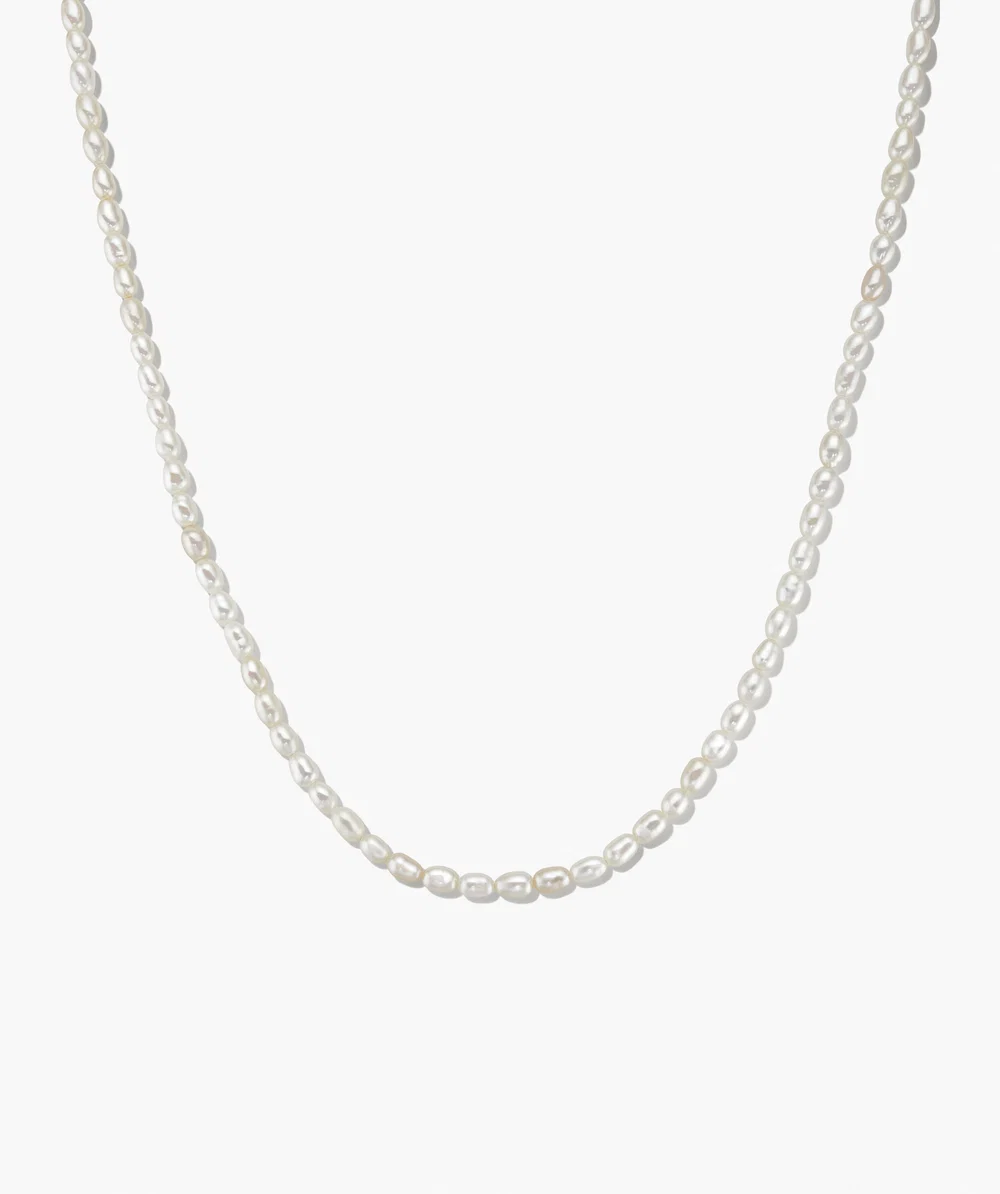
The Tiny Pearl Necklace by Mejuri is a delicate strand of small cultured freshwater pearls finished with 18k gold vermeil over sterling silver. Instead of relying on a large pendant or oversized pearls, the necklace uses petite 4 × 3 mm pearls to create a lighter, finer interpretation of classic pearl jewelry. Its current length adjusts from 14 to 16 inches, allowing it to sit relatively high on the neckline or provide the shortest layer in a necklace stack.
Mejuri currently describes the necklace as hypoallergenic, states that its vermeil is applied over a 91% recycled sterling-silver base, and says its pearls are traceable to their country of origin. Because cultured freshwater pearls are organic gems, small differences between individual pearls are expected rather than every piece looking mechanically identical.
About Tiny Pearl Necklace
Tiny Pearl Necklace takes the traditional pearl strand and reduces its scale.
The pearls measure only 4 mm × 3 mm, giving the necklace a noticeably finer appearance than classic strands built from larger round pearls. Mejuri identifies them as cultured freshwater pearls, produced in freshwater mollusks rather than mined or manufactured as imitation beads.
This smaller pearl size makes the necklace particularly adaptable. It can work as the only necklace with a simple shirt or dress, sit close to the neckline beneath a longer pendant, or provide a soft contrast beside polished gold chains.
The current construction uses 18k gold vermeil on sterling silver for the metal components. It should therefore be described as a pearl necklace with gold-vermeil hardware rather than as a solid 18k gold necklace.
Tiny Pearl Necklace Features
Current verified product details include petite cultured freshwater pearls, a 4 × 3 mm pearl size, an adjustable 14-to-16-inch length, 18k gold vermeil over sterling silver, and a manufacturer-stated 91% recycled sterling-silver base. Mejuri also describes the pearls as 100% traceable to their country of origin.
The necklace does not depend on a central charm or colored gemstone. Its visual character comes from the repeated pearl surfaces, small-scale proportions, and warm metal details.
Cultured Freshwater Pearl Construction
Mejuri identifies the pearls as cultured freshwater pearls.
Freshwater cultured pearls form inside freshwater mollusks, usually mussels. GIA explains that modern freshwater pearls are cultivated primarily in lakes and ponds and can vary considerably in shape, color, size, and luster. Many are tissue-nucleated, meaning layers of nacre form around introduced mantle tissue rather than a large shell bead.
For independent background on how freshwater pearls differ from Akoya, Tahitian, and South Sea pearls, see GIA’s guide to different pearl types.
This distinction matters because cultured does not mean imitation. The pearls are produced by living mollusks with human assistance, whereas imitation pearls are made from other materials intended to reproduce a pearl-like appearance.
4 × 3 mm Pearl Size
The current product specification gives each pearl an approximate size of 4 mm × 3 mm.
This is one of the most important characteristics of the necklace.
Many classic pearl strands use larger pearls that become an obvious focal point around the neck. The 4 × 3 mm scale creates a more subtle line, allowing the necklace to feel lighter and easier to combine with other jewelry.
The slightly different length and width measurements also indicate that the pearls should not be assumed to be perfectly spherical.
Mejuri specifically notes that individual pearls may show slight variations in size and shape.
Why Pearl Variation Is Normal
Pearls are organic gems, so perfect uniformity is not necessarily expected.
GIA evaluates pearl appearance using seven principal factors: size, shape, color, luster, surface, nacre, and matching. For necklaces containing many pearls, matching considers how consistently the pearls work together visually.
Readers who want to understand pearl quality beyond simple size can use GIA’s pearl quality guide.
On Tiny Pearl Necklace, subtle variations can make the strand look less manufactured and reinforce the character of cultured freshwater material.
Pearl Luster And Surface
Pearl does not sparkle in the same way as a faceted diamond or sapphire.
Instead, its appearance depends heavily on luster, which describes the quality and intensity of light reflected from the pearl’s surface and underlying nacre layers.
GIA notes that pearls with stronger luster produce brighter and sharper reflections. Surface quality also matters, since natural-looking pits, spots, or texture can affect how an individual pearl appears.
Because these pearls are very small, the overall effect comes from dozens of softly reflective surfaces working together rather than one large gemstone.
Petite Pearl Strand Design
Tiny Pearl Necklace is closer in spirit to a miniature traditional strand than a pendant necklace.
The pearls form the main decorative line across the neckline rather than being concentrated in one center charm.
That construction gives the necklace a different visual rhythm from a gold chain.
A plain chain creates a continuous metallic line.
A tiny pearl strand creates repeated soft points with subtle gaps and changes in reflection as the necklace moves.
This is one reason the necklace layers particularly well with smooth gold chains.
Adjustable 14 To 16 Inch Length
Mejuri’s current primary listing gives the necklace an adjustable length of 14 to 16 inches.
At the shorter end, the pearls sit relatively close to the base of the neck, depending on individual proportions.
Extending toward 16 inches creates slightly more space and can make the necklace easier to position above another chain.
Exact placement naturally changes with neck circumference, shoulder shape, clothing, and the specific adjustment point selected.
Styling At The Shorter Length
A shorter setting can emphasize the fine pearl line.
It works especially naturally with open shirts, scoop necks, square necklines, V-necks, and strapless or wider-neck garments where the pearls can remain visible against skin.
It can also make Tiny Pearl Necklace an effective first layer.
A longer chain or pendant can then sit beneath it without both pieces occupying the same visual level.
Styling At The Longer Length
At approximately 16 inches, the necklace gains a slightly more relaxed position.
This may work better with higher necklines or when the wearer does not prefer a particularly close pearl strand.
The extra length can also help separate the pearls from another short necklace.
Because only a two-inch range is available, someone specifically looking for a much lower pearl necklace should consider whether a different chain length would better suit the intended neckline.
18k Gold Vermeil Details
The metal components use 18k gold vermeil over sterling silver.
Vermeil is not solid 18k gold.
The FTC explains that vermeil is a special category of gold-plated jewelry in which sterling silver forms the base underneath the gold coating.
For readers comparing jewelry materials, FTC guidance on gold, silver and vermeil jewelry explains the difference between solid gold, sterling silver, plating, and vermeil.
The accurate Erothots description is therefore 18k gold vermeil over sterling silver, not solid 18k gold.
Sterling Silver Beneath The Gold
The vermeil uses sterling silver as its underlying precious metal.
FTC consumer guidance states that sterling silver contains 92.5% pure silver, which is why sterling pieces may also carry the familiar 925 designation.
Mejuri separately states that the sterling-silver base used in this necklace contains 91% recycled material.
Those percentages describe two different things.
92.5% concerns the silver content of sterling silver.
91% recycled material is Mejuri’s sourcing claim about the material used to produce the sterling-silver base.
Understanding The Recycled Silver Claim
A recycled-content claim should not be confused with metal purity.
The Responsible Jewellery Council’s Chain of Custody framework covers systems for tracing responsibly sourced and recycled gold, silver, and platinum-group metals through jewelry supply chains.
For broader context, see the Responsible Jewellery Council Chain of Custody standard.
That standard helps explain how recycled precious-metal sourcing can be documented. It should not be treated as independent verification of Mejuri’s particular 91% figure unless product-specific certification is provided.
Pearl Traceability Claim
Mejuri currently describes the pearls in Tiny Pearl Necklace as 100% traceable to their country of origin.
This is a manufacturer traceability statement rather than a GIA grading report or independent pearl-origin certification.
It is therefore appropriate to state the claim as Mejuri’s published sourcing information rather than presenting it as an independently verified gemological conclusion.
Understanding Cultured Pearl Terminology
Pearl terminology matters because natural pearls, cultured pearls, and imitation pearls are separate categories.
The FTC Jewelry Guides specifically cover the accurate representation of natural and cultured pearls, imitation materials, precious metals, gemstone characteristics, origin, quality, treatment, and other jewelry attributes.
Readers interested in labeling standards can review the FTC Jewelry Guides.
For this product, cultured freshwater pearl is the clearest description supported by the current manufacturer information.
Ways To Style Tiny Pearl Necklace
The necklace works especially well when its small pearl size is treated as a texture rather than a dramatic statement.
With a white shirt or simple tee, it creates a softer neckline without requiring a pendant.
With a black or navy top, the pale pearl surfaces become more visible.
With cream, beige, or pastel clothing, the necklace creates a quieter tonal effect.
The warm vermeil hardware also makes it easy to coordinate with yellow-gold earrings, rings, or bracelets.
Wearing Tiny Pearl Necklace Alone
Wearing the necklace by itself allows the small pearls to remain the main detail.
This works particularly well with clothing that already contains strong patterns, texture, tailoring, or embellishment.
The necklace adds polish without introducing another obvious shape.
Small hoops or plain studs can complete the look while allowing the pearl strand to remain clearly visible.
Layering With A Gold Chain
Pearl and polished metal create useful textural contrast.
A fine gold chain can sit below Tiny Pearl Necklace to add shine without adding another gemstone.
A slightly heavier chain creates even stronger contrast against the petite pearls.
The most important factor is length.
Keeping enough distance between the pearl strand and the second chain allows each necklace to remain visible rather than appearing tangled into one line.
Layering With A Pendant
Tiny Pearl Necklace can also sit above a longer pendant.
Because the strand does not contain a large centerpiece, it leaves visual room for another necklace lower on the chest.
A black onyx pendant creates strong contrast.
A white sapphire or diamond-style pendant maintains a lighter palette.
A simple gold charm creates a warmer, more minimal combination.
The pearl strand works particularly well as the shorter layer because of its current 14-to-16-inch adjustment.
Pairing With Pearl Earrings
A pearl necklace does not require matching pearl earrings, but the combination can work when the earring scale remains controlled.
Tiny pearl studs can create a coordinated look without making the styling overly formal.
A single pearl drop can add more movement.
If larger pearl earrings are chosen, keeping the necklace at its simplest setting can prevent the full look from becoming visually crowded.
Pairing With Gold Hoops
Gold hoops create a more contemporary contrast with the traditional pearl material.
Small huggies keep the jewelry understated.
Medium polished hoops give the face more definition while leaving the necklace delicate.
Mixed gold-and-silver earrings can also work because the visible necklace finish is warm gold but the pearls themselves remain neutral.
Pearls With Casual Clothing
Pearls do not need to be reserved for formal clothing.
The small 4 × 3 mm scale makes Tiny Pearl Necklace especially easy to combine with denim, cotton shirts, fine knits, simple dresses, and everyday basics.
Using a petite pearl strand with casual clothing can make the necklace feel less ceremonial than a larger traditional strand.
This makes Tiny Pearl Necklace particularly practical for someone who likes pearl jewelry but wants something that can stay in regular rotation.
Best Occasions For This Style
Tiny Pearl Necklace can work for a broad range of settings, including everyday outfits, workwear, dinners, celebrations, weddings, travel wardrobes, family events, and understated evening styling.
The small pearl size gives it flexibility.
Worn alone, it stays simple.
Layered with gold chains or pendants, it can become part of a stronger jewelry look.
Its traditional material also makes it suitable for gift giving without requiring the recipient to wear highly formal jewelry.
Pearl Hardness And Delicate Care
Pearls require more careful treatment than many gemstones.
GIA places pearl at only 2.5 on the Mohs hardness scale, meaning it can scratch or abrade relatively easily.
This matters especially in a necklace containing many small pearls, because repeatedly storing them against harder gemstones or rough metal surfaces can gradually affect their finish.
For detailed maintenance recommendations, see GIA’s pearl care and cleaning guide.
Perfume And Cosmetics Around Pearls
GIA notes that pearls can be affected by chemicals and acids, including perfume, hairspray, cosmetics, and perspiration.
A useful routine is to put the necklace on after fragrance, skincare, hair products, and makeup have been applied and allowed to dry.
After wearing it, gently wiping the pearls with a very soft clean cloth can remove some surface residue.
This matters more for pearls than for many harder gemstones because nacre is comparatively soft and chemically sensitive.
Cleaning Tiny Pearl Necklace
Pearl jewelry should be cleaned conservatively.
GIA specifically advises against ultrasonic and steam cleaning for pearls. Warm, mildly soapy water can be used for occasional cleaning, while routine care can be as simple as wiping cultured pearls with a soft clean cloth after wear.
Avoid abrasive jewelry cleaners or brushes that could scratch the pearl surfaces.
The gold-vermeil components also benefit from gentle handling because aggressive polishing can gradually affect the plated gold layer.
Do Not Use Ultrasonic Cleaning
An ultrasonic cleaner may be appropriate for certain durable gemstones and metal-only jewelry, but pearls are different.
GIA specifically states that pearls should never be cleaned in an ultrasonic or steam cleaner.
The safest home approach is gentle hand cleaning and careful drying.
This is an important distinction when a jewelry collection contains both hard stones such as sapphire and softer organic gems such as pearl.
Protecting The Vermeil Finish
The pearl strand is not the only part that needs care.
The gold-vermeil hardware can gradually show wear through repeated abrasion because the gold exists as a surface layer over sterling silver.
Avoid harsh polishing compounds, chlorine-based cleaners, and unnecessary chemical exposure.
If the metal becomes dirty, use a soft cloth rather than aggressively polishing it as if it were solid gold.
Storage Between Wears
Store Tiny Pearl Necklace separately from harder jewelry.
A soft pouch or lined compartment can help protect the pearl surfaces and reduce tangling.
Avoid dropping diamond rings, sapphire earrings, or heavy metal pieces directly on top of the necklace.
GIA’s pearl hardness information is particularly relevant here because materials with greater hardness can scratch softer pearl surfaces.
Keeping the necklace relatively flat can also help preserve the visual line of the strand.
What Makes Tiny Pearl Necklace Different From A Classic Strand
A traditional pearl necklace can feel visually substantial because larger pearls create a continuous bright band around the neckline.
Tiny Pearl Necklace reduces that scale to 4 × 3 mm cultured freshwater pearls.
This changes the personality of the piece.
The smaller strand can feel lighter with everyday clothing, takes up less visual space when layered, and allows earrings or another pendant to carry more of the overall jewelry emphasis.
It retains the recognizable softness of pearl without requiring the wearer to build the entire outfit around the necklace.
Who May Prefer This Pearl Size
Tiny Pearl Necklace is particularly suitable for someone who finds conventional pearl strands too large or formal.
The petite scale also works well for necklace layering because it introduces a completely different texture without the bulk of large pearls.
Someone specifically looking for prominent statement pearls may prefer a larger pearl necklace.
Someone wanting subtle pearl texture and a relatively close 14-to-16-inch placement is more likely to appreciate this design.
Final Note
The Tiny Pearl Necklace combines 4 × 3 mm cultured freshwater pearls with 18k gold vermeil over sterling silver in an adjustable 14-to-16-inch strand. Mejuri currently states that the vermeil uses a 91% recycled sterling-silver base and that the pearls are traceable to their country of origin.
For Erothots shoppers, its strongest characteristic is scale. The small pearls give classic pearl jewelry a lighter everyday feel while still providing the soft luster and natural variation associated with cultured freshwater material.
It can stand alone as a fine pearl strand or become the textural first layer beneath longer gold chains and pendants. Because pearls are considerably softer than stones such as sapphire or diamond, gentle cleaning and separate storage are especially important for keeping the necklace looking its best.
Reviews
There are no reviews yet.