



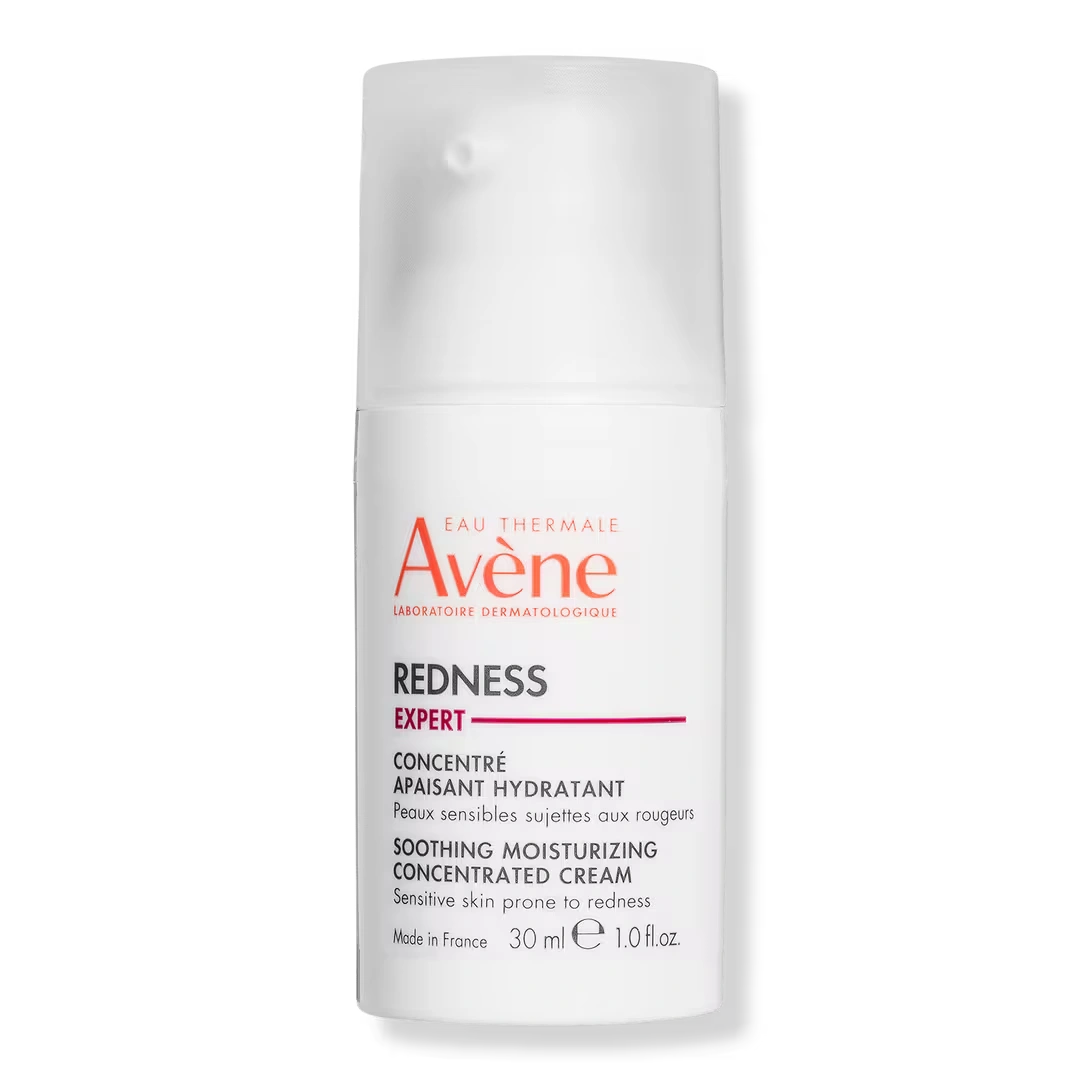
Avène Redness Expert Soothing Moisturizing Concentrated Cream is a lightweight, fragrance-free facial moisturizer developed for sensitive and reactive skin prone to persistent visible redness, warmth, tightness, and discomfort. The 1.0 fl oz / 30 mL cream combines Avène Thermal Spring Water with 6% Angiopausine™, a patented milk-thistle-derived ingredient, glycerin, emollients, sunflower seed oil, and vitamin E. Avène reports 24-hour hydration and a 48% reduction in visible redness intensity in its finished-product clinical testing.
The formula is deliberately concise and contains no added fragrance, drying alcohol, silicones, parabens, sulfates, mineral oil, or talc. It has also received the National Rosacea Society Seal of Acceptance, although that seal should not be interpreted as proof that the cream treats or improves rosacea for every person.
About Redness Expert Soothing Moisturizing Concentrated Cream
Redness Expert is positioned between a traditional sensitive-skin moisturizer and a targeted cosmetic redness treatment. It is intended to hydrate while reducing the appearance of established redness and easing sensations such as warmth and tightness that can accompany reactive skin. Avène recommends it for morning and evening use on the face and neck.
The cream has a lightweight, non-greasy texture and can also function as a moisturizer underneath makeup. Avène says the formula is 98% of natural origin and was co-developed with dermatologists.
Redness Expert Soothing Moisturizing Concentrated Cream Features
The product is built around three connected concerns: visible redness, uncomfortable reactive sensations, and dehydration.
Avène’s clinical testing found a 48% reduction in visible redness intensity after twice-daily use. The study involved 41 participants and assessed results over 29 days using the Global Flushing Severity Score. A separate 41-person assessment found reductions in discomfort, warmth, and tightness beginning by day 15, while hydration testing involved 30 participants.
Those details are important because they identify the results as finished-product clinical findings, rather than conclusions inferred from one ingredient alone.
The cream should still be described as cosmetic redness care. Persistent facial redness can have many causes, including rosacea, irritation, contact dermatitis, sun exposure, and other skin conditions. The American Academy of Dermatology’s facial redness guide explains why the cause matters when redness does not settle.
6% Angiopausine™ From Milk Thistle
The ingredient most strongly associated with Redness Expert is Angiopausine™.
Avène describes it as a patented active developed after approximately three years of research and derived from milk thistle. The cream contains the ingredient at 6%, and the published INCI identifies Silybum Marianum Fruit Extract as the recognizable milk-thistle component.
Avène associates Angiopausine with reducing the appearance of visible redness. The Canadian manufacturer page goes further in describing the ingredient as acting on superficial hypervascularization, but for a cosmetic product page the safer wording is that the finished formula is designed to visibly reduce redness and flushing appearance.
It should not be presented as a medicine that eliminates enlarged blood vessels or cures rosacea.
What The 48% Redness Result Means
Avène’s most specific performance figure is the reported 48% reduction in visible redness intensity.
The result came from a 41-person clinical study with twice-daily application for 29 days. Redness was assessed with the Global Flushing Severity Score rather than simply through a general satisfaction questionnaire.
That gives the claim useful context, but it remains an average result under defined study conditions. It does not mean every person’s redness will decrease by exactly 48%.
The cause of redness, baseline skin condition, environmental triggers, accompanying skincare, and individual sensitivity can all influence visible results.
Comfort Improvements From Day 15
Avène also evaluated subjective sensations associated with reactive skin.
In a 41-person clinical study, the brand reports reduced discomfort, warmth and tightness in as soon as 15 days with twice-daily application.
These sensations can be relevant for reactive skin because redness does not always appear alone. Some people also describe their skin as hot, tight, stinging, or generally uncomfortable.
The cream is intended to soothe those sensations cosmetically. Persistent burning or unexplained pain, however, should not simply be covered with progressively more moisturizer.
Avène Thermal Spring Water
Avène Thermal Spring Water is the first ingredient in the formula rather than ordinary purified water being listed separately.
The brand associates its thermal water with calming, softening, and soothing sensitive skin and states that the ingredient has been studied extensively across its dermatological research program.
Within this cream, thermal spring water forms the aqueous base in which the moisturizing, emollient, botanical, and stabilizing ingredients are dispersed.
It should still be viewed as part of the complete formulation rather than assuming that thermal water alone accounts for the clinical redness results.
Glycerin For Hydration
Glycerin is the third ingredient in the current formula.
As a humectant, glycerin helps attract and retain water in the outer layers of the skin. That makes it especially relevant in redness-prone skincare because a compromised or dehydrated skin barrier can contribute to sensations of tightness and increased sensitivity.
The American Academy of Dermatology specifically lists glycerin among useful moisturizing ingredients for dry and sensitive skin.
Redness Expert combines glycerin with pentylene glycol, fatty alcohols, sunflower oil, and lipid-like emollients rather than relying on glycerin alone.
24-Hour Hydration
Avène reports that Redness Expert provides 24-hour hydration. The manufacturer’s footnote identifies this as hydration kinetics testing involving 30 participants.
That supports the product’s role as an actual moisturizer rather than a redness serum that would necessarily require a separate cream afterward.
Twenty-four-hour hydration does not mean the skin can never need another application within that period. Cleansing, weather, skin dryness, and individual routine can influence comfort.
Avène’s efficacy studies were based on two applications each day, which is also the brand’s recommended routine.
Sunflower Seed Oil
Helianthus Annuus Seed Oil, or sunflower seed oil, appears within the moisturizing base.
Sunflower oil works primarily as an emollient, helping soften dry surface skin and reduce a rough feel. It complements glycerin’s water-binding role by adding an oil-soluble conditioning component.
This combination of humectants and emollients is particularly logical in a redness-focused cream because supporting surface comfort can help minimize the dry, tight sensation that often accompanies sensitive skin.
Octyldodecanol And Lightweight Emollience
Octyldodecanol is the second ingredient in the formula.
It is an emollient fatty alcohol commonly used to create smooth spreadability and reduce a dry surface feel. It should not be confused with the low-molecular-weight drying alcohols that people often mean when they say they avoid “alcohol” in sensitive-skin products.
Avène separately identifies this product as alcohol-free within its formulated-without claims.
Myristyl alcohol is also present. Like many long-chain fatty alcohols used in creams, it contributes body and emollience rather than behaving like denatured alcohol.
Vitamin E
Tocopherol, or vitamin E, appears toward the end of the formula.
Its role is mainly antioxidant and formulation-supportive, complementing the emollient ingredients already present.
Vitamin E is not the central anti-redness technology in this product. That role belongs to the overall formulation and Avène’s Angiopausine-focused clinical testing.
This distinction prevents a familiar vitamin ingredient from receiving more credit than the product evidence supports.
Fragrance-Free For Reactive Skin
Redness Expert contains no added fragrance.
This is particularly relevant for redness-prone skin because fragrance can trigger irritation in some people with highly reactive complexions.
The AAD’s rosacea skincare recommendations specifically advise choosing fragrance-free rather than merely “unscented” skincare when rosacea-prone skin is easily irritated.
Fragrance-free does not mean a product is guaranteed never to sting or irritate. Any ingredient can be incompatible with an individual person’s skin.
A Short 17-Ingredient Formula
One notable aspect of Redness Expert is that its current U.S. ingredient list is comparatively short.
The formula contains:
Avène Thermal Spring Water (Avène Aqua), Octyldodecanol, Glycerin, Myristyl Alcohol, Pentylene Glycol, Silybum Marianum Fruit Extract, Potassium Cetyl Phosphate, Myristyl Glucoside, Citric Acid, Diutan Gum, Glyceryl Behenate, Glyceryl Dibehenate, Helianthus Annuus (Sunflower) Seed Oil, Sodium Benzoate, Tocopherol, Tribehenin, and Xanthan Gum.
There is no niacinamide, retinoid, exfoliating acid treatment, benzoyl peroxide, or added perfume in the current formula.
That restrained ingredient profile can be useful when someone wants redness-focused moisturization without layering several strong treatment actives at once.
Formulated Without Silicones
Avène currently identifies Redness Expert as silicone-free.
The lightweight slip instead comes from ingredients such as octyldodecanol, fatty alcohols, glyceryl esters, sunflower oil, and texture-building gums.
Silicone-free is a formulation characteristic rather than evidence that silicones are inherently harmful to redness-prone skin. People who personally prefer silicone-free skincare may simply appreciate knowing that this cream fits that preference.
No Drying Alcohol, Sulfates Or Mineral Oil
Avène’s current U.S. formulated-without list includes fragrance, parabens, sulfates, alcohol, silicones, silica, wheat, mineral oil, dairy, aluminum, ethoxylated agents, talc, and mercury. The company also identifies the formula as vegan.
These exclusions should not be interpreted as suggesting that every excluded cosmetic ingredient is unsafe.
The more important practical point is that Avène has deliberately constructed Redness Expert around a relatively restrained sensitive-skin formula.
National Rosacea Society Seal Of Acceptance
Redness Expert currently carries the National Rosacea Society Seal of Acceptance.
The meaning of that seal is quite specific. The National Rosacea Society says accepted skincare products are evaluated by an independent panel of dermatologists to determine that they do not contain ingredients known to be generally unsuitable for sensitive rosacea skin.
The organization also explicitly states that the seal:
does not guarantee that a person will avoid an adverse reaction, does not guarantee that the product will improve rosacea, and does not represent an endorsement or medical treatment recommendation.
That makes the seal valuable sensitive-skin context without turning the cream into a rosacea medicine.
Redness-Prone Skin Is Not Always Rosacea
Visible facial redness can have several causes.
The AAD notes that redness may come from rosacea, contact dermatitis, seborrheic dermatitis, eczema, medication reactions, psoriasis, sun damage, and other conditions. Its facial redness overview emphasizes that persistent redness sometimes requires identifying the underlying cause rather than simply changing moisturizers.
Redness Expert can therefore be useful for redness-prone sensitive skin without implying that everyone who buys the cream has rosacea.
Moisturizer And Rosacea-Prone Skin
Moisturizing is an important part of many rosacea-friendly skincare routines because barrier disruption is common in rosacea-prone skin.
A peer-reviewed review on barrier deficiency in rosacea discusses evidence of impaired barrier function and the potential value of appropriate over-the-counter skincare alongside medical management.
The AAD likewise recommends applying moisturizer to rosacea-prone skin and choosing gentle, fragrance-free products.
That makes Redness Expert’s combination of moisturization and visible-redness testing particularly relevant, while still keeping medical treatment and cosmetic skincare separate.
Lightweight Cream Rather Than A Gel
The AAD recommends a cream rather than a lotion or gel for many people with rosacea because cream formats can be more comfortable on easily irritated skin.
Redness Expert follows that general format but avoids becoming especially heavy. Avène describes it as a light, non-greasy cream, and Ulta similarly categorizes its texture as lightweight.
This can make it easier to layer under daytime sunscreen or makeup.
Makeup Base
Avène specifically identifies Redness Expert as suitable for use as a makeup base.
The cream should be allowed to settle comfortably on the skin before foundation or concealer is layered over it.
The AAD’s guidance on rosacea flare prevention recommends using a mild, fragrance-free emollient before makeup when rosacea-prone skin is easily irritated.
This is consistent with the role Redness Expert is intended to fill.
Building The Routine
Avène recommends applying the cream twice daily to the face and neck. Its clinical efficacy testing also used two applications each day.
A straightforward routine can begin with a gentle cleanser, followed by any well-tolerated treatment products, then Redness Expert as the moisturizer.
During the daytime, sunscreen should follow because Redness Expert does not contain SPF.
There is little benefit in repeatedly layering thick amounts of cream simply because redness is visible. Consistent application and an otherwise gentle routine are more aligned with how the finished product was tested.
Sunscreen Is Still Important
Redness Expert is not a sunscreen.
This matters particularly for redness-prone or rosacea-prone skin because sunlight is a common trigger. The AAD’s rosacea guidance emphasizes daily sun protection and recommends broad-spectrum SPF 30 or higher.
A separate sunscreen should therefore be part of the morning routine when UV protection is needed.
Avène itself shows Redness Expert as the moisturizing step followed by sunscreen in its suggested skincare sequence.
Avoiding Too Many Irritating Actives
Highly reactive skin may not respond well to a routine built from numerous exfoliants and strong treatment products at the same time.
The AAD’s rosacea skincare guidance recommends avoiding several common irritants when they trigger sensitive skin, including fragrance, alcohol, menthol, camphor, glycolic acid, lactic acid, sodium lauryl sulfate, and urea.
Redness Expert itself does not contain most of these ingredients, but the rest of the routine still matters.
A soothing moisturizer cannot fully compensate for repeatedly applying another product that causes burning or irritation.
Testing A New Cream On Reactive Skin
Even a National Rosacea Society-accepted formula can react differently from one person to another.
The NRS explicitly states that its seal does not guarantee zero adverse reactions.
For highly reactive skin, trying a new cream on a small area first can make it easier to assess tolerance before applying it across the entire face.
Persistent burning, significant swelling, itching, or worsening redness is a reason to stop and reassess rather than assuming discomfort proves the cream is working.
Packaging And Formula Origin
The current product comes in a 30 mL pump bottle, helping limit repeated finger contact with the formula. Avène’s Canadian product information identifies it as made in France.
Avène states that the formula is 98% natural origin and describes the packaging as recyclable excluding the outer carton or associated packaging components where applicable.
The 98% figure describes ingredient origin rather than proving greater efficacy or safety simply because the ingredients are natural-derived.
Who May Appreciate Redness Expert Soothing Moisturizing Concentrated Cream
This moisturizer makes the strongest case for someone whose skin tends to look persistently flushed, reactive, dry, warm, or uncomfortable and who prefers a lightweight fragrance-free cream instead of a heavily active serum.
Its concise formula and absence of fragrance, drying alcohol, silicones, and exfoliating acids may also appeal to people who keep their sensitive-skin routines relatively simple.
The National Rosacea Society Seal of Acceptance provides additional context for rosacea-prone skin, but someone with diagnosed rosacea should not use the seal as a reason to stop prescribed treatment. The NRS specifically notes that accepted skincare products do not replace medical therapy.
What Makes Redness Expert Soothing Moisturizing Concentrated Cream Different
The defining feature of Avène Redness Expert Soothing Moisturizing Concentrated Cream is that its redness positioning is supported by finished-product testing rather than relying only on generic “calming” language.
Avène uses 6% Angiopausine™, derived from milk thistle, alongside thermal spring water, glycerin, sunflower oil, emollients, and vitamin E. In the brand’s 41-person clinical study, twice-daily use for 29 days produced a reported 48% reduction in visible redness intensity. Separate testing found improvements in discomfort, warmth, and tightness by day 15 and measured 24-hour hydration.
The cream is also fragrance-free, lightweight, non-greasy, 98% natural origin, and accepted under the National Rosacea Society’s Seal of Acceptance program.
For Erothots, Redness Expert Soothing Moisturizing Concentrated Cream is best positioned as a 30 mL fragrance-free Avène moisturizer for sensitive, reactive and redness-prone skin, featuring 6% milk-thistle-derived Angiopausine, 24-hour hydration and clinically measured visible-redness improvement, while keeping the distinction clear between cosmetic soothing care and medical treatment for rosacea or other persistent causes of facial redness.

Reviews
There are no reviews yet.