



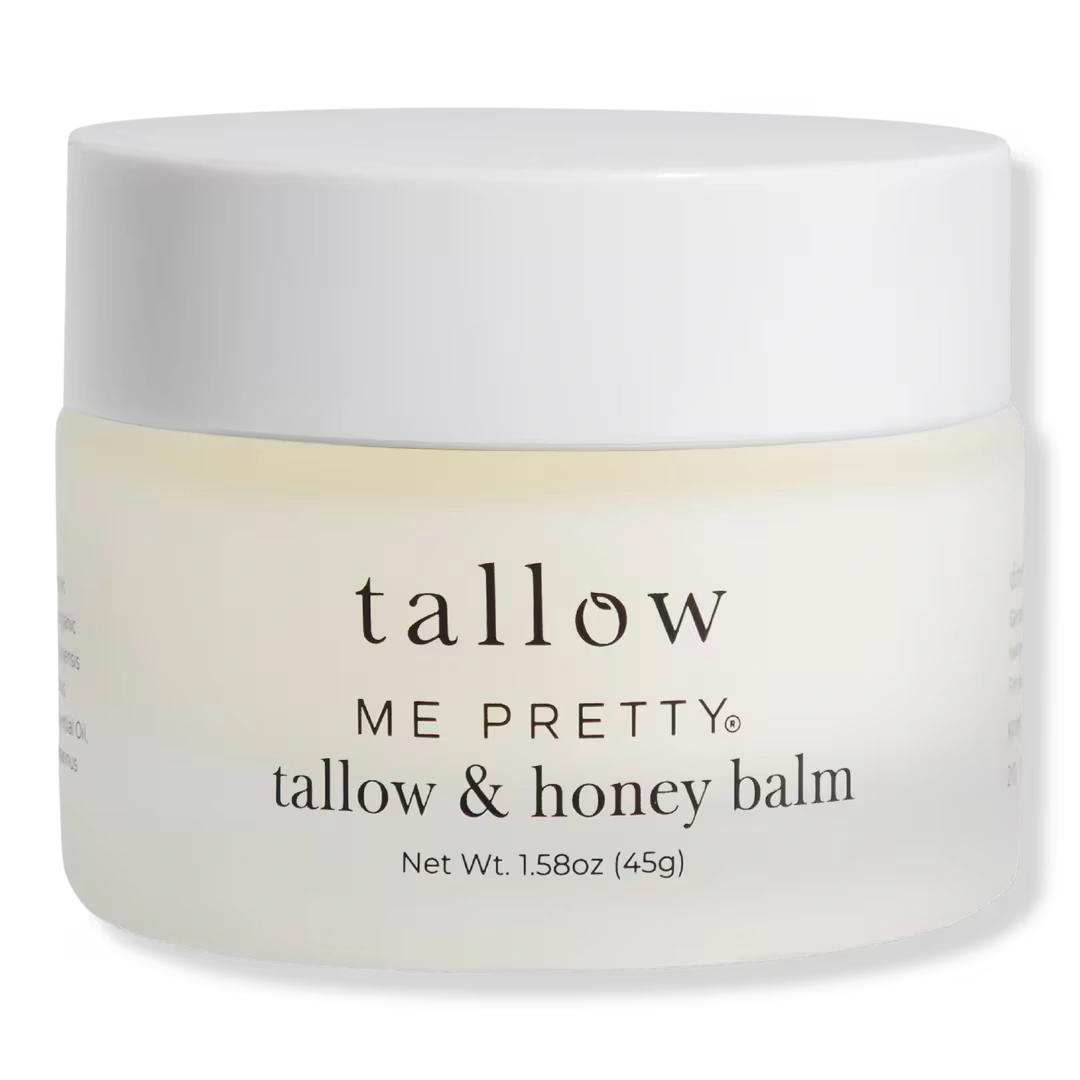
allow Me Pretty Tallow & Honey Balm is a rich, multi-purpose face-and-body moisturizer built around grass-fed and grass-finished beef tallow, beeswax, jojoba seed oil, and raw honey. Unlike a conventional lotion, it does not begin with added water. Instead, its ingredient list is dominated by lipids, wax, and emollients that create a substantial protective layer over dry skin. The current Ulta size is 1.58 oz.
The formula is often presented as minimalist skincare, but it is important not to mistake it for an unscented four-ingredient balm. Tallow Me Pretty also includes lavender, sweet orange, tangerine, grapefruit, tea tree, and rosemary essential oils, with one current manufacturer ingredient listing additionally naming Citrus Grandis Peel Oil. That makes the finished balm botanically fragranced even though the brand describes it as free from synthetic fragrance.
About Tallow & Honey Balm
Tallow & Honey Balm belongs to a very different moisturizer category from lightweight gels and water-rich facial lotions. Its first ingredient is rendered beef tallow, followed by beeswax and jojoba oil, so the formula is inherently richer and more lipid-heavy.
That matters most for dry skin. A balm does not need to supply large amounts of water itself to be useful. One of its main jobs can be slowing moisture loss from skin that already contains water, especially when it is applied after cleansing, bathing, or another hydrating skincare step.
Dermatologists similarly distinguish between light lotions and heavier creams or ointment-like moisturizers. The American Academy of Dermatology notes that thicker moisturizers can be particularly useful for dry skin, while its dry-skin recommendations emphasize applying moisturizer when the skin still has moisture to trap.
Tallow Me Pretty uses stronger words such as “healing,” “repair,” and claims around eczema, dermatitis, psoriasis, minor abrasions, and rashes on its own product page. Those should remain manufacturer claims, not be rewritten as established medical indications for this cosmetic balm.
Tallow & Honey Balm Features
The strongest feature of this formula is its concentration of emollient and occlusive materials. Beef tallow supplies the dominant lipid phase, beeswax adds structure and helps create a protective film, jojoba provides a lighter emollient component, and honey contributes a humectant-rich ingredient to an otherwise oil-heavy balm.
The formula is also notably free of a long conventional cosmetic base. There is no listed added water, silicone, mineral oil, synthetic perfume, sulfate surfactant, or conventional paraben preservative in the current ingredient declaration. This does not make the balm “chemical-free,” nor does it automatically make it suitable for every sensitive skin type. The essential-oil blend is a particularly important consideration for reactive skin.
The product can be applied to areas such as hands, elbows, heels, and other dry body areas, and the manufacturer also positions it for facial use.
Grass-Fed And Grass-Finished Beef Tallow
The first ingredient is grass-fed and grass-finished beef tallow. Tallow is rendered animal fat, so the texture and skin feel are fundamentally different from a conventional water-based moisturizer.
Tallow Me Pretty says its tallow is traditionally rendered, filtered in small batches, and not bleached or deodorized. Ulta similarly describes the ingredient as U.S.-sourced and carefully dry-rendered at low heat.
The manufacturer also makes numerous claims about fatty acids and naturally occurring vitamins in the tallow. It says it performs laboratory testing on its tallow source, but the current retail product page does not give the final concentration of each fatty acid or vitamin in the finished Tallow & Honey Balm itself.
For that reason, Erothots would not turn broad statements such as “contains vitamins A, D, E and K” into exact vitamin-dose claims for each jar unless finished-product analytical data are available.
The more useful cosmetic fact is simpler: tallow forms a rich lipid base that can reduce the dry, tight sensation associated with a compromised-feeling skin surface.
Why A Tallow Balm Feels Different From Lotion
Most conventional lotions contain substantial amounts of water. They combine that water with humectants, oils, emulsifiers, and other ingredients to create an easily spreadable emulsion.
Tallow & Honey Balm takes another route.
Because its published formula contains no separately listed water phase, the product is far more concentrated in oils, waxes, and lipid materials.
That generally produces a thicker application and means a relatively small amount may spread over a larger area than an equivalent amount of thin lotion.
This format also makes it particularly logical as a finishing moisture layer. Applying a small amount to slightly damp skin can pair the existing water on the skin with the balm’s more occlusive components.
The AAD notes that ointments can hold moisture particularly effectively when skin is very dry. That does not make tallow identical to a dermatological ointment, but it explains why a lipid-heavy balm can feel more protective than a lightweight lotion. Dermatologist dry-skin guidance provides broader context.
Organic Beeswax And Moisture Sealing
Organic Cera Alba, or beeswax, is the second ingredient.
Beeswax gives a balm physical structure while also forming a water-resistant emollient film over the surface. In this formula, it works alongside the tallow rather than replacing it.
A 2023 review indexed by the National Library of Medicine examined beeswax in dermatological and cosmetic preparations and described its established history as an emollient and formulation ingredient.
That broader research supports beeswax as a reasonable barrier-supporting cosmetic ingredient, but it does not prove that this exact balm medically repairs eczema or another diagnosed skin disease.
The most defensible product benefit is helping reduce the rough, unprotected feel of dry skin by creating a more substantial surface layer.
Jojoba Seed Oil
The third ingredient is Organic Simmondsia Chinensis, or Jojoba Seed Oil.
Jojoba is technically a liquid wax ester rather than a typical triglyceride-rich plant oil. In skincare, its practical role is primarily emollient: it improves spreadability and helps soften the skin surface.
That addition is particularly useful in a tallow-and-beeswax balm because both of those ingredients can feel comparatively dense.
Jojoba gives the formula a lighter-moving component and helps explain why the product can melt and spread when warmed between the fingers.
The manufacturer calls jojoba highly compatible with skin, but Erothots would avoid saying it is “identical to human sebum.” Similarity in some lipid characteristics does not mean the two substances are chemically identical.
Organic Raw Honey
The balm also contains Organic Raw Honey.
Honey has genuine scientific interest in dermatology. A review indexed by PubMed discusses honey’s humectant, antimicrobial, and wound-care properties in a variety of contexts.
However, this is one area where product claims need especially careful wording.
Research involving wound treatment often uses medical-grade honey, which is prepared and standardized specifically for medical use. Guidance published in the medical literature notes that honey intended for wound management needs appropriate medical-grade preparation.
Tallow Me Pretty lists organic raw honey, not medical-grade wound honey.
That means studies of sterile medical honey dressings should not be used to market this cosmetic balm as a wound-treatment product.
For this formulation, the safer interpretation is that honey contributes humectant and skin-conditioning properties within a moisturizer.
Essential Oils Make This A Fragranced Balm
The product is currently described as free from synthetic fragrance, but it should not be described as fragrance-free.
The published ingredient lists contain aromatic oils from lavender, sweet orange, tangerine, grapefruit, tea tree, and rosemary. Ulta and one section of the manufacturer’s page also include Citrus Grandis Peel Oil.
These oils naturally provide scent.
This distinction matters because “natural fragrance” is still fragrance from a skin-tolerance perspective.
The FDA’s fragrance guidance notes that fragrance ingredients can trigger sensitivities or allergic reactions in some people. The FDA’s broader cosmetic allergen guidance also identifies fragrances among common cosmetic allergen categories.
That does not mean everyone will react. It simply means “natural” should not be used as a synonym for “non-irritating.”
Lavender Essential Oil
Lavandula Angustifolia Lavender Essential Oil appears in the formula.
Lavender contributes fragrance and is commonly included in products marketed around a calming sensory experience.
It can also cause reactions in some users. The National Center for Complementary and Integrative Health notes that topical lavender products can cause allergic skin reactions in some people.
For someone with ordinary dry skin and no fragrance sensitivity, this may not create a problem.
For skin that is already inflamed, extremely reactive, or known to respond badly to essential oils, a simpler fragrance-free balm may be a more predictable choice.
Tea Tree Oil
Melaleuca Alternifolia Tea Tree Leaf Oil is also present.
Tea tree oil has been extensively promoted for its antimicrobial properties, but its presence should not convert the product into an acne medication, eczema treatment, or antiseptic wound balm.
The NCCIH tea tree oil guidance notes that topical tea tree products are tolerated by many people but can cause redness and irritation in some users.
The concentration in Tallow & Honey Balm is not stated, so it would be inappropriate to assign it a specific antimicrobial strength or compare it with a standardized tea tree treatment.
Citrus And Rosemary Oils
The balm also uses several citrus-derived oils, including sweet orange, tangerine, and white grapefruit, along with rosemary leaf oil.
These ingredients contribute heavily to the product’s aromatic profile.
Because exact essential-oil concentrations and extraction methods are not published in the current retail information, Erothots would avoid making additional claims about phototoxicity, aromatherapy effects, antibacterial potency, or therapeutic concentration.
This is another area where reading the actual formulation is more useful than calling the balm simply “tallow and honey.”
The name highlights two ingredients, but the finished formula contains a substantial essential-oil blend.
A Strong Balm For Dry Skin Does Not Need Medical Claims
Tallow Me Pretty markets the product for dry patches and makes stronger claims around eczema, psoriasis, dermatitis, rashes, abrasions, and irritation.
Those uses require context.
Eczema and psoriasis are medical skin conditions, not simply stronger versions of ordinary dryness. A moisturizer may be part of skin-care management, but that does not automatically make every moisturizing balm a treatment for the underlying disease.
The AAD generally advises people with very dry or sensitive skin to favor fragrance-free moisturizers, because fragrances can aggravate susceptible skin.
That recommendation is particularly relevant here because the formula contains multiple essential oils.
Erothots would therefore describe the balm as useful for dry, rough-feeling skin and moisture sealing, while keeping disease-treatment language attached specifically to the manufacturer’s claims rather than presenting it as established medical evidence.
Barrier Support Versus Barrier “Healing”
The skin barrier depends on an organized mixture of cells and lipids in the outermost skin layers.
Applying an emollient balm can help the surface feel softer and can reduce moisture loss by providing a protective film.
That gives terms such as barrier support a logical cosmetic meaning.
“Healing the barrier” is a stronger phrase and needs more context.
A moisturizer can assist dry skin while the skin’s own barrier functions recover, but its performance depends on the complete formula, how damaged the skin is, and what caused the problem in the first place.
For a simple dry area, a lipid-rich balm may feel very effective.
For persistent redness, recurrent rash, infection, significant cracking, or a diagnosed inflammatory condition, relying entirely on a cosmetic balm is less appropriate.
Applying Tallow & Honey Balm In A Routine
Tallow Me Pretty currently recommends warming the balm between the fingers and applying it to dry or irritated areas. Ulta similarly directs users to massage it onto clean skin as needed.
Because this is a rich balm, application quantity matters.
Starting with a small amount makes more sense than coating the skin heavily. The warmth of the fingers softens the tallow and beeswax, helping the product spread more evenly.
For dry body skin, applying it shortly after bathing can be particularly logical because some water remains in the outer skin layers for the balm to help retain.
For the face, it can sit as the richer final moisturizing step rather than being placed beneath several water-based serums.
Its essential-oil content also means avoiding direct eye contact is sensible.
Face Use Versus Body Use
The brand positions the balm for both face and body.
On the body, its dense texture is particularly easy to understand. Hands, knuckles, elbows, feet, and other areas that experience repeated washing or friction often benefit from heavier emollient layers.
Facial use is more individual.
Someone with very dry facial skin may appreciate a rich balm, while someone whose skin becomes congested easily may prefer a lighter product. The manufacturer does not provide a product-specific clinical comedogenicity study on the current page, so Erothots would not label the product “non-comedogenic” without supporting data.
The best way to judge facial suitability is by the complete formula and personal tolerance rather than generic claims that tallow is either universally pore-clogging or universally acne-safe.
Natural Does Not Automatically Mean Hypoallergenic
The manufacturer strongly emphasizes the product’s natural and organic ingredient story.
That can be a meaningful purchasing preference, but it should not be interpreted as an allergy guarantee.
The AAD specifically warns that “all natural” does not mean hypoallergenic and notes that botanical ingredients can still trigger sensitive skin. Dermatologist moisturizer guidance is particularly relevant to formulas containing numerous plant oils.
For this balm, lavender, tea tree, citrus, rosemary, honey, beeswax, and jojoba all create possible individual sensitivities despite their natural origin.
A person with a known allergy to bee products or a history of essential-oil reactions should read the ingredient list especially carefully.
Current Ingredient Profile
Ulta currently lists the formula as Grass Fed & Finished Beef Tallow, Organic Cera Alba (Beeswax), Organic Simmondsia Chinensis (Jojoba) Seed Oil, Organic Raw Honey, Organic Lavandula Angustifolia (Lavender) Essential Oil, Organic Citrus Sinensis (Sweet Orange) Oil, Organic Citrus Grandis Peel Oil, Organic Citrus Reticulata (Tangerine) Oil, Citrus Paradisi (White Grapefruit) Essential Oil, Organic Melaleuca Alternifolia (Tea Tree) Leaf Oil, and Organic Rosmarinus Officinalis (Rosemary) Leaf Oil.
There is a small current manufacturer inconsistency worth recording.
One ingredient block on Tallow Me Pretty’s product page includes Organic Citrus Grandis Peel Oil, matching Ulta. A later manufacturer ingredient section omits that one ingredient while retaining the other citrus and botanical oils.
The available source material does not explain whether that is a page-editing error, reformulation difference, or another catalog issue.
For Erothots, the ingredient panel on the actual jar should therefore remain the final authority when checking an allergy or specific essential-oil preference.
Formulated-Without Claims In Context
Ulta currently says the product is made without GMOs, artificial fragrance, parabens, phthalates, sulfates, synthetic dyes, petroleum derivatives, and unnecessary fillers.
These are specific brand-positioning claims rather than an overall safety score.
For example, sulfate-free has limited practical importance in a leave-on balm because cleansing sulfate surfactants would not normally be expected to form the basis of this product category anyway.
Synthetic-fragrance-free is more relevant, but it still does not equal fragrance-free because essential oils remain aromatic ingredients.
Likewise, petroleum-free does not establish that petroleum-derived occlusives are inherently unsafe. The AAD frequently recommends petrolatum-based ointments for very dry skin because they can be effective and well tolerated. AAD petroleum-jelly guidance provides that broader context.
The best way to evaluate Tallow & Honey Balm is therefore by what it actually contains rather than by assuming every excluded ingredient is undesirable.
Who May Prefer Tallow & Honey Balm
This product has the clearest fit for someone who enjoys substantial balms and wants a moisturizer centered on animal-derived tallow, beeswax, raw honey, and botanical oils rather than a conventional water-based cream.
It may be particularly appealing for dry hands, rough elbows, heels, seasonal dryness, or other body areas where a thin lotion disappears too quickly.
People who specifically want fragrance-free skincare should choose another product because the essential-oil blend is central to this formula.
It is also not vegan because the first ingredient is beef tallow and the formula contains both honey and beeswax.
For very reactive skin, the high number of aromatic botanical oils deserves more consideration than the short overall ingredient count might initially suggest.
Erothots Take On Tallow & Honey Balm
Tallow Me Pretty Tallow & Honey Balm is a concentrated lipid balm with a clear purpose: place a substantial emollient and moisture-sealing layer over dry skin.
The structural core is simple and logical. Grass-fed and grass-finished beef tallow forms the rich base, beeswax adds protective structure, jojoba improves emollience and spread, and raw honey contributes a humectant-rich ingredient.
Where the product becomes more complicated is its botanical oil blend. Lavender, orange, tangerine, grapefruit, tea tree, and rosemary oils mean this is not a fragrance-free sensitive-skin balm, even though it is free from synthetic perfume. FDA and dermatology guidance both support keeping fragrance sensitivity in mind when skin is already dry or reactive.
The honey story also needs realistic wording. Honey has interesting topical research, but much of the strongest wound-care literature concerns specially prepared medical-grade honey, not ordinary raw honey blended into a cosmetic moisturizer.
For that reason, Erothots would avoid converting Tallow Me Pretty’s eczema, psoriasis, dermatitis, abrasion, and “healing” language into independent medical claims.
Taken on the formula itself, the strongest value proposition is straightforward: a dense tallow, beeswax, jojoba, and honey balm designed to soften dry, rough-feeling skin and help seal in existing moisture, with a naturally aromatic essential-oil blend that gives the product more sensory character but also makes individual skin tolerance especially important.
Reviews
There are no reviews yet.