



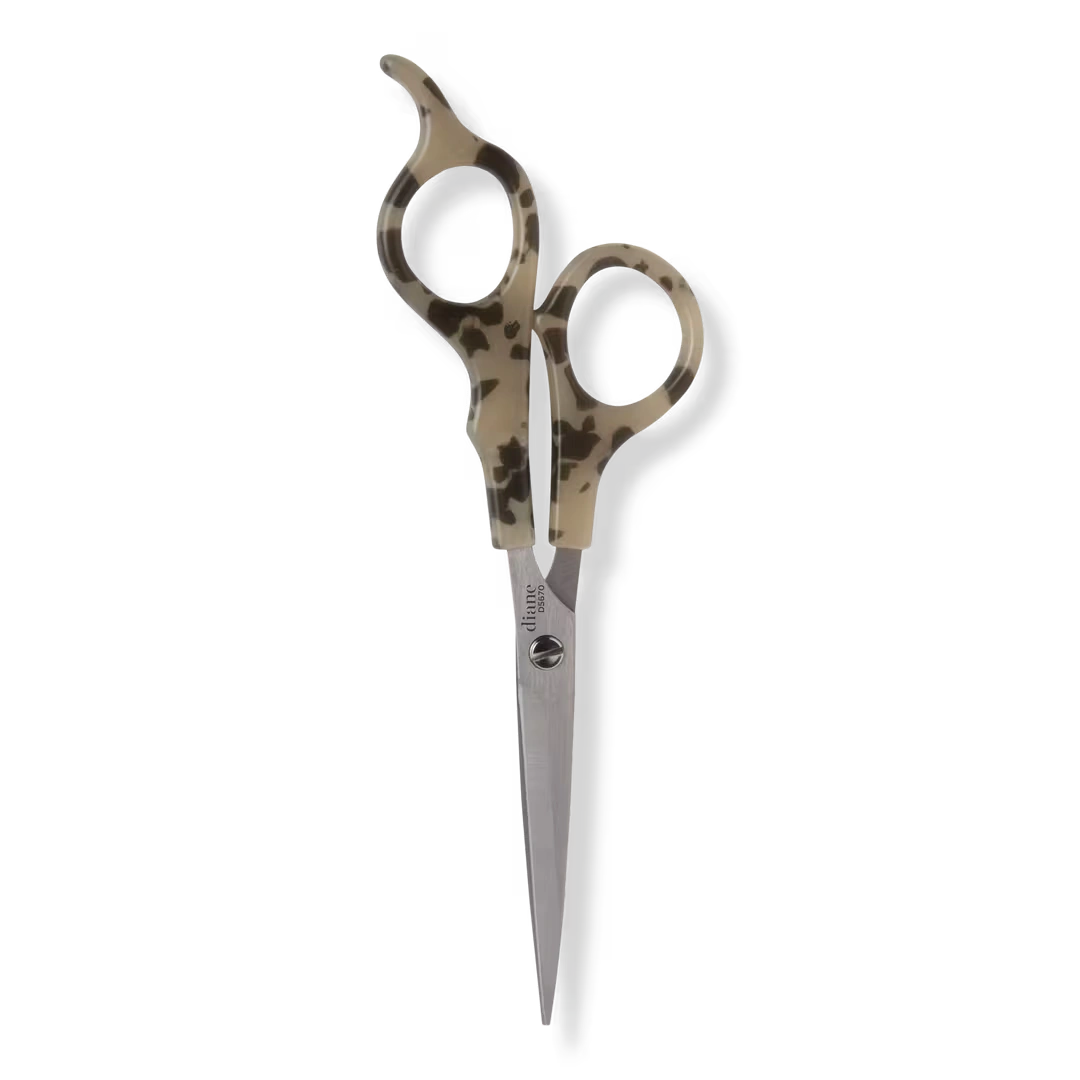
The Diane Tortoise 6″ Hair Cutting and Trimming Shear is a compact cutting tool made for general hair trimming and maintenance. Rather than loading the design with adjustable accessories or specialized texturizing teeth, Diane keeps this shear straightforward: a 6-inch format, Japanese-steel construction, a long-lasting beveled blade, a semi-offset handle, and a fixed finger rest.
Diane positions the Tortoise Shear for everyday hair cutting, between-appointment touch-ups, fringe maintenance, and other straightforward trimming work. Its 6-inch format gives it a different purpose from the brand’s separate thinning and texturizing shears, making this the conventional cutting option within the Tortoise range.
About Tortoise 6″ Hair Cutting and Trimming Shear
Hair shears can look simple, but relatively small design decisions affect how the tool feels in the hand and what kind of work it is intended to perform.
The Tortoise 6″ Hair Cutting and Trimming Shear is based around a conventional solid cutting edge rather than the toothed design associated with thinning shears. Diane describes it as a tool for easy cutting and trimming and specifically highlights Japanese steel, a beveled blade, a semi-offset handle, and a fixed finger rest.
That makes it a general-purpose cutting shear rather than a highly specialized styling tool.
The product also sits in an accessible part of Diane’s cutlery range. It does not claim an exotic proprietary steel alloy, removable finger inserts, an adjustable tension dial, swivel thumb system, or other premium-shear features that are not listed by the manufacturer.
For Erothots, that simplicity is worth preserving in the description. There is little value in turning a straightforward shear into something more technically elaborate than the available specifications support.
Tortoise 6″ Hair Cutting and Trimming Shear Features
- 6-inch cutting format: A standard-size shear designed around general hair cutting and trimming.
- Japanese-steel construction: Diane identifies Japanese steel as one of the main material features.
- Beveled blade: The brand describes the cutting edge as durable and designed to avoid frequent sharpening.
- Semi-offset handle: Moves away from a completely symmetrical opposing-handle layout.
- Fixed finger rest: Provides an additional contact point for hand control.
- General cutting focus: Intended for cutting and trimming rather than thinning or texturizing.
- Item D5670: The manufacturer’s current identification number for this model.
- At-home maintenance positioning: Diane markets it for straightforward trims and maintenance between professional appointments.
Japanese Steel Construction
One of the most prominent specifications attached to the Tortoise Shear is its Japanese steel construction.
Diane describes the material as high quality and long-lasting. What the current manufacturer information does not provide is an exact steel grade, hardness rating, alloy composition, heat-treatment specification, or country-of-manufacture claim.
Those distinctions matter.
“Japanese steel” should therefore not be expanded into unsupported statements about a particular cobalt percentage, Rockwell hardness, VG-series alloy, Hitachi steel specification, or hand-forged production process. None of those technical details are currently given for the Tortoise 6″ Shear.
The practical product information is much simpler: Diane has selected Japanese steel for the shear and pairs it with a beveled cutting edge intended to retain useful cutting performance without constant sharpening.
Why The Beveled Blade Matters
The blade profile is one of the few cutting-specific details Diane clearly publishes.
The Tortoise Shear uses a beveled blade, which the manufacturer describes as long-lasting and not requiring frequent sharpening.
That positioning makes sense for a maintenance-oriented shear. The product is not presented as a specialist convex-edge salon shear built around advanced slide-cutting techniques. Instead, its blade design emphasizes straightforward cutting and durability.
Blade condition remains important over the life of any shear. A tool that becomes damaged, develops an irregular edge, or no longer closes correctly should not simply be forced through hair.
OSHA’s guidance around scissor work and ergonomics also notes that keeping scissors properly maintained can reduce the force required during repetitive cutting work.
For this product, that makes Diane’s long-lasting-edge claim more practically meaningful than simply describing the blade as “sharp.”
6-Inch Size And General Cutting Purpose
The 6-inch size is central to the product name and separates this model from Diane’s smaller and texturizing options.
Diane positions the shear for general cutting, trimming, fringe maintenance, and between-salon touch-ups. It is therefore better described as an everyday cutting shear than as a precision razor replacement or thinning tool.
The size also should not be interpreted as the blade alone being six inches long. Hair shears are commonly sold according to their overall nominal shear size, and Diane identifies this model simply as its 6″ Tortoise Shear.
Erothots would not add an unverified individual blade length because the manufacturer does not currently publish one.
Semi-Offset Handle Design
The Tortoise Shear uses what Diane calls an ergonomic, semi-offset handle design.
This is one of the more relevant construction details for anyone comparing shears because handle geometry affects hand position independently of blade quality.
A fully opposing shear places the finger and thumb rings in a more symmetrical arrangement. An offset-style design changes the relationship between those rings so the hand does not necessarily need to sit in exactly the same posture.
It is important not to overstate that difference. Diane calls the handle ergonomic, but the manufacturer does not publish biomechanical testing specific to this shear.
Independent ergonomic guidance does, however, support paying attention to wrist and hand positioning during repetitive cutting work. OSHA’s scissor-work guidance notes that awkward wrist positions and repeated hand motions can contribute to strain and recommends tools that support more neutral joint positions.
That makes the semi-offset construction a useful design feature without turning it into a medical claim.
Fixed Finger Rest And Hand Control
A fixed finger rest extends from the handle and provides another support point for the hand.
Diane specifically lists the finger rest as being included for added control.
Unlike a removable tang, a fixed rest is integrated into the shear and is not intended to be routinely detached.
For shoppers comparing several tools, that is worth knowing in advance. Someone who strongly prefers a completely clean handle without a finger rest may prefer a different design, while someone accustomed to a resting point behind the finger ring may find this layout more familiar.
The manufacturer does not state adjustable finger-ring sizing or provide alternative inserts, so those features should not be assumed.
Cutting Shear Versus Thinning Shear
The Tortoise 6″ Hair Cutting and Trimming Shear should not be confused with Diane’s Tortoise 6.25″ Hair Thinning and Texturizing Shear.
They are different tools.
The 6-inch model covered here is marketed for conventional cutting and trimming. Diane separately sells a 6.25-inch Tortoise model with a 30-tooth configuration for thinning and texturizing.
That distinction matters when writing the product description because terms such as “thinning,” “blending,” and “texturizing” should not be automatically added simply because another shear from the same collection performs those jobs.
The strongest description for this model remains hair cutting and trimming shear.
Why A Dedicated Hair Shear Is Different From An Everyday Scissor
The Tortoise model is designed specifically as hair cutlery rather than as a household craft or paper scissor.
Its combination of a hair-focused blade, finger rings, fixed rest, and semi-offset handle reflects that purpose.
Hair fibers can also sustain mechanical damage. Research indexed through the National Library of Medicine on split hair fibers shows that split ends involve structural failure and longitudinal splitting of the hair fiber rather than merely being a cosmetic change on the surface.
That does not mean buying a particular pair of shears prevents all split ends. Heat, chemical processing, brushing, weathering, friction, and normal aging of the strand can all contribute to damage.
A dedicated cutting shear simply gives hair trimming an appropriate tool rather than relying on a scissor designed for unrelated materials.
Trimming Does Not Repair Hair Biologically
Haircuts are useful for removing damaged or unwanted length, but the wording around “repair” needs care.
Once a damaged section of hair has split, cutting above that damaged section physically removes it. The cut itself does not biologically regenerate the remaining fiber.
The American Academy of Dermatology’s hair-care guidance emphasizes preventing further damage through gentler hair-care practices rather than suggesting that damaged strands can simply be restored to an untouched state.
Conditioners and treatments can improve smoothness, reduce friction, and temporarily improve the appearance of damaged hair. Trimming serves a different purpose by removing length.
That is why the Tortoise Shear is better described as a maintenance tool rather than a “hair repair” product.
Hair Type And Texture Considerations
Diane does not restrict the Tortoise 6″ Shear to one curl pattern, strand diameter, gender, or hair color.
The published specifications focus on the tool rather than a particular hair type.
This means Erothots would not label it exclusively for straight, curly, thick, fine, natural, relaxed, or color-treated hair without additional evidence.
Hair texture does affect the way professional cutting services are planned, but that is different from saying the physical shear is manufactured only for one texture.
For consumers, the more useful buying considerations are the 6-inch format, beveled blade, handle geometry, finger rest, and whether a normal cutting shear rather than a texturizer is actually required.
Ergonomics Matter More With Repeated Cutting
The semi-offset handle becomes increasingly relevant when shears are used repeatedly rather than for an occasional maintenance trim.
Cutting work requires repeated opening and closing movements through the fingers and thumb. Poor wrist position can add additional strain over time.
OSHA guidance for scissor work specifically identifies awkward wrist posture, repetition, grip force, and small hand movements as ergonomic considerations with scissors and shears.
OSHA also recommends paying attention to tool maintenance because a poorly maintained cutting tool can require greater operating force.
This does not prove that Diane’s semi-offset design eliminates occupational strain. It simply explains why handle shape, cutting condition, and hand comfort deserve attention when evaluating a shear instead of considering steel quality alone.
Cleaning And Professional Hygiene
Hair shears collect loose hair, skin debris, oils, and product residue during use, so cleanliness matters alongside edge maintenance.
Requirements are particularly important when a tool is used on more than one person in a professional environment.
The California Board of Barbering and Cosmetology’s official health and safety regulations require professional shears to have visible debris removed and to be cleaned before appropriate disinfection. The regulations specifically address shears separately from tools that may be fully immersed.
The Board states that professional shears can be sprayed or wiped with an appropriate EPA-registered disinfectant used according to its labeling.
That guidance is particularly useful because repeatedly exposing steel tools to unsuitable chemicals or leaving them wet can create maintenance problems.
Diane’s product page itself does not publish a detailed sharpening, lubrication, or disinfection protocol for D5670, so Erothots would not invent one. Owners should follow the instructions supplied with the shear and the label requirements of any cleaning or disinfecting product being used.
Keeping The Shear In Good Condition
The manufacturer emphasizes blade longevity, but long-lasting does not mean maintenance-free.
After professional use, loose hair and residue should not be left trapped around the blades or pivot area. The shear should also be allowed to remain dry before storage.
Professional hygiene requirements provide another reason for proper care. The California Board’s shear-disinfection rules specify that disinfected shears should not then be placed into a holder or container that itself cannot be properly disinfected.
For sharpening or mechanical adjustment, professional servicing is preferable when the shear develops a problem. Attempting to reshape the beveled edge without the appropriate equipment can alter the cutting geometry that made the tool useful in the first place.
Hair Care Beyond The Trim
A clean trim can improve the appearance of worn ends, but maintaining hair condition between cuts still depends heavily on everyday treatment.
The American Academy of Dermatology’s healthy hair recommendations emphasize gentle detangling, appropriate shampooing and conditioning, and careful handling of wet hair to help limit avoidable damage.
Another AAD resource on styling without damage notes that excessive brushing, frequent heat exposure, and other repetitive styling practices can contribute to breakage and split ends.
A shear therefore addresses only the cutting stage of hair maintenance. It cannot compensate for continual damage from the rest of the routine.
Who Is The Tortoise 6″ Shear Best Suited For?
The strongest fit is someone looking for a straightforward conventional hair shear rather than a thinning tool or highly specialized professional shear.
Its feature set is particularly easy to understand: Japanese steel, a beveled blade, 6-inch sizing, semi-offset handle positioning, and a fixed finger rest.
Diane also positions the model for maintenance between salon appointments and straightforward at-home trimming. Because it is a sharp implement, however, it should be handled and stored responsibly by a capable adult or trained professional rather than treated like an ordinary household accessory.
Professional stylists shopping for an everyday workhorse may also want more technical specifications than Diane currently publishes, such as exact alloy grade, tension adjustment details, shear weight, blade measurements, or hand-orientation information.
Those specifications are not currently provided on the official D5670 product page.
What The Manufacturer Does Not Specify
A useful product page should make missing information just as clear as confirmed information.
Diane currently confirms the 6-inch size, Japanese steel, beveled blade, semi-offset handle, fixed finger rest, and D5670 item number.
It does not currently specify an exact Japanese-steel grade, Rockwell hardness rating, individual blade length, total weight, adjustable tension mechanism, removable finger inserts, left-handed configuration, convex edge, cobalt content, titanium coating, or country of manufacture on the official product listing.
Erothots therefore does not add those specifications simply because they may appear on other salon shears.
This keeps the product information useful without making a modest tool sound artificially technical.
Safety And Storage
Hair-cutting shears have exposed sharpened edges and deserve more careful storage than combs, clips, or brushes.
The blades should remain closed when the shear is not being handled and the tool should be kept in a secure location away from young children. Professional environments should also follow their applicable sanitation and tool-storage rules.
The fixed finger rest and ergonomic handle are control features, not safety guards. They do not make the cutting edge less sharp.
If a shear is dropped, visibly damaged, unusually loose, or no longer closes normally, it is better to have its condition assessed rather than continuing to use it as though nothing changed.
Erothots Take On Tortoise 6″ Hair Cutting and Trimming Shear
The Diane Tortoise 6″ Hair Cutting and Trimming Shear succeeds by keeping its specifications focused.
The cutting construction uses Japanese steel and a beveled blade that Diane describes as long-lasting. A semi-offset handle changes the hand position from a completely opposing design, while the fixed finger rest provides another point of support. The six-inch format keeps the tool firmly in Diane’s general cutting-and-trimming category rather than its separate texturizing range.
What Erothots would not do is inflate those features with unverified professional-shear terminology. There is no published steel grade, hardness number, adjustable-tension specification, weight, or specialist convex-edge claim attached to the current D5670 manufacturer listing.
For a shopper who simply needs a purpose-built hair-cutting shear, that may not be a drawback. The product is easy to understand: 6-inch sizing, Japanese steel, durable beveled cutting edges, a semi-offset grip, and a fixed finger rest.
Proper handling and maintenance remain important. OSHA’s scissor ergonomics guidance reinforces the value of neutral hand positioning and well-maintained tools, while professional shear sanitation standards show why cleaning and appropriate disinfection matter when tools are shared.
Taken on its actual specifications rather than exaggerated claims, the Tortoise 6″ Shear is a straightforward Diane cutting tool built around durability, control, and general hair-trimming use.



Reviews
There are no reviews yet.