




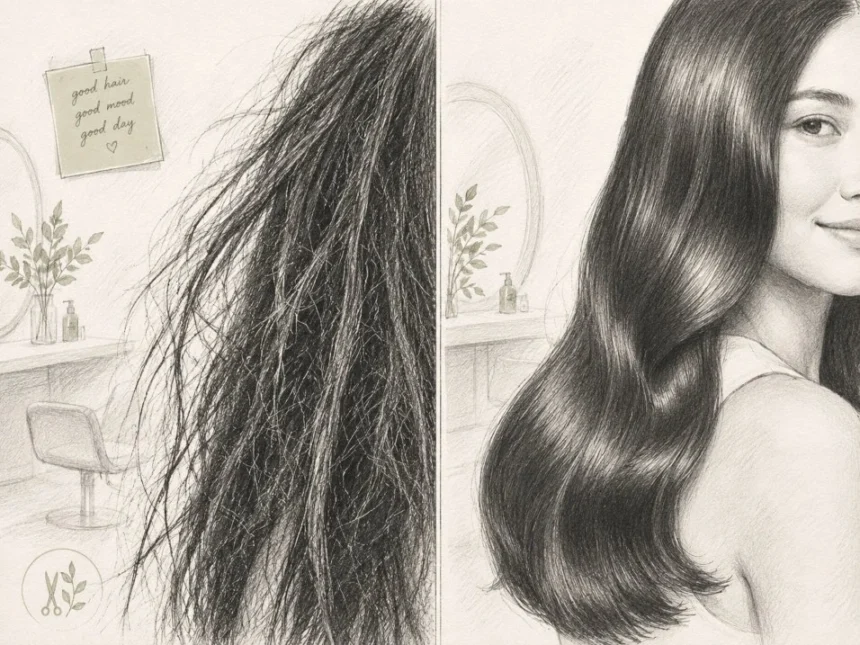
The first bond-building treatment I bought made my hair feel so good that I immediately used it again.
Bond building treatments are designed to help reinforce weakened hair after damage from bleaching, coloring, chemical services, or frequent heat styling. They are not an instant cure for every type of damage, but the right formula can help improve strength, reduce breakage, and make hair feel smoother over time.
Then I used it two days later.
By the end of the week, I had added a bonding shampoo, bonding conditioner, pre-shampoo treatment and leave-in product because I had convinced myself that seriously damaged hair required as much repair technology as possible.
My hair was smoother, but it also felt strangely stiff through the ends. Some sections tangled more easily after drying, and the bleached pieces around my face still snapped when I handled them roughly.
I remember holding one of those broken strands beneath the bathroom light and feeling confused. Every product in my routine said repair somewhere on the bottle. Why was my hair still breaking?
The mistake was assuming bond building meant reversing damage.
It does not work quite like that.
Bond-building treatments can improve the properties of damaged hair, and some chemistries have genuine scientific support. But severely processed hair is not a cracked wall that can simply be glued back to its original condition. Bleaching, coloring, heat, friction and chemical services can affect several parts of the hair fiber at once.
I had been trying to repair one part of that problem while continuing to create new damage everywhere else.
I Needed to Understand What Was Actually Damaged

Before bond builders, I thought damaged hair mainly meant rough cuticles.
That is only part of the picture.
A hair fiber contains an outer cuticle surrounding a cortex rich in keratin proteins. Those proteins are stabilized through several types of chemical interactions, including strong disulfide links associated with cystine residues.
A detailed review of hair structure and hair-care chemistry explains how chemical treatments can alter keratin structure, lipids and the bonds that contribute to the fiber’s mechanical properties. Chemical processes do not necessarily damage only the outside of the strand.
That helped me understand why my hair could look glossy after conditioner while still breaking easily.
A conditioner may improve surface lubrication and reduce friction. That is valuable, but it does not necessarily mean all structural changes deeper in a heavily bleached fiber have disappeared.
Once I understood that, I stopped using softness as my only measurement of repair.
Bleaching Had Done More Than Make My Hair Dry
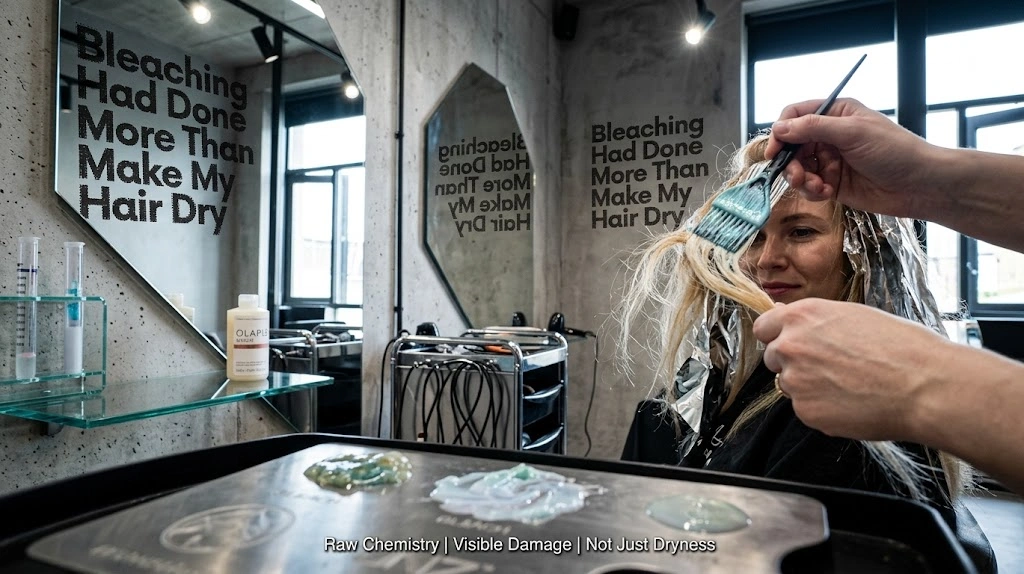
My most damaged sections were the pieces that had been lightened repeatedly.
I used to describe them as dry, which made me think the obvious answer was more moisture.
Bleaching is more complicated than dehydration.
A 2024 microscopic study examining structural changes in excessively bleached hair found visible deterioration in the cuticle and internal hair structure compared with untreated fibers. Bleached samples showed increasingly rough, disrupted surfaces as processing became more severe.
Research reviewing chemical damage to the hair shaft has also described oxidative color processes as capable of weakening the fiber and contributing to breakage.
That explained why applying another rich mask could make my ends temporarily softer without solving their fragility.
I was dealing with accumulated structural damage, not simply hair that needed a bigger dose of conditioner.
“Bond Builder” Did Not Describe One Universal Technology
This was the part I had completely missed while shopping.
I assumed all bonding products repaired the same bonds in roughly the same way.
They do not.
Some formulas are built around maleate-related chemistry. Others use peptides, proteins, amino acids, acids or different crosslinking approaches. Some products marketed in the bonding category appear to focus heavily on conditioning and reducing friction.
That makes the phrase bond building less useful than I originally assumed.
One laboratory investigation looked specifically at damaged keratin treated with bis-aminopropyl diglycol dimaleate, an ingredient associated with one well-known type of bonding technology. The researchers examined structural changes in damaged keratin rather than simply relying on how soft the hair felt after treatment.
More recent research has continued looking at chemical methods for reinforcing damaged keratin, including experimental thiol-reactive compounds designed to form new crosslinks. That developing field makes bond repair scientifically interesting, but it also reminded me not to assume every bottle using the word bond contains equivalent technology.
A shampoo with bonding language on the front may be very different from a concentrated pre-treatment.
The category name is not the mechanism.
I Stopped Expecting a Bond Builder to Make Old Hair New
This was probably the biggest shift in my thinking.
The visible hair shaft is a keratinized fiber. It cannot heal biologically in the way living skin repairs a small injury.
Cosmetic treatments can improve the fiber’s mechanical behavior, coat damaged areas, reduce friction, strengthen weak sections or create new chemical interactions. Those improvements can be significant.
They still do not send the strand backwards through time.
If a section has been repeatedly bleached until its cuticle is severely disrupted and its internal structure has deteriorated, I would not expect one mask to recreate untouched virgin hair.
That distinction changed what I considered a successful result.
I stopped asking whether the treatment had erased the damage.
I started asking whether I had less breakage, easier detangling, better elasticity and hair that tolerated ordinary handling more reliably.
Those were outcomes I could actually observe.
My Split Ends Taught Me the Limit of “Repair”
One product made my split ends temporarily look almost closed.
The ends felt smooth after styling, and I convinced myself the treatment had repaired them.
After several washes, the same splits were visible again.
I eventually accepted that a deeply split or fractured end may need to be cut rather than repeatedly disguised.
Cosmetic ingredients can coat and smooth damaged sections. That can reduce friction and improve appearance, which still has value.
But I no longer interpret a smooth-looking split end as permanent structural restoration.
Sometimes the most effective damage-control decision is removing the weakest length and protecting what remains.
That was difficult for me because I had spent months trying to keep every centimeter.
The haircut eventually improved my hair more visibly than another month of adding treatments to ends that were already breaking apart.
I Had Made Bond Repair My Entire Routine
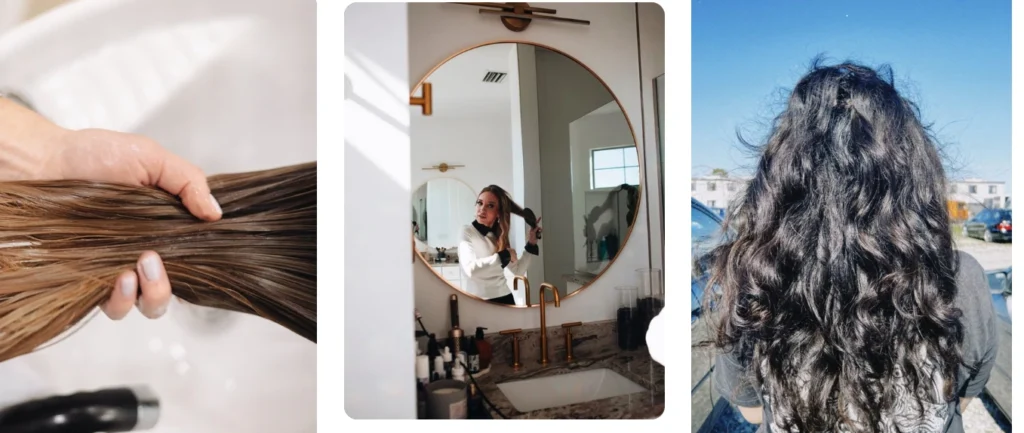
Once I became interested in bonding technology, every product suddenly needed to belong to the category.
I used bonding shampoo, conditioner, treatment and leave-in.
Then I added a bonding styling cream.
The routine became complicated without necessarily becoming more effective.
This was where 1.Anchor became useful to the way I evaluated products. I stopped counting the number of bonding claims and started asking what specific job each product was performing.
My shampoo needed to cleanse effectively without making the lengths miserable.
My conditioner needed to reduce friction and make detangling safer.
A dedicated bond treatment needed a clear reason to exist beyond duplicating the conditioning products already in my shower.
My leave-in needed to make styling easier and, when relevant, provide clearly stated heat protection.
Once every product had a job, I needed far fewer of them.
Conditioning Was Still Necessary
For a while, I treated ordinary conditioner as old technology.
Why use something that merely coated the hair, I thought, when a modern bond builder could supposedly repair it internally?
That was another false choice.
Damaged hair benefits from reduced friction.
The American Academy of Dermatology recommends conditioning after shampooing and notes that damaged hair is fragile and more likely to break. Its guidance on stopping everyday hair damage includes conditioner, gentler detangling and reduced heat as basic protective measures.
A leave-in can also have a useful role. The AAD’s guidance on leave-in conditioner notes that these products can make hair easier to comb, reduce frizz and help limit breakage during styling. Some are also formulated as heat protectants.
That reminded me that reducing future mechanical damage matters as much as trying to reinforce existing damage.
A sophisticated repair treatment followed by aggressive detangling made little sense.
Heat Was Undoing Part of the Work
I was religious about my bond mask and careless with my flat iron.
That contradiction lasted longer than I would like to admit.
Because my hair looked healthier after bonding treatments, I became more comfortable applying heat. I interpreted improved feel as increased tolerance.
My hair had not received unlimited heat resistance.
The AAD recommends letting hair partially air-dry when possible and using flat irons only on dry hair at low or medium temperatures. Its guidance for styling without hair damage also warns that excessive heat can damage every hair type.
I eventually reduced both the temperature and frequency.
That produced a less dramatic immediate difference than the bond treatment, but over several months the combination mattered.
My new growth was not being pushed through the same cycle of damage as the older lengths.
That made far more sense than damaging the hair repeatedly and expecting my treatment to repair everything afterwards.
I Became More Conservative With Bleach
This was where bond builders had accidentally made me overconfident.
Because salon bonding treatments were available during lightening, I started thinking bleaching had become almost damage-free.
It had not.
Bond-building technology may help reduce or manage certain forms of structural damage, but it does not turn aggressive chemical processing into a neutral event.
The AAD’s advice on coloring and perming hair explains that lightening typically requires stronger peroxide exposure as the desired change moves farther from the natural color, increasing the potential for damage.
That changed my salon conversations.
I started asking how much lightening was realistically necessary rather than assuming a bonding additive gave me permission to chase the palest possible result in one appointment.
Sometimes protecting the hair meant accepting a slower color journey.
Porosity Made My Ends Behave Differently
One thing bond builders could not completely normalize was the difference between my roots and ends.
The newest hair near my scalp was smoother and less chemically processed.
The older ends had years of accumulated coloring, heat and mechanical wear.
They absorbed water differently, tangled differently and reacted differently to products.
Using exactly the same amount of treatment everywhere sometimes left my healthier upper sections heavy while the ends still felt rough.
I started applying according to need rather than symmetry.
The most damaged sections received the focused treatment. Lighter products were enough elsewhere.
That also made it easier to tell whether the treatment was genuinely helping.
If I coated every strand with several heavy products, almost anything could feel silky for one afternoon.
I wanted to know how the weakened sections behaved after several washes and normal styling.
Protein and Bond Repair Were Not Automatically the Same Thing
I used to call every strengthening mask a protein treatment and every protein treatment a bond builder.
That blurred important differences.
Hydrolyzed proteins and amino-acid-derived ingredients can improve the feel and properties of damaged hair in certain formulations. Researchers have even investigated crosslinking approaches involving keratin-related materials for improving mechanically damaged fibers.
But that does not make every protein mask equivalent to every bond-building treatment.
The hair physicochemistry literature shows how many chemical and physical interactions contribute to hair performance. A single marketing category cannot fully describe that complexity.
This helped me stop obsessing over whether my routine had the “correct” balance between moisture, protein and bonds based on social-media rules.
I watched the actual hair.
If it became rough, excessively stiff or difficult to detangle after adding several strengthening products, I simplified the routine.
I did not keep applying them because the calendar said it was repair day.
More Frequent Treatment Was Not Always More Useful
My original instinct had been to use the strongest treatment as frequently as possible.
Eventually I started following the directions for the specific product.
That sounds painfully obvious, but bond builders are sold in so many forms that it is easy to create a routine that was never tested as a complete system.
A pre-shampoo treatment may have different instructions from a leave-in mask. A salon additive may not be designed for home use. A bonding conditioner may be intended for regular washing, while another intensive formula may be used less frequently.
I became suspicious of universal advice telling everyone to use bond repair exactly once a week or after every wash.
Different formulations have different concentrations and mechanisms.
The instructions on the actual product were more useful than a generic schedule I found online.
I Started Paying Attention to Claims, Not Just Ingredients
The beauty industry made me fluent in ingredient names before it made me good at evaluating evidence.
I could identify an impressive bonding molecule on a label and still know almost nothing about how well the finished formula performed.
That is why I began paying attention to claim support.
Did the brand say the product reduced breakage?
If so, how had breakage been measured?
Did it claim stronger hair after one use?
Was that based on instrumental testing of treated fibers or merely a consumer questionnaire about feel?
Was the active ingredient studied alone, or had the retail formula itself been evaluated?
The FDA’s information on cosmetic labeling claims explains that cosmetic claims generally do not receive premarket FDA approval, although labeling must still be truthful and not misleading.
That was useful commercial context.
“Clinically tested,” “bond repairing” and “strengthens damaged hair” may sound similar on a shelf, but they do not automatically tell me what experiment was performed.
Now I look for the method behind the claim whenever a company provides it.
The Best Bond Treatment Was the One That Changed My Breakage Pattern
Shine became less important to me.
My silicone-rich conditioner could create beautiful shine without claiming to rebuild anything.
What I wanted from a bond-building treatment was improved behavior in the sections that normally failed.
The highlighted pieces around my face were my test.
Before I changed the routine, they tangled easily when wet and occasionally snapped while I was styling them.
After several months of less bleaching, lower heat, gentler handling and a well-tolerated bond treatment, I noticed fewer short broken pieces collecting around the sink.
Could I prove the bond product was responsible for all of that?
No.
I had changed several damaging habits at the same time.
That uncertainty actually made me trust my assessment more. Hair care rarely happens under laboratory conditions at home. A product works inside a routine, and sometimes the routine change matters as much as the bottle.
I Stopped Using Hair Loss and Hair Breakage Interchangeably
Broken strands had also made me worry that I was losing hair from the root.
Those are not necessarily the same issue.
A strand snapping somewhere along its length is a fiber problem. Increased shedding from the scalp or progressive thinning can have completely different causes.
The AAD’s damaged-hair guidance recommends seeing a dermatologist when changing hair-care habits does not help, particularly when thinning or hair loss is a concern.
That boundary matters because no bonding mask can diagnose why hair density is changing.
If I were seeing obvious scalp thinning, unusual shedding, bald patches or continuing loss rather than simple mid-shaft breakage, I would not keep upgrading to stronger bond treatments.
I would want to know what was happening at the follicle.
My Routine Became More Preventive Than Reparative
The biggest improvement happened when I stopped making repair the center of the routine.
I still use a bond-building treatment.
I simply put more effort into protecting the hair that has not yet been severely damaged.
I space chemical services appropriately. I use less heat. I detangle more carefully. I condition consistently. I avoid repeatedly pulling the same sections into tight styles.
The AAD’s broader recommendations for healthy hair habits similarly emphasize limiting excessive heat and handling hair according to its type and condition.
Those habits are not as marketable as molecular repair technology.
They are also the reason I need less repair now.
What I Would Buy Differently Today
I would not buy an entire bonding range simply because the bottles belong together.
I would identify the weakest point in my current routine.
If chemically processed hair is breaking despite good conditioning, a dedicated bond-building treatment may be worth investigating.
If the hair is mostly dry and tangled but not heavily chemically damaged, better conditioning and gentler styling may make a larger difference.
If I am continuing to bleach aggressively every few weeks and use very high heat every morning, I would address those habits before expecting another treatment to compensate.
I would also look for brands that explain their technology beyond repeating the word bond.
Not every company needs to publish proprietary chemistry, but I appreciate knowing what outcome the formula is designed to improve and what testing supports that claim.
The science is interesting enough without turning it into magic.
What Bond Repair Actually Means to Me Now
My definition is much narrower than it used to be.
A useful bond-building treatment can improve the strength, resilience or mechanical behavior of damaged hair through a specific formulation strategy. Depending on the product, that may involve crosslinking chemistry, peptides or other mechanisms intended to support compromised keratin structures.
What it cannot do is give me permission to keep damaging my hair indefinitely.
It cannot make a severely split end biologically new.
It cannot reverse every structural change caused by years of bleaching.
It cannot treat hair loss occurring at the follicle.
And it does not replace conditioner, careful handling or sensible heat use.
Once I stopped expecting all of those things, I actually became more impressed with bond builders.
They no longer had to perform a miracle to earn a place in my routine.
They only had to make fragile hair behave better while I stopped creating the same damage faster than I could manage it.
That was the lesson hidden inside my overloaded bathroom shelf.
I had been buying repair while practicing damage.
The treatment became useful only when those two sides of my routine finally stopped fighting each other.