




I knew I had made the wrong haircut decision two mornings after leaving the salon.
Choosing between a blunt bob vs modern shag is really about how much structure, texture, and daily styling you want. A blunt bob gives a cleaner, sharper shape, while a modern shag feels softer, layered, and more relaxed.
On Saturday afternoon, my new blunt bob had looked almost impossibly good. The ends formed one clean line, the surface was glossy, and the front curved neatly toward my jaw. I left the salon taking photographs from every angle because I was convinced I had finally found the short haircut I would keep.
Then I washed it.
By Monday morning, one side had flipped outward, the section near the back of my head had developed a bend I had completely forgotten existed, and the ends looked wider than they had after the salon blow-dry. I spent nearly twenty minutes trying to recreate the smooth shape with a dryer and flat iron.
I managed it, but standing there with a hot tool in my hand before 8 a.m., I realized I had chosen the haircut from the finished photograph instead of choosing it for the hair I actually lived with.
That mistake now shapes the way I think about the blunt bob vs modern shag question. In 2026, both cuts are current. The better choice is not necessarily the one that looks best immediately after a professional blowout. It is the one whose structure works with the way your hair naturally falls and the amount of styling you realistically want to do.
I Had Treated the Blunt Bob Like a Low Maintenance Shortcut
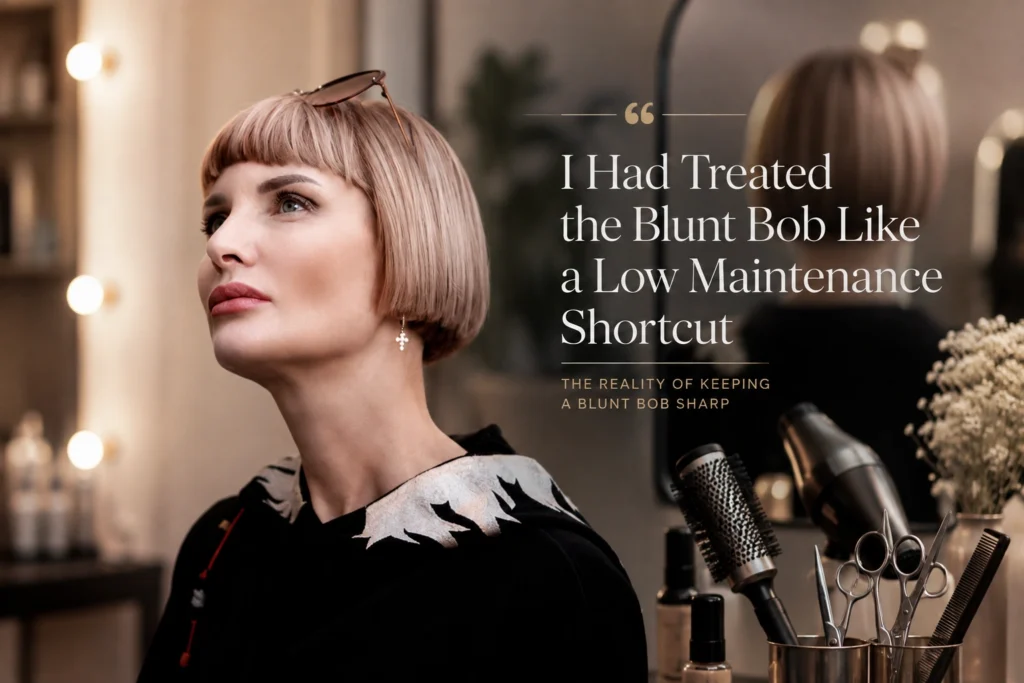
Part of the bob’s appeal was its simplicity.
One strong perimeter. Minimal visible layering. No complicated styling instructions. I assumed removing length would automatically remove work.
That was my first misunderstanding.
Current 2026 haircut coverage still gives the bob an important place, although the shape is becoming more individualized. Vogue’s 2026 hair trend forecast points toward sharper, polished shapes, including graduated bobs with weight around the front and more deliberate structure through the back.
Recent short haircut coverage from InStyle also shows how many versions now sit under the bob umbrella, including curved, French-inspired, curly and shorter variations. In other words, asking a stylist for “a bob” is no longer very specific.
My mistake was even more specific. I had asked for a very clean, almost one-length perimeter because that was the detail I liked in my reference photograph.
What I had not asked was what that perimeter would do after my first shampoo.
A Blunt Line Makes the Hair’s Natural Behavior More Visible
A precise bob has nowhere to hide.
If the ends bend differently on one side, you notice. If the hair expands as it dries, the outside shape changes. If you have a strong growth pattern near the crown or hairline, removing length can make that pattern more obvious.
That does not make the blunt bob difficult by definition. Some people find a clean bob remarkably easy because their natural texture falls close to the intended shape.
My hair did not.
The American Academy of Dermatology recommends learning how your particular hair type behaves and adapting care accordingly. Its healthy hair guidance specifically distinguishes between straight, curly, fine, thick and other hair characteristics because washing, conditioning, detangling and styling needs vary.
I wish I had made that assessment before the scissors came out.
Instead of asking whether the bob looked sophisticated, I should have asked whether my natural hair wanted to form that line.
My Morning Routine Exposed the Real Cost
The haircut itself was not the expensive part.
The maintenance was.
To get the finish I had expected, I started blow-drying more carefully and running a flat iron over several sections. A haircut I had chosen partly because I wanted an easier routine had quietly increased my dependence on heat.
That changed the calculation.
The AAD’s recommendations for styling hair without unnecessary damage advise reducing blow-drying frequency where possible and using flat irons on dry hair at low or medium heat. Excessive heat can damage hair regardless of hair type.
Its broader guidance on preventing everyday hair damage similarly recommends letting hair air-dry when possible, reducing hot-tool exposure and conditioning regularly.
That did not mean I needed to abandon a blunt bob forever. It meant styling time and heat use belonged in the haircut decision before the appointment, not after it.
The Modern Shag Looked Messier but Became More Predictable

Several months later, after the bob had grown past my jaw, I tried a much softer cut.
I was cautious because the word shag made me imagine aggressive 1970s layers and a fringe that required constant attention.
The 2026 version was different.
Allure’s spring 2026 haircut report describes the modern shag with softer, airier layering, movement around the face and fringes that blend into the rest of the haircut instead of feeling disconnected. The stylists interviewed also linked the current version with allowing more natural texture to remain visible.
That distinction mattered to me.
My stylist left enough length for the cut to feel soft but removed strategic weight. Instead of demanding that every strand end at one exact horizontal line, the haircut gave my natural bends somewhere to go.
The first time I washed it at home, I expected another unpleasant surprise.
There wasn’t one.
It did not look like the salon blowout, but it still looked intentional.
That became my new definition of a successful haircut.
A Modern Shag Is Not Automatically the Easier Option
I would still be careful with the claim that a shag is universally low maintenance.
Layers can solve one problem and create another.
If the shortest layers are cut too aggressively for the person’s density or normal styling habits, the haircut can feel disconnected. A fringe may require more frequent adjustment than the rest of the cut. Someone wanting a very polished single-length ponytail may also find heavily layered pieces less convenient.
Fine hair requires particularly thoughtful layering because removing too much weight can change how full the perimeter appears. Very dense hair may benefit from internal weight removal, but the location of those layers matters.
Curly and tightly coiled hair adds another consideration because shrinkage and curl pattern affect where the layers finally sit after drying.
The AAD’s curly hair care recommendations explain that curly and tightly coiled hair tends to require different handling, conditioning and detangling than straight hair. That was another reminder for me that a stylist’s reference photograph means far more when the model has a texture reasonably comparable to the client’s.
I would rather bring three imperfect photographs showing similar hair behavior than one perfect celebrity photograph showing completely different hair.
I Stopped Choosing Haircuts by Face Shape
For years, I had read rules telling me that a certain face should have a certain bob length or that another face needed layers in a specific place.
Those rules made haircut decisions feel scientific when they often ignored the variables I found much more important.
How does the hair dry naturally? Where is the density? Does the person normally wear it straight, wavy or curly? Is there enough length required for tying it back? How frequently are salon trims realistic? Is a fringe enjoyable or irritating during a normal workday?
Those questions changed my haircut more than trying to assign myself to a geometric face category.
Current 2026 trends support that more personalized approach. Vogue’s forecast does not describe one mandatory haircut. It includes polished bobs alongside fringes, glossy styling and other adaptable shapes, while Allure’s seasonal coverage includes modern shags, shoulder-length cuts and softly sculpted bobs.
The trend is choice, not one compulsory silhouette.
The Blunt Bob Needed Better Conditions Than I Had Given It
I would choose a blunt bob again, but I would ask different questions.
I would want to see what happens when the hair is not stretched smooth with a round brush. I would ask whether a small amount of internal shaping could preserve the solid perimeter while helping the hair sit better. I would also discuss exactly where the bottom line should fall, because a few centimeters can change whether the hair clears the shoulders, touches clothing or begins flipping outward.
That last point surprised me during grow-out.
There was a stage when my bob reached the top of my shoulders and suddenly behaved differently. The ends repeatedly turned outward where they contacted clothing.
I had treated length as an aesthetic choice. It was also mechanical.
The haircut interacted with my neck, collar, jacket and sleeping position.
None of those details appeared in my inspiration picture.
The Modern Shag Needed Better Communication Too
The word shag is just as dangerous when used without detail.
I would not walk into a salon now and simply request one.
I would explain where I want the shortest layers to begin, how much visible separation I like and whether I am prepared to maintain bangs. I would show examples with my usual texture rather than only photographs where the hair has been curled professionally.
I would also discuss the grow-out.
That became especially important after learning how easily a haircut can turn into repeated styling sessions. My earlier experience with 1.Anchor had already taught me to evaluate beauty decisions by what happens between appointments, not just by how impressive they look on the first day.
The same principle applies here. A haircut should have a plan for week six as well as day one.
Wash Day Became My Best Test of the Cut
I used to judge haircuts immediately after leaving the salon.
Now I reserve judgment until the first few washes.
That is when I learn whether the shape is genuinely helping me.
How frequently a person washes also changes styling demands. Cleveland Clinic’s guidance on how often to wash hair explains that appropriate frequency varies according to factors including hair characteristics and scalp oiliness.
Someone washing and restyling daily may experience a haircut very differently from someone washing once or twice a week and preserving natural texture between wash days.
I began factoring that rhythm into the salon conversation.
If I had to completely reconstruct a haircut after every wash, it was not as low maintenance as I had originally claimed.
The Blunt Bob Makes More Sense When You Want Structure
The part of the blunt bob I still love is its clarity.
The strong outside line can make even a plain outfit feel considered. It can work beautifully without elaborate visible layering, and the limited number of shape changes makes the cut easy to understand.
But I now think it makes the most sense when someone actually enjoys that structure.
If your preferred finish is smooth and controlled, and the required maintenance already resembles the way you normally style your hair, a blunt bob can fit naturally into your routine.
The problem begins when you love the final photograph but dislike everything required to maintain that photograph.
That was me.
The Modern Shag Makes More Sense When You Want Movement

The shag solved the problem I had been fighting.
My hair already contained bends and uneven movement. Instead of flattening those differences, the layered haircut incorporated them into the shape.
That was freeing, but not because the shag was objectively better.
It simply asked less of my particular routine.
Current coverage of short and layered cuts also shows how much overlap now exists between traditional haircut categories. There are shaggy bobs, soft bobs, short shags and hybrid shapes rather than a strict line separating one haircut family from another. InStyle’s current short-hair overview is a good example of how personalized those categories have become in 2026.
That overlap gives a good stylist more room to customize.
You may not need the bluntest possible bob or the most layered possible shag.
The best answer may sit somewhere between them.
What I Would Tell My Stylist Now
I would bring photographs, but I would use them differently.
Instead of saying, “I want this haircut,” I would explain what I liked about each photograph. Maybe it was the solid-looking ends. Maybe it was the movement around the front. Maybe it was the ability to air-dry the hair without producing a triangular shape.
I would also mention what I did not want.
I would explain how often I wash my hair, whether I use heat, whether I need to tie it back and how often I realistically plan to return for a trim.
Those details may sound less exciting than discussing 2026 haircut trends, but they would have prevented my original mistake.
Blunt Bob Vs Modern Shag Which One Would I Choose Now?
I would choose according to behavior, not trend status.
If I wanted a strong, clean outline and already enjoyed smoothing or carefully shaping my hair, I would seriously consider the blunt bob. I would still have the stylist adjust the internal structure where necessary rather than insisting on a technically pure one-length cut.
If I wanted movement, preferred seeing more of my natural texture and did not mind visible layering, I would lean toward the modern shag. I would keep the first version relatively soft rather than immediately cutting very short crown layers or a dramatic fringe.
For hair that is already fragile from frequent heat or chemical processing, I would also think carefully before choosing a cut whose appearance depends on even more hot-tool styling. The AAD consistently recommends reducing unnecessary heat and rough handling when trying to limit breakage.
The haircut has to work with the condition of the hair, not merely the photograph saved on a phone.
The Lesson My First Bob Left Me With
I still have the photographs from that Saturday afternoon.
The haircut looked excellent.
That is exactly why the experience was useful. A haircut can be beautifully executed and still be wrong for the way you want to live with your hair.
My modern shag was less dramatic when I left the salon. There was no perfectly sharp line to photograph. It moved, separated and changed slightly depending on how I dried it.
Yet on ordinary mornings, it behaved more like I expected.
That is the test I trust now.
When choosing between a blunt bob and modern shag in 2026, I would not ask which haircut looks better.
I would ask which one still looks like a deliberate haircut after you wash it yourself on a rushed Wednesday morning.
That answer tells you much more than the salon mirror ever did.