



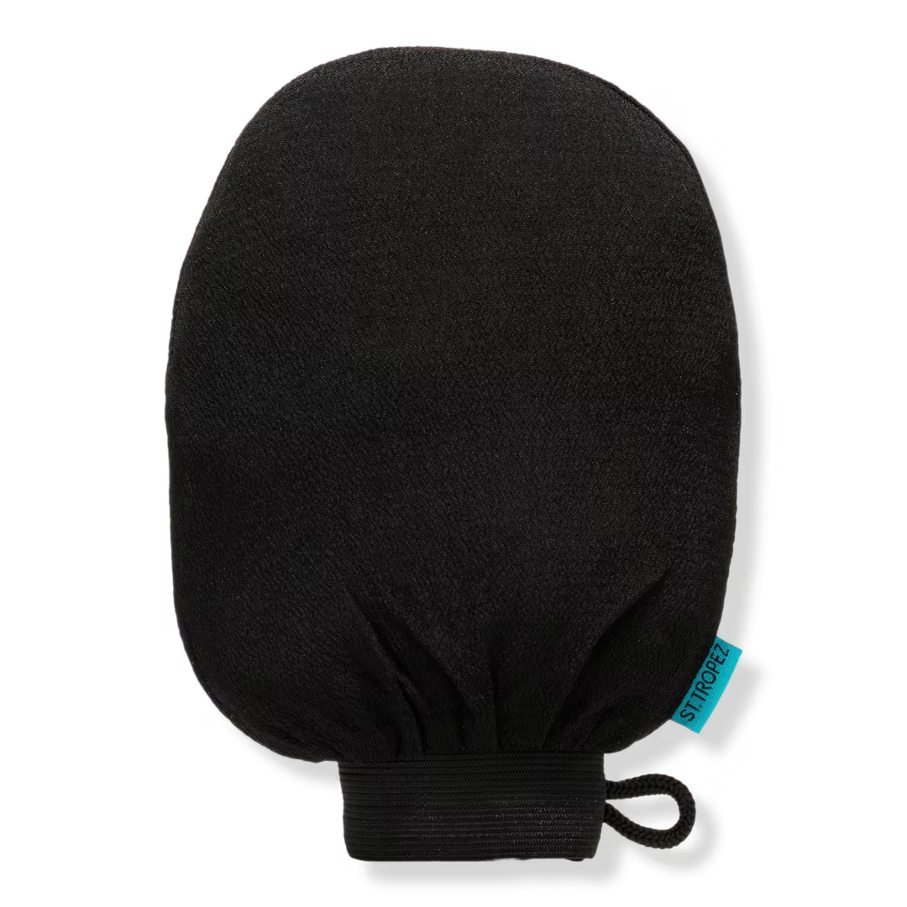
The Tan Buildup Remover Mitt by St. Tropez is a reusable physical-exfoliation accessory created to lift old self-tan buildup, smooth dry surface skin, and prepare the body for a cleaner-looking fresh tan application. Instead of relying on a liquid exfoliating formula, acids, or abrasive granules, the mitt uses its textured viscose surface to create controlled friction over wet skin.
Its biggest advantage is precision. It can be moved over larger areas where an older tan is fading unevenly, then concentrated around knees, elbows, ankles, feet, and hands where self-tanner commonly clings more noticeably. St. Tropez also specifically positions the mitt as a tool for correcting localized tanning mistakes.
About Tan Buildup Remover Buffing Mitt
Self-tan rarely disappears from every part of the body at exactly the same rate. A fading application can look reasonably even across the legs or arms while leaving darker traces around the knees, ankles, elbows, wrists, or feet. Dry areas can make those differences more noticeable because cosmetic tanning color develops on the outermost layers of the skin.
The Tan Buildup Remover Buffing Mitt gives those areas a dedicated mechanical exfoliation step before another tanning product is applied.
St. Tropez describes the mitt as being designed to remove accumulated tan while buffing dry skin and helping correct self-tanning mistakes. Its intended result is a smoother, cleaner surface that is better prepared for another application rather than skin coated with another corrective cosmetic.
That distinction makes this quite different from a bottled tan remover. The mitt itself contains no DHA-removing active, exfoliating acid, cleansing ingredient, oil, fragrance, or moisturizer. Its effect comes primarily from the interaction between its textured fabric, wet skin, and gentle movement.
Tan Buildup Remover Buffing Mitt Features
- Dedicated self-tan removal surface: The textured fabric is designed specifically for lifting residual cosmetic tan rather than simply applying tanning products.
- Physical exfoliation: It buffs dry surface skin through mechanical friction instead of relying on acids or exfoliating chemicals.
- Targeted correction: Small tanning mistakes can be worked on more precisely by positioning a finger inside the mitt over the affected area.
- Useful around stubborn areas: St. Tropez highlights elbows, knees, ankles, feet, and hands as places where more focused buffing may be necessary.
- Reusable construction: The mitt can be rinsed after each session and used again once dry.
- Works with normal shower products: It can be used on wet skin alongside an existing bath or shower cleanser.
- Compatible with a fuller tan-removal routine: St. Tropez also pairs the mitt with its Tan Remover Mousse when more noticeable buildup needs attention.
- No separate cosmetic formula: There is no ingredient list to layer onto the skin because the mitt itself performs the exfoliating work.
Material And Buffing Construction
The material breakdown is particularly important with this product because the fabric effectively is the working part of the formula.
St. Tropez lists the construction as 80% viscose fabric, 16% elastic band, and 4% rope.
Viscose makes up the majority of the buffing surface. Rather than producing the soft velvet-like contact expected from a tanning application mitt, this surface is intended to provide enough texture to physically loosen dry skin and residual tan.
The elastic portion gives the mitt flexibility around the hand, helping maintain contact as it moves across curved sections of the body.
This construction also explains why the Tan Buildup Remover Buffing Mitt should not be confused with a tanning applicator. An applicator mitt is normally designed to spread tanning mousse or lotion smoothly while protecting the hands. A remover mitt deliberately needs more texture because its job is almost the opposite: lifting an existing cosmetic layer rather than applying another one.
Why Self-Tan Buildup Can Become Patchy
Understanding the way sunless tanning works makes the purpose of a remover mitt easier to understand.
Many self-tanning formulas use dihydroxyacetone, commonly called DHA. The FDA information on sunless tanners explains that DHA reacts with amino acids in the skin’s surface to create temporary darkening. It is not the same biological process as producing a natural UV tan.
Because that cosmetic color is associated with the outer skin surface, it fades as those surface cells naturally shed.
The process does not always look perfectly uniform. Thicker or drier sections of skin may retain a different amount of visible color than smoother surrounding areas. Repeated tanning applications without adequate preparation can make those differences increasingly noticeable.
A remover mitt helps deal with the surface part of that problem. It does not bleach the skin or remove pigment from deeper tissue. Instead, physical exfoliation loosens some of the dry surface cells carrying residual tanning color.
Physical Exfoliation Rather Than A Chemical Tan Remover
The words “tan remover” can easily suggest that this mitt contains a special substance that dissolves self-tan. It does not.
There is no conventional cosmetic ingredient declaration because this is a reusable accessory. The product’s performance depends on controlled physical buffing.
That can be useful for someone who does not want to add another body scrub or exfoliating liquid to an already crowded tanning routine. The same mitt can be brought out when the previous tan becomes uneven, rinsed afterward, dried, and stored for the next preparation session.
Physical exfoliation still needs moderation. The American Academy of Dermatology’s exfoliation guidance notes that exfoliation should be performed carefully because excessive or unsuitable exfoliation can irritate the skin.
The goal with this mitt is therefore controlled buffing, not aggressive scrubbing.
Preparing Skin For A More Even Self-Tan
Removing an older tanning layer is only part of what makes this accessory useful. It also helps prepare the surface for whatever comes next.
The American Academy of Dermatology’s self-tanner guidance recommends exfoliating before self-tanner application and paying particular attention to thicker areas such as the elbows, knees, and ankles.
That advice lines up naturally with the areas St. Tropez identifies for more concentrated use of its removal mitt.
When dry flakes and obvious residual tanning patches are reduced first, a fresh product is less likely to be layered directly over an irregular-looking previous application.
The important point is preparation rather than trying to scrub the skin completely smooth in one session. If repeated rubbing is needed to remove a deeply developed tan, gentler gradual exfoliation is preferable to causing unnecessary irritation.
Correcting Small Tanning Mistakes
The mitt is also designed for more localized corrections.
St. Tropez recommends dampening the area and positioning an index finger inside the mitt when a small tanning mistake needs attention. This creates a smaller contact point than rubbing with the entire palm of the mitt.
That approach can make sense around:
Hands and knuckles, where tanning products may collect around creases.
Feet and ankles, where the transition between tanned and less-tanned skin can become obvious.
Elbows and knees, where thicker, drier skin can hold stronger-looking color.
Small streaks or patches, where treating the whole surrounding area would be unnecessary.
Precision matters because the objective is to reduce the visible difference between an uneven patch and the surrounding tan, not simply scrub away as much color as possible.
Working With Wet Skin
St. Tropez specifically instructs users to work with the mitt on wet skin using gentle circular motions and says it can be paired with normal bath or shower products.
Wet skin helps the mitt move more comfortably across the surface than aggressive dry rubbing.
Start with light pressure over broader areas. More concentrated pressure can be reserved for spots where old tanning color is visibly holding on, particularly around the knees, elbows, hands, feet, and ankles.
After the area has been buffed sufficiently, rinse away loosened residue.
Anyone with skin that is already irritated, sore, scratched, or inflamed should avoid treating the area aggressively. The AAD’s guidance on gentle exfoliation similarly emphasizes removing surface cells gently rather than scrubbing hard enough to irritate skin.
Using It With Tan Remover Mousse
The mitt can function independently with a normal shower product, but it can also become part of a stronger tan-removal routine.
St. Tropez pairs it with its Tan Remover Mousse for more persistent areas. The brand’s instructions for the mousse include applying the product to dry tanned skin, allowing the product time to work, rinsing, and using the remover mitt during the removal stage.
This pairing creates two different types of removal action: the cosmetic remover product helps loosen the existing tan while the mitt provides physical exfoliation.
The mitt itself, however, remains formula-free. Someone who only needs to tidy a small patch or remove naturally fading buildup may not need an additional removal product every time.
Texture And Skin Feel
Calling the mitt “buffing” is more accurate than calling it soft.
It needs enough surface texture to create useful friction against old tan and dry skin. That is quite different from the plush surface found on many self-tan applicator mitts.
After appropriate buffing, the expected finish is simply cleaner and smoother-feeling skin with less obvious residual tan. There is no oily finish, moisturizing film, fragrance, shimmer, or tanning pigment left behind by the mitt itself.
Because no cosmetic formulation is deposited, the final skin feel will also depend on the bath or body product used alongside it.
Reusable Design And Care
Unlike disposable wipes or single-use removal products, the Tan Buildup Remover Buffing Mitt is designed for repeated use.
St. Tropez recommends rinsing the mitt with warm water after each use and leaving it to dry naturally.
That simple care step matters. Tan residue, cleanser, and exfoliated surface material can remain in the fabric after use, so rinsing helps clear the working surface before it is stored again.
Allowing the mitt to dry naturally before putting it away also avoids leaving a damp body-care accessory sitting in a closed environment.
The manufacturer currently advises putting the mitt in general waste when it reaches the end of its usable life.
Who May Find This Mitt Most Useful
The Tan Buildup Remover Buffing Mitt makes the most sense for regular self-tan users rather than someone looking for an everyday moisturizing body accessory.
It may be particularly useful when:
- an older self-tan is fading unevenly;
- darker buildup remains around dry areas;
- a new full-body tanning application is planned;
- the knees, elbows, ankles, hands, or feet need extra preparation;
- a small application mistake needs targeted correction;
- a reusable tool is preferred over repeatedly buying disposable removal wipes.
People who do not use self-tanner could still use the textured mitt for physical body exfoliation, but that is not its primary purpose. Its construction, positioning, and instructions are specifically centered around sunless-tanning preparation and correction.
When Gentler Skin Care Makes More Sense
There is a point where additional buffing stops being useful.
If an area becomes noticeably irritated, continued friction can make the skin feel worse rather than improving its appearance. Harsh scrubbing is particularly unnecessary when the remaining self-tan is already fading naturally.
A gentle approach also becomes more important for people using other exfoliating skincare products. Combining several strong exfoliation methods at once can increase the chance of dryness or irritation.
The AAD’s home-exfoliation advice recommends matching exfoliation to the condition of the skin and avoiding practices that damage the surface.
The Tan Buildup Remover Buffing Mitt is therefore best treated as a preparation accessory rather than something that needs to be rubbed aggressively until every trace of tanning color disappears.
Self-Tan Is Not Sun Protection
A freshly reapplied self-tan may make skin appear bronzed, but the cosmetic color should not be mistaken for meaningful ultraviolet protection.
FDA guidance explains that DHA-based sunless tanning changes the appearance of the skin’s surface without creating the same biological tan caused by UV exposure. Unless a separate product is specifically formulated and labeled with sunscreen protection, the appearance of a tan does not make sunscreen unnecessary.
The FDA’s current sunscreen guidance recommends combining sunscreen with other sun-protective measures rather than relying on one method alone.
This means tan removal, fresh self-tan application, and sun protection should be treated as separate parts of body care.
What Makes The Tan Buildup Remover Buffing Mitt Different
The appeal of this product comes from how little complexity it adds to a tanning routine.
There is no lengthy ingredient list to interpret, no development time, no shade choice, and no cosmetic finish to coordinate with another product. It is simply a purpose-built textured mitt for the awkward stage between an old tan and a new one.
Its 80% viscose fabric construction provides the main exfoliating surface. The flexible hand-held format gives better control than trying to correct small areas with a large body towel, while its reusable design means it can stay with the rest of a tanning kit instead of being discarded after one session.
The most useful distinction is therefore not that it performs a radically different type of exfoliation. It is that its shape, texture, and intended technique are specifically adapted to the common problems that appear as self-tan wears away.
Erothots Take On Tan Buildup Remover Buffing Mitt
The St. Tropez Tan Buildup Remover Buffing Mitt is best understood as a practical maintenance tool rather than another tanning cosmetic.
Its job starts when an existing tan stops looking uniform. Instead of covering darker knees, patchy ankles, or fading areas with another layer of self-tanner, the mitt gives the skin a preparation step first. That can make considerably more sense than continuously layering new tanning product over old buildup.
The construction is straightforward: 80% viscose fabric, 16% elastic band, and 4% rope, with no separate active formula or fragrance to account for.
The reusable design is another practical advantage. Rinse it after use, allow it to dry naturally, and it can return to the tanning routine when another application begins to fade.
Most importantly, it should be used with restraint. Physical exfoliation works through friction, so harder scrubbing is not automatically better. Gentle buffing on wet skin, extra attention only where buildup actually remains, and sensible care afterward make the product much more useful.
For regular self-tan users, that makes the Tan Buildup Remover Buffing Mitt a focused accessory for three specific jobs: lifting residual tan, smoothing dry surface buildup, and creating a more even starting point before the next tanning application.
Reviews
There are no reviews yet.