



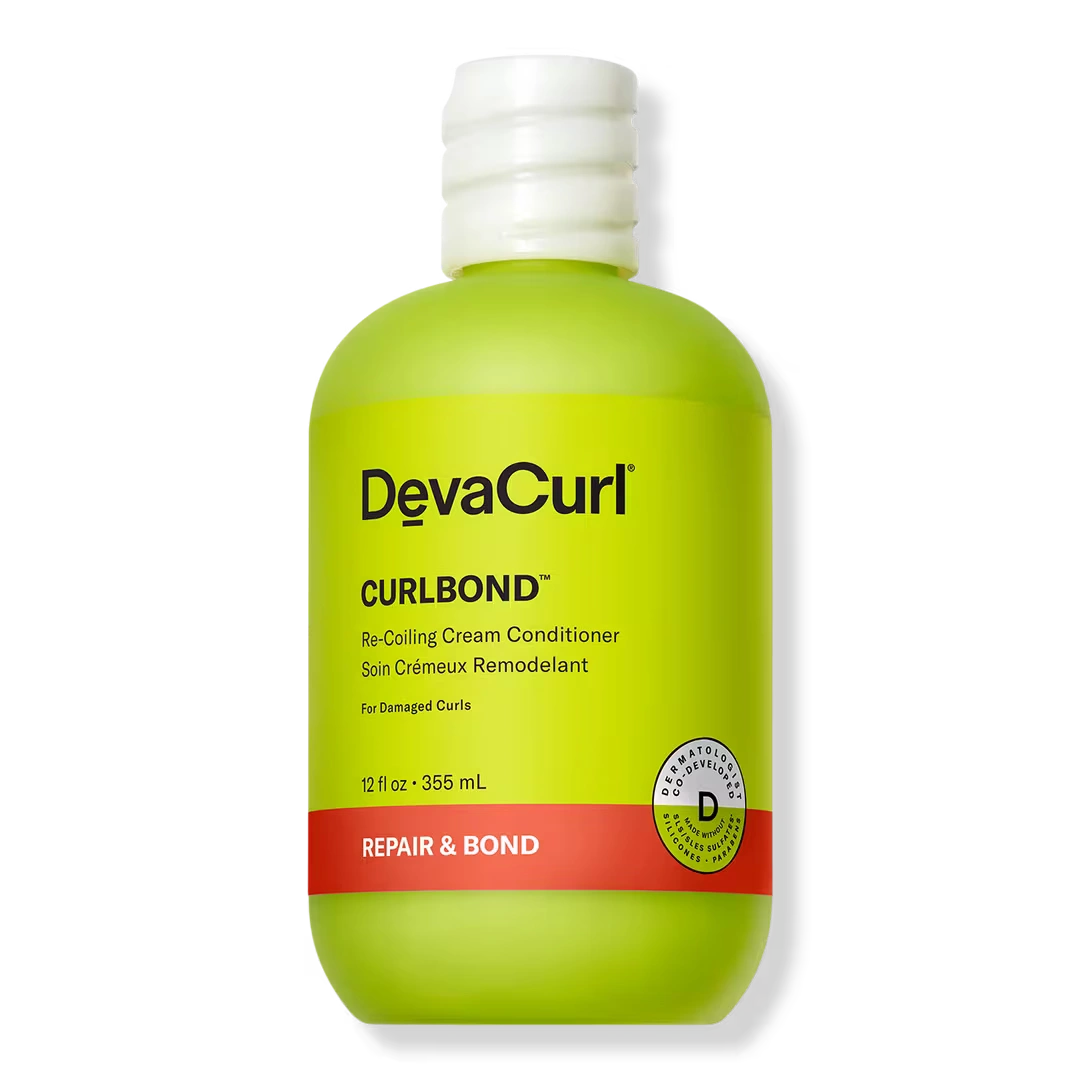
DevaCurl CURLBOND Re-Coiling Cream Conditioner is a repair-focused rinse-out conditioner created for waves, curls, and coils affected by chemical processing, heat, brushing, protective styling, friction, and other forms of repeated stress. It combines a rich conditioning base with DevaCurl’s CurlBond Complex, which the brand identifies around succinic acid, lysine, arginine, and naturally derived guar. The goal is to improve strength, soften damaged curls, make detangling easier, reduce breakage during wet combing, and help compromised curl patterns look more defined again.
DevaCurl currently describes CURLBOND Conditioner as suitable for every curl pattern and particularly useful where damage has changed how the hair feels, detangles, or forms its usual curl shape.
About CURLBOND Re-Coiling Cream Conditioner
The “re-coiling” part of the name describes the cosmetic goal of the formula rather than a promise to permanently reset someone’s natural curl pattern.
Hair that has been repeatedly bleached, colored, relaxed, heat styled, brushed, or exposed to friction can become rougher, weaker, and more difficult to manage. In curly hair, that damage may also show up as sections that appear limp, frizzy, stretched, or less defined than surrounding curls.
DevaCurl developed CURLBOND Conditioner specifically around this type of compromised hair. The company says its CurlBond system is intended to help repair existing damage, support curl formation, and protect against additional damage. DevaCurl lists chemical services along with heat, brushing, protective styles, and friction among the situations for which the conditioner was designed.
Curly and coily hair can already be relatively prone to dryness and breakage, which makes effective conditioning especially important. Dermatologists at the American Academy of Dermatology recommend conditioning curly hair thoroughly and detangling carefully while the hair has adequate slip.
CURLBOND combines that basic conditioning function with a specialized repair story.
CURLBOND Re-Coiling Cream Conditioner Features
The conditioner is built around three connected jobs: reducing friction during detangling, supporting damaged fibers, and helping curls look smoother and better defined.
Its current formula begins with water, cetearyl alcohol, behentrimonium chloride, PPG-3 Benzyl Ether Myristate, glycerin, Stearamidopropyl Dimethylamine, and stearyl alcohol. Those ingredients establish a substantial conditioning base before the CurlBond ingredients such as succinic acid, arginine, guar derivatives, and Lysine HCl are added.
That composition is important because the conditioner is not relying on “bond repair” terminology alone. It also contains conventional ingredients that help lubricate the hair, reduce static, improve slip, and make wet curls easier to separate.
Scientific reviews of conditioner chemistry describe cationic conditioning ingredients as particularly useful on damaged hair because weathered hair surfaces become more negatively charged and can interact with positively charged conditioning agents.
Understanding CurlBond Complex
DevaCurl says the ingredients contributing to its CurlBond repair system include Succinic Acid, Lysine, Arginine, and naturally derived Guar.
These ingredients should be considered as part of the complete formula rather than as four isolated miracle ingredients.
Succinic Acid
Succinic acid appears relatively high in the current ingredient declaration, immediately after several of the conditioner’s major emollient and conditioning ingredients.
DevaCurl includes it as part of the CurlBond system and connects that system with helping damaged hair regain strength and flexibility.
Different bond-care brands use different chemistries, so it would be inaccurate to assume that CURLBOND works identically to every other product marketed as a bond builder.
Its repair story should remain specific to DevaCurl’s own formulation rather than being grouped automatically with unrelated patented bond technologies.
Arginine And Lysine
The current formula contains Arginine and Lysine HCl. DevaCurl describes these amino acids as part of its CurlBond technology and refers to them as the building blocks of protein.
That creates an important distinction for people who monitor protein-containing curl products.
CURLBOND does not currently list a conventional hydrolyzed protein such as hydrolyzed keratin, rice protein, or wheat protein. Instead, its repair story includes individual amino acids.
Calling it an amino-acid-containing repair conditioner is therefore more precise than suggesting that the formula is dominated by hydrolyzed protein.
Naturally Derived Guar
The formula contains Guar Hydroxypropyltrimonium Chloride and Hydroxypropyl Guar Hydroxypropyltrimonium Chloride.
These guar-derived conditioning polymers can help improve slip and manageability.
That function becomes particularly useful during detangling. Damaged curls may already be weaker, so forcing through knots with excessive pressure can add mechanical stress precisely when the hair is most vulnerable.
What “Bond Repair” Means For Hair
Hair is composed largely of keratin proteins held together through several types of interactions and chemical bonds. Chemical treatments can alter those structures and weaken the fiber.
That does not mean damaged hair biologically heals itself after conditioner is applied. The visible part of a hair strand is not living tissue.
Cosmetic repair is better understood as improving the behavior and condition of an existing fiber. A repair conditioner may help make the strand feel smoother, improve its resistance to handling, reduce friction, temporarily improve damaged areas, and help prevent some additional breakage.
This distinction keeps the product claim realistic.
CURLBOND may help damaged curls behave more like healthier hair, but it cannot transform heavily processed length back into completely untouched virgin hair.
4x Stronger Hair And 79% Less Breakage
DevaCurl currently makes one of its clearest measurable performance claims on the conditioner page: 4x stronger hair with 79% less breakage.
The testing context matters just as much as the numbers.
The company specifies that the comparison concerns wet-combing breakage on damaged hair versus untreated hair.
That means Erothots would not rewrite the claim as “reduces all hair breakage by 79%.”
Wet-combing testing provides a controlled way to assess how treated hair responds to mechanical stress. Real-life breakage also depends on bleaching history, heat exposure, detangling technique, tight hairstyles, brushes, towels, humidity, sleeping habits, and many other factors.
The accurate interpretation is that DevaCurl reports substantially lower wet-combing breakage under its stated damaged-hair testing conditions.
Why Easier Detangling Matters For Damaged Curls
Some of the conditioner’s most practical repair value may come from something much simpler than bond terminology: slip.
The current formula contains behentrimonium chloride, Stearamidopropyl Dimethylamine, Cetrimonium Chloride, Polyquaternium-7, Quaternium-87, Quaternium-91, fatty alcohols, and guar-based conditioning agents.
These ingredients help create the creamy, slippery character expected from a rinse-out conditioner.
The AAD recommends using conditioner after shampooing and taking particular care when detangling textured hair. Dermatologists advise combing thick or curly hair while conditioner is still present rather than repeatedly brushing it dry.
This is especially relevant to already damaged hair because reducing the force needed to separate tangles can reduce unnecessary mechanical stress.
Rich Conditioning Without Silicones
CURLBOND is currently listed as silicone-free.
The ingredient list supports that positioning. Familiar silicones such as Dimethicone and Amodimethicone do not appear in the current formula.
That does not make the conditioner lightweight or minimally conditioning.
Cetearyl Alcohol, Behentrimonium Chloride, Stearamidopropyl Dimethylamine, Stearyl Alcohol, Cetrimonium Chloride, guar derivatives, Polyquaternium-7, and additional quaternary conditioning agents provide a substantial alternative smoothing system.
For shoppers following a silicone-free curl routine, that difference may be useful.
For everyone else, the more important point is simply that the product achieves slip and softness through a different conditioning architecture.
Fatty Alcohols Are Part Of The Creamy Base
Cetearyl Alcohol is the second ingredient in the formula, and Stearyl Alcohol also appears near the top.
Despite the word “alcohol,” these are fatty alcohols, not the same type of ingredient people usually mean when they talk about fast-evaporating alcohol in cosmetics.
Fatty alcohols help thicken conditioners, improve softness, stabilize emulsions, and create a richer sensory feel.
CURLBOND does contain Isopropyl Alcohol farther down the current ingredient list, but assessing the entire conditioner according to that one lower-listed ingredient would ignore the much larger conditioning system surrounding it.
Moisture And Repair Are Not Exactly The Same
DevaCurl itself makes an unusually useful distinction on the official product page: CURLBOND Conditioner is primarily designed to repair, although it also conditions and softens curls. For deeper nourishment, the company points toward richer treatment masks.
That helps set expectations.
The formula does contain moisture-supporting ingredients such as glycerin, Glycereth-26, panthenol, fatty alcohols, and Caprylic/Capric Triglyceride.
However, someone with extremely dry, coarse, porous, or repeatedly bleached curls may still want a separate deeper-conditioning treatment periodically.
Repair and moisture frequently overlap, but they are not always identical hair needs.
Curl Definition And “Re-Coiling”
Ulta currently says the patented CurlBond Complex helps enhance curl definition and elasticity while softening curls.
The term “re-coiling” is best understood in this cosmetic context.
When damaged strands become rougher and less flexible, they may no longer group and bend as consistently. Improving conditioning, reducing friction, and supporting the fiber can make curls appear more uniform and better defined.
The effect has limits.
If chemical or thermal damage has permanently altered a section of hair, no rinse-out conditioner can guarantee that it will immediately return to its original virgin pattern. In some cases, maintaining healthier new growth and gradually trimming severely compromised length remains part of recovering the overall curl pattern.
Up To 48 Hours Of Frizz Control
Current Ulta information attributes up to 48 hours of frizz reduction to the patented CurlBond Complex.
This is a manufacturer performance claim rather than a universal personal guarantee.
Humidity, porosity, styling products, drying method, weather, sleep, and repeated touching can all affect how quickly frizz reappears.
Still, the ingredient profile provides a logical foundation for smoother-looking curls. Cationic conditioners and polymers can improve fiber alignment and reduce the roughness that contributes to a frizzy appearance.
The sensible product expectation is better-conditioned, smoother curls with manufacturer-tested extended frizz control, rather than identical 48-hour performance in every environment.
Color-Treated Curl Compatibility
DevaCurl identifies its current formulas as safe for color-treated curls. The current Ulta listing goes further and says CurlBond Complex can help preserve color for up to 20 washes.
Again, that figure should remain attached to the manufacturer’s claim.
The product page does not publish enough of the testing protocol to determine how every hair color, dye technology, water temperature, or washing routine would compare.
Color-safe also does not mean color cannot fade.
The useful takeaway is that CURLBOND was specifically developed to fit into routines where chemical coloring may already be one source of damage.
Research on chemically treated hair also supports the broader value of conditioning. A published study found that incorporating conditioning agents into an oxidative hair-color system reduced several measurements of damage caused by coloring.
That independent study does not test CURLBOND itself, but it helps explain why conditioning is so relevant after chemical processing.
Cozy Getaway Fragrance
CURLBOND Re-Coiling Cream Conditioner is not fragrance-free.
DevaCurl calls its scent Cozy Getaway and describes it as a warm tropical fragrance beginning with coconut water, casaba melon, gardenia petals, and bitter orange before moving toward amber and vanilla bean.
The current ingredient declaration contains Parfum/Fragrance and Linalool.
For many users, the scent is simply part of the wash-day experience.
Someone specifically seeking fragrance-free curl care, however, should not assume that silicone-free, paraben-free, or dermatologist co-developed means unscented.
Silicone-Free, Paraben-Free, Gluten-Free And Vegan
DevaCurl currently identifies CURLBOND Conditioner as silicone-free, formulated without parabens, gluten-free, cruelty-free, and part of a range with vegan formulas. The brand defines its vegan positioning as being free from animal-derived ingredients.
The company also states that it is formulated without SLS/SLES sulfates. DevaCurl itself notes that these cleansing surfactants are not normally used in its conditioners and stylers, so this claim is less central to the conditioner’s performance than the silicone-free positioning.
The published ingredient list remains more informative than relying on “free-from” terminology alone.
Working CURLBOND Into Wash Day
After cleansing, the conditioner is applied to wet curls. DevaCurl recommends gently detangling with the fingers, gliding the formula through the ends, and rinsing thoroughly.
For thick or dense curls, dividing the hair into sections can make it easier to distribute conditioner through the interior of the hairstyle.
Damaged ends generally deserve the most attention because they have experienced the greatest amount of weathering and manipulation.
Detangling should remain gentle rather than forcing through resistant knots. AAD guidance recommends using conditioner consistently and reducing rough handling, high heat, and aggressive brushing to limit further hair damage.
CURLBOND is formulated as a rinse-out conditioner, so it makes more sense to use a dedicated leave-in product afterward when additional conditioning is required rather than assuming every rinse-out formula should remain in the hair.
Current Ingredient Profile
The current published formula is:
Aqua/Water/Eau, Cetearyl Alcohol, Behentrimonium Chloride, PPG-3 Benzyl Ether Myristate, Glycerin, Stearamidopropyl Dimethylamine, Stearyl Alcohol, Succinic Acid, Arginine, Caprylic/Capric Triglyceride, Cetrimonium Chloride, Citric Acid, Glycereth-26, Guar Hydroxypropyltrimonium Chloride, Hydroxypropyl Guar Hydroxypropyltrimonium Chloride, Isopropyl Alcohol, Lysine HCl, Panthenol, Pentaerythrityl Tetra-Di-T-Butyl Hydroxyhydrocinnamate, Polyquaternium-7, Propylene Glycol, Quaternium-87, Quaternium-91, Sodium Hydroxide, Tetrasodium Glutamate Diacetate, Tocopheryl Acetate, Potassium Sorbate, Sodium Benzoate, Parfum/Fragrance, and Linalool.
DevaCurl notes that ingredients such as preservative or fragrance systems can be updated, so the label on the bottle being purchased should remain the final reference when checking a specific allergy or ingredient preference.
Who May Prefer CURLBOND Re-Coiling Cream Conditioner
The clearest match is curly, coily, or wavy hair that is showing signs of accumulated damage.
That might include curls that have become more difficult to detangle after bleaching, sections that feel rough after repeated heat styling, color-treated hair experiencing increased breakage, or hair stressed by frequent brushing, friction, and protective styling.
DevaCurl says the conditioner can also be used on hair that is not obviously damaged, but the company expects the most noticeable results where heat, color, or mechanical styling has already created sensitivity or damage.
Someone whose hair is healthy but primarily needs intensive moisture may find a dedicated deep-moisture conditioner or mask more directly suited to that concern.
Protecting Curls From New Damage
A repair conditioner makes the most sense when it is paired with habits that reduce repeated damage.
The AAD recommends using conditioner after washing, limiting high heat, handling wet hair gently, avoiding rough towel drying, and being careful with hairstyles that repeatedly pull on the hair.
This matters because no conditioner can completely compensate for continuous high-temperature styling or aggressive detangling.
CURLBOND may make compromised fibers easier to manage and more resistant to wet-combing breakage, but preserving that improvement still requires treating the strands gently between wash days.
Bottle And Sustainability Detail
DevaCurl currently states that the CURLBOND Conditioner bottle is made using 50% recycled ocean-bound plastic.
That is a specific packaging improvement, not a claim that the complete product is plastic-free or zero-waste.
Keeping the wording precise is useful because sustainability claims can quickly become broader than the underlying specification.
The verified claim here is simply that half of the bottle material is described by DevaCurl as recycled ocean-bound plastic.
Erothots Take On CURLBOND Re-Coiling Cream Conditioner
CURLBOND Re-Coiling Cream Conditioner is most compelling when treated as a curl-specific repair conditioner rather than as a vague “bond builder.”
Its base is already a serious conditioning formula. Cetearyl alcohol, Behentrimonium Chloride, Stearamidopropyl Dimethylamine, Stearyl Alcohol, Cetrimonium Chloride, Polyquaternium-7, guar derivatives, and additional conditioning agents provide slip, softness, and easier detangling. Succinic acid, arginine, lysine, and naturally derived guar then form the repair story DevaCurl associates with CurlBond Complex.
The performance numbers are also useful when kept in context. DevaCurl reports 4x stronger hair and 79% less breakage, specifically against wet-combing breakage on damaged hair compared with untreated hair. Ulta additionally lists up to 48 hours of frizz reduction and color preservation for up to 20 washes as CurlBond Complex claims.
Its limits are equally important. “Re-coiling” does not mean every severely heat-damaged or chemically altered strand will permanently return to its original curl pattern. “Repair” does not mean biological healing of dead hair tissue. And although the formula is silicone-free, paraben-free, gluten-free, cruelty-free, and identified by DevaCurl as vegan, it does contain added fragrance.
For damaged waves, curls, and coils, its strongest value is the combination of repair-focused chemistry with practical wash-day conditioning: better slip, gentler detangling, less wet-combing breakage, improved softness, frizz control, and support for curls whose definition has been affected by styling or chemical stress.
Reviews
There are no reviews yet.