



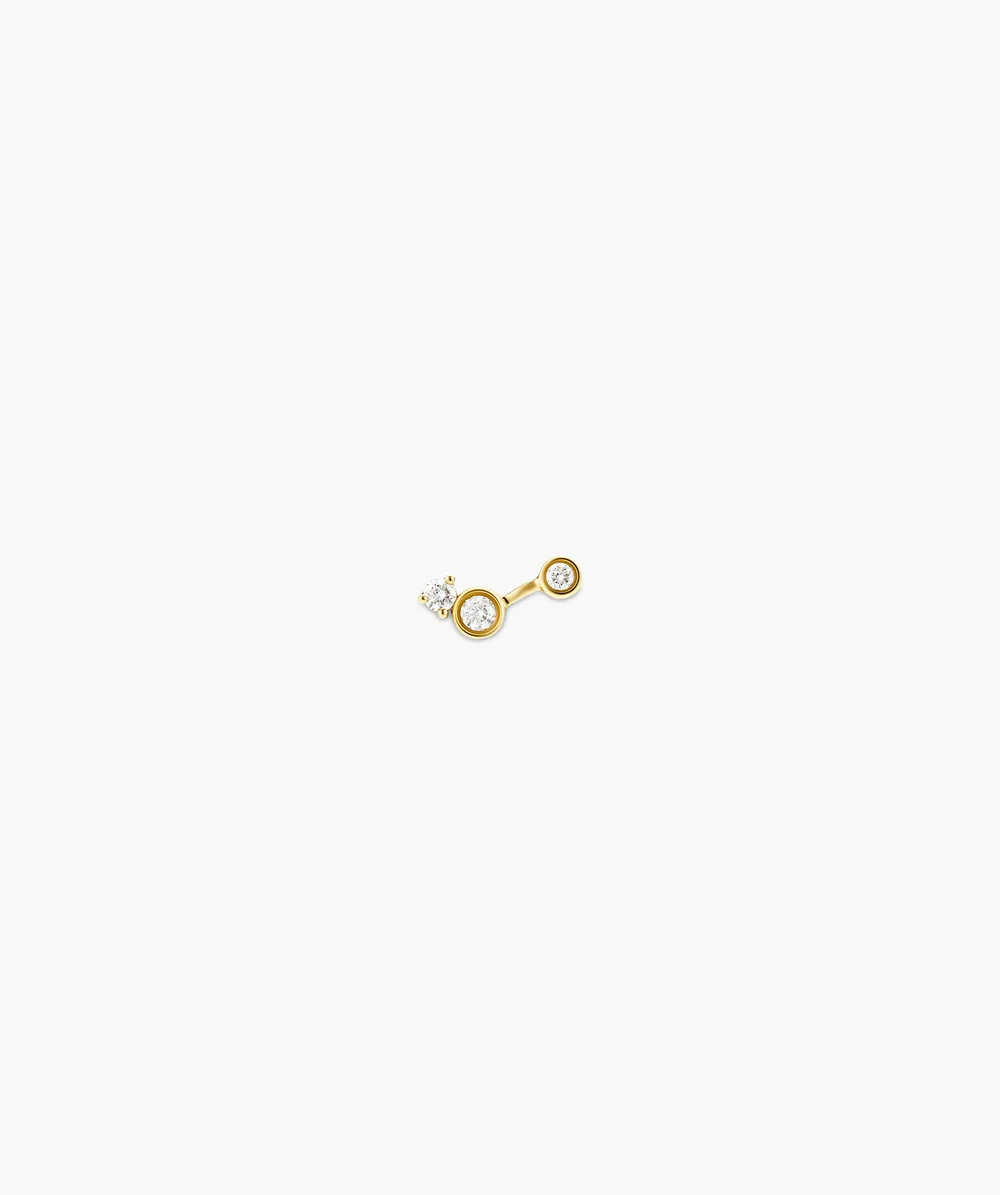
The Single Celeste Lab Grown Diamond Triad Stud by Mejuri arranges three graduated lab-grown diamonds into a compact, constellation-inspired line of light. Made in solid 14k yellow gold, the stud combines 1.5 mm, 1.7 mm, and 2 mm diamonds in prong and bezel settings. The complete design measures 8.8 mm long and 4 mm wide, with a published minimum diamond weight of 0.06 ct. Mejuri specifies FG color and VS clarity for the diamonds and sells this earring individually rather than as a pair. (Mejuri)
Its proportions make it more noticeable than a conventional single-diamond mini stud without turning it into a long drop earring. The three-stone arrangement also gives the piece a directional shape that can be positioned as part of a curated ear stack.
About Single Celeste Lab Grown Diamond Triad Stud
The Single Celeste Lab Grown Diamond Triad Stud belongs to Mejuri’s Celeste collection, which uses arrangements inspired by stars and constellations. Here, three connected lab-grown diamonds form an asymmetric cluster rather than sitting as three unrelated stones. Mejuri uses both prong and bezel settings, creating small differences in the way metal surrounds each diamond. (Mejuri)
The stud is currently made in 14k yellow gold with lab-grown diamonds. Mejuri describes the gold as solid, water resistant, and hypoallergenic, and states that its current U.S. 14k material contains 90% recycled gold. The company also currently makes traceability and emissions claims for the lab-grown diamonds used in this piece. Those sustainability statements are manufacturer claims rather than independent conclusions about every lab-grown diamond on the market. (Mejuri)
Single Celeste Lab Grown Diamond Triad Stud Features
The current product combines three lab-grown diamonds measuring 1.5 mm, 1.7 mm, and 2 mm, a minimum combined diamond weight of 0.06 ct, FG color, VS clarity, an overall 8.8 mm length, and 4 mm width. It is constructed in solid 14k yellow gold and is sold as one earring. Mejuri’s current single-stud collection also labels this style as Flat Back Available, although detailed flat-back post measurements are not published in the accessible technical specification for this exact product. (Mejuri)
Three Graduated Diamond Sizes
Using three different stone sizes is central to the Celeste look.
The smallest diamond measures 1.5 mm, the middle diamond measures 1.7 mm, and the largest measures 2 mm. (Mejuri)
This gradual increase creates a natural visual direction instead of making the stud look like three identical stones placed in a straight row.
The larger 2 mm diamond can act as the strongest point of light while the two smaller stones extend the constellation-like shape across the ear.
Mejuri does not state an individual carat weight for each of the three stones, so those weights should not be estimated from their diameters.
Minimum 0.06 Carat Diamond Weight
Mejuri publishes a minimum total carat weight of 0.06 ct for the lab-grown diamonds in the stud. (Mejuri)
Carat refers to diamond weight, not directly to visible size.
That is why the published millimeter measurements are also useful. They show how the three diamonds are physically scaled even though their combined weight is relatively small.
For a miniature ear stud, the arrangement of several differently sized diamonds can produce more visual coverage than one small stone of similar total weight concentrated in a single setting.
Understanding The Lab Grown Diamonds
These are lab-grown diamonds, not cubic zirconia, glass, white sapphire, or another diamond simulant.
GIA explains that laboratory-grown diamonds have essentially the same chemical composition, crystal structure, optical properties, and physical properties as diamonds formed naturally in the Earth. Their primary distinction is origin: one grows through a technological manufacturing process while the other forms geologically. (GIA 4Cs)
For independent background, see GIA information about laboratory-grown diamonds.
That distinction should remain clear on an Erothots product page. The correct phrase is lab-grown diamond, rather than simply “diamond” without mentioning laboratory origin.
Lab Grown Diamond Is Not The Same As A Simulant
The distinction is important because several clear materials can resemble diamonds visually.
GIA explains that actual simulants such as cubic zirconia and synthetic moissanite have different chemical and physical properties, whereas laboratory-grown diamonds are diamond material with a laboratory origin. (GIA 4Cs)
FTC guidance likewise says sellers should clearly identify laboratory-created diamonds in a way that communicates they are not mined diamonds. (Federal Trade Commission)
Readers interested in disclosure standards can review the FTC Jewelry Guides.
FG Diamond Color
Mejuri specifies the three diamonds as FG color. (Mejuri)
GIA’s D-to-Z grading system begins at D, representing the colorless end of the normal diamond color range. GIA groups D through F as colorless, while G through J is considered near-colorless. (GIA 4Cs)
That means Mejuri’s published FG description spans the boundary between F and G within those standard color categories.
It is best treated as the manufacturer’s specified color range rather than claiming that every individual 1.5 mm, 1.7 mm, and 2 mm stone has a separate GIA grading report.
For more context, see GIA’s official diamond color scale.
VS Diamond Clarity
The current clarity specification is VS. (Mejuri)
VS means Very Slightly Included within the GIA clarity system. GIA evaluates clarity by considering characteristics such as the number, size, position, nature, and visibility of inclusions and blemishes under controlled examination. (GIA 4Cs)
At these very small diamond sizes, the practical visual experience is different from inspecting a much larger solitaire diamond.
Erothots should therefore state VS clarity according to Mejuri without inventing a more specific grade such as VS1 or VS2.
Readers can refer to GIA guidance on diamond clarity grades for independent grading context.
Prong And Bezel Settings
Mejuri uses a combination of prong and bezel settings within the three-diamond design. (Mejuri)
These two setting approaches create slightly different visual relationships between diamond and metal.
A bezel surrounds more of a stone’s perimeter with metal, giving the diamond a defined gold outline.
A prong setting leaves more of the stone visually exposed around its edges.
Using both in one small stud helps the three diamonds look related without making every element exactly identical.
The accessible product specification does not clearly map each particular stone size to a specific setting, so Erothots should not guess which of the 1.5 mm, 1.7 mm, or 2 mm diamonds uses each construction.
8.8 mm Overall Length
The stud measures 8.8 mm long. (Mejuri)
This elongated proportion is one reason it behaves differently from a normal round solitaire stud.
Rather than creating one small circular point at the piercing, the Celeste Triad extends across more of the ear.
Depending on how the post and stud orientation work on an individual ear, that line can become part of a larger curated arrangement.
The compact sub-centimeter length still keeps it far from the scale of a long bar or drop earring.
4 mm Overall Width
The complete stud is 4 mm wide. (Mejuri)
That relatively narrow width helps preserve the directional constellation silhouette.
With the largest individual diamond measuring 2 mm, the full 4 mm width accounts for both the stones and their surrounding setting structure.
The result remains slim enough to fit comfortably among other small earrings in a multi-piercing composition.
Solid 14k Yellow Gold
The current product uses solid 14k yellow gold. (Mejuri)
Fourteen-karat gold contains 14 parts gold out of 24 total parts, with the remaining portion consisting of alloying metals. The FTC explains that pure 24k gold is relatively soft and that jewelry commonly uses gold alloys such as 14k to combine gold with other metals. (Consumer Advice)
For independent precious-metal guidance, see FTC advice on buying gold jewelry.
Because this is solid 14k gold, it should not be described as vermeil, gold plating, or gold-tone metal.
What Solid 14k Gold Means Here
The gold alloy forms the gold jewelry component itself rather than existing only as a decorative surface coating.
This distinction matters when comparing the Celeste stud with gold-vermeil earrings.
Vermeil uses sterling silver underneath a gold layer.
The Celeste Triad’s current yellow-gold construction is instead listed by Mejuri as solid 14k gold. (Mejuri)
That does not mean the material is pure gold. The 14k designation still indicates that the alloy contains 14 parts gold in 24.
Mejuri’s 90% Recycled Gold Claim
Mejuri currently states that this piece is made using 90% recycled 14k gold. (Mejuri)
That percentage concerns the source of the gold used in the material.
It does not mean the finished alloy is 90% pure gold.
The metal remains 14k gold in composition, while the recycled percentage is a separate manufacturer sourcing claim.
Responsible Jewellery Council standards provide broader industry context for traceability and recycled precious-metal supply chains. (Responsible Jewellery Council)
Readers interested in responsible sourcing systems can refer to the Responsible Jewellery Council standards.
That industry guidance should not be treated as independent verification of Mejuri’s exact 90% claim unless product-specific certification is documented.
Traceability And Emissions Claims
The current U.S. product page states 100% traceable lab-grown diamonds and describes the diamonds using a net-zero emissions claim. (Mejuri)
These are claims made by Mejuri about its own supply and production arrangements.
They should not be generalized into a statement that all laboratory-grown diamonds have the same environmental footprint or traceability.
Lab-grown diamonds can be produced using different technologies, facilities, energy mixes, and supply chains. GIA notes that the two principal growth methods are HPHT and CVD, although Mejuri’s current accessible product specification does not identify which specific growth process produced the three diamonds in this stud. (gia)
Erothots should therefore avoid stating that the Celeste diamonds are HPHT or CVD unless Mejuri provides that exact information.
Sold Individually
The Single Celeste Lab Grown Diamond Triad Stud is sold individually. (Mejuri)
This is an essential product detail.
A shopper purchasing one unit receives one stud, not a conventional pair of earrings.
The individual format makes sense for the design because it is particularly suited to asymmetrical ear styling, second or third piercings, and curated stacks.
Someone wanting a matching stud on each ear would need to confirm quantity when ordering rather than assuming a pair is included.
Flat Back Availability
Mejuri’s current single-earring and single-stud collections mark the Celeste Lab Grown Diamond Triad Stud as Flat Back Available. (Mejuri)
However, the current accessible product specification does not publish the detailed post length, post thickness, flat-back diameter, or titanium specifications that appear on some other Mejuri stud listings.
For that reason, those measurements should not be borrowed from another product.
The safest Erothots wording is that a flat-back configuration is currently surfaced by Mejuri, with exact backing specifications to be confirmed for the selected configuration.
How The Triad Sits In An Ear Stack
The 8.8 mm elongated form makes this stud useful as more than a tiny point of sparkle.
In a first-lobe position, it can create a fine three-diamond statement without the circular shape of a hoop.
In a second piercing, it can sit beside a small huggie and introduce a diagonal or vertical diamond line.
In a more layered arrangement, its graduated three-stone shape can become a transition between one larger earring and several tiny upper-ear accents.
Exact orientation will depend on piercing placement, ear anatomy, and the backing configuration chosen.
Styling With A Plain Huggie
A plain yellow-gold huggie creates a useful contrast.
The hoop provides a continuous curved metal surface, while the Celeste stud introduces three separate diamonds.
Keeping the huggie slightly larger allows it to remain the anchor while Celeste adds controlled sparkle above or beside it.
The shared yellow-gold tone can connect the two without making their shapes identical.
Styling With Diamond Earrings
The Celeste stud can also sit within an all-diamond ear arrangement.
A tiny bezel diamond can provide one smaller point of light.
A diamond huggie can create a curved line.
The Triad then contributes a constellation-like three-stone shape.
Varying the number and scale of stones generally keeps a diamond ear stack from looking like several repeated versions of the same earring.
Styling With Plain Gold Studs
For a quieter combination, pair Celeste with a tiny sphere, bar, heart, or other plain-gold stud.
The plain earring gives the eye somewhere to rest while the three diamonds remain the primary decorative element.
This approach is particularly useful when Celeste is worn higher on the ear, where too many neighboring gemstone pieces can begin to look crowded.
Mixed-Metal Styling
Although the current Celeste Triad is yellow gold, the rest of the ear does not have to remain exclusively gold.
A small sterling-silver hoop or white-metal stud can create deliberate contrast.
A two-tone necklace, watch, or bracelet elsewhere in the outfit can help repeat both metals.
The diamonds themselves are visually neutral, so introducing silver does not create a conflict with a colored gemstone.
Wearing It As The Main Earring
The stud can also work without an elaborate ear stack.
Its 8.8 mm length and three separate diamonds provide more visual coverage than a tiny solitaire stud, while the 4 mm width keeps the overall appearance refined. (Mejuri)
With hair tucked behind the ear, the constellation-like layout becomes easier to see.
With hair down, the three diamonds provide small flashes of light without requiring a larger hoop or dangling earring.
Best Occasions For This Stud
The compact proportions give the Single Celeste Lab Grown Diamond Triad Stud considerable flexibility.
It can work with everyday clothing, workwear, simple dresses, dinner outfits, celebrations, travel wardrobes, and more formal styling.
The diamonds give it enough brightness for polished occasions, while the small overall dimensions keep it appropriate for less formal looks.
Its individual format also makes it useful when deliberate asymmetry is part of the ear styling.
Understanding Diamond Hardness
Both natural and laboratory-grown diamond share diamond’s characteristic material properties. GIA places diamond at 10 on the Mohs hardness scale, making it highly resistant to scratching. (GIA 4Cs)
That does not make diamond jewelry indestructible.
GIA notes that diamonds can still chip from impact and that settings can loosen or become damaged. (GIA 4Cs)
For a small three-stone stud, the gold settings and connections deserve just as much attention as the hardness of the diamonds themselves.
Cleaning The Lab Grown Diamonds
Ordinary skin oils and cosmetics can reduce a diamond’s visible brilliance.
GIA recommends routine cleaning using a lint-free cloth or warm water, mild soap, and a soft toothbrush for diamond jewelry. It also recommends periodically checking settings for security. (GIA 4Cs)
For detailed care guidance, see GIA advice for caring for diamond jewelry.
For Celeste, use gentle pressure around the three small settings rather than aggressively scrubbing the connected gold structure.
Caring For The 14k Gold
Solid 14k gold does not have a thin outer gold layer that can simply wear through like conventional plating, but polished gold can still scratch.
Avoid unnecessary contact with abrasive surfaces and harsh household chemicals.
GIA recommends protecting fine jewelry from chlorine, strong cleaners, and chemical exposure that may affect metals or settings. (gia)
A soft cloth after wear can remove fingerprints, oils, and cosmetic residue while preserving the polished appearance.
Protecting The Three Settings
The three stones depend on their individual settings remaining secure.
Avoid catching the elongated stud on towels, clothing, hair tools, or other objects.
If one stone begins to move visibly or a setting looks bent, continuing to wear the earring can increase the chance of loss.
Periodic professional inspection is particularly sensible for frequently worn gemstone jewelry because even hard diamonds depend on comparatively softer metal to hold them in position.
Storing The Stud
Because this product is sold individually and measures less than a centimeter long, it is easy to misplace.
A small lined compartment or dedicated jewelry pouch is better than leaving it loose among chains and rings.
Diamond can scratch many other jewelry materials, so separate storage also protects neighboring pieces. GIA recommends keeping diamonds properly stored rather than allowing them to rub directly against other jewelry. (GIA 4Cs)
Keep any selected backing with the stud when it is removed so the components remain together.
Hypoallergenic Manufacturer Claim
Mejuri currently describes this stud as hypoallergenic. (Mejuri)
That is a manufacturer description and should not be interpreted as a guarantee that every individual will tolerate every alloy or backing component.
Anyone with a known metal sensitivity should consider the exact hardware and material configuration selected rather than relying only on general product terminology.
Water-Resistant Manufacturer Claim
Mejuri also describes the current solid-gold stud as water resistant. (Mejuri)
Water resistance should not be interpreted as complete immunity to every chemical environment.
Chlorinated pools, household cleaners, cosmetics, and other substances may affect jewelry differently from ordinary fresh water.
For long-term care, minimizing unnecessary chemical exposure remains sensible even with solid-gold jewelry.
What Makes The Celeste Triad Different
Most miniature diamond studs focus on one stone.
Celeste spreads its 0.06 ct minimum diamond weight across three graduated diamonds, creating an 8.8 mm constellation-like line instead of concentrating everything into one round point. (Mejuri)
The combination of 1.5 mm, 1.7 mm, and 2 mm stones introduces gradual scale, while the mixture of prong and bezel settings prevents the design from feeling completely repetitive.
That structure is particularly effective in an ear stack because it fills more visual space without requiring a larger hoop or a long dangling design.
Final Note
The Single Celeste Lab Grown Diamond Triad Stud combines three graduated 1.5 mm, 1.7 mm, and 2 mm lab-grown diamonds in solid 14k yellow gold. Mejuri publishes a 0.06 ct minimum total diamond weight, FG color, VS clarity, 8.8 mm length, and 4 mm width, with a combination of prong and bezel settings. Most importantly, it is sold individually. (Mejuri)
For Erothots shoppers, its strongest quality is the amount of visual shape created within a very small earring. It provides more direction and diamond coverage than a basic solitaire stud while remaining compact enough for second piercings, layered ear styling, or understated solo wear.
Reviews
There are no reviews yet.