



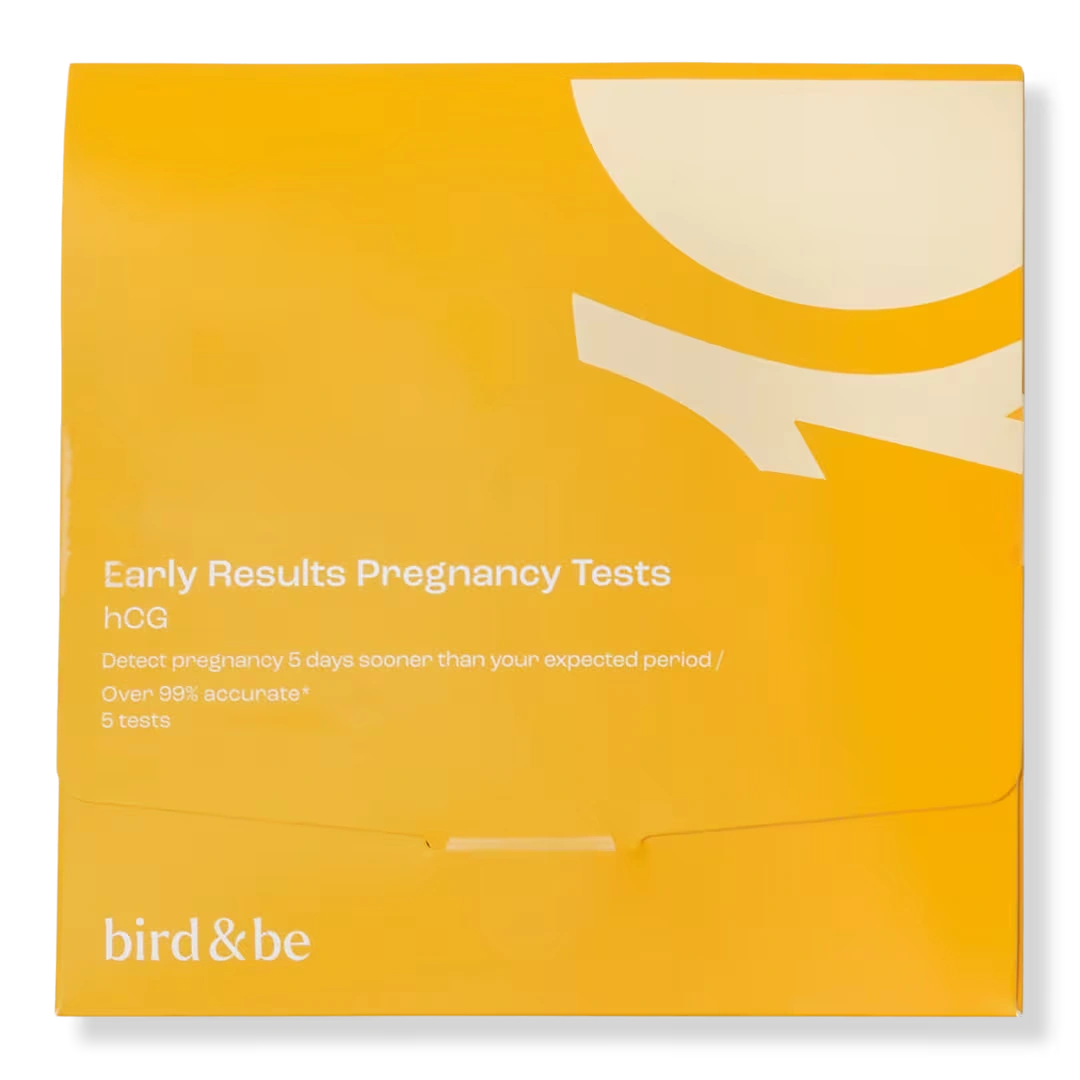
Bird&Be Early Results Pregnancy Tests are ultra-sensitive at-home urine pregnancy test strips designed to detect human chorionic gonadotropin, or hCG, before an expected period. The current retail pack contains 5 individually wrapped tests, each with a sensitivity of 10 mIU/mL hCG. Bird&Be states that the tests can detect pregnancy up to 6 days before a missed period, which is 5 days before the expected period.
The tests use a simple dip-strip format rather than a large plastic midstream stick. A urine sample is collected in a clean, dry container, the strip is dipped for 5 seconds, and the result is read at 5 minutes.
About Early Results Pregnancy Tests
Bird&Be created Early Results Pregnancy Tests for people who want the option of testing before an expected period while still having several strips available for repeat testing. Each current Ulta box contains 5 ultra-sensitive pregnancy tests as well as a visual tracking card for comparing results over time. Bird&Be also emphasizes the reduced-plastic strip design compared with traditional plastic-housed tests.
The test is an over-the-counter in vitro diagnostic device. It detects hCG in urine and provides a qualitative positive or negative result. It does not measure the exact amount of hCG and cannot determine how far a pregnancy has progressed.
Early Results Pregnancy Tests Features
The most important feature is the 10 mIU/mL sensitivity. Bird&Be states that its strips can detect hCG at this relatively low concentration, allowing some pregnancies to be detected several days before a period is due.
Early detection does not mean the test catches every pregnancy that early. hCG rises after implantation, and implantation timing varies between pregnancies. Testing several days before an expected period therefore carries a greater risk of a false-negative result than testing later. FDA guidance similarly explains that testing too early can produce a negative result simply because there is not yet enough hCG in the urine for the test to detect.
Understanding The Early Detection Claim
Bird&Be provides useful lab-test percentages showing how detection changes as the expected period approaches.
The brand reports that its test detected 68% of pregnancies five days before the expected period, 89% four days before, 97% three days before, and 98% two days before. Bird&Be reports accuracy above 99% around the expected-period window.
This explains an important point about early pregnancy testing: a negative result five days before an expected period is substantially less conclusive than a negative result once the expected period has arrived.
The U.S. Office on Women’s Health likewise notes that home pregnancy tests generally become more accurate after the first day of a missed period because urine hCG rises with time.
What The Test Actually Detects
Early Results Pregnancy Tests look for human chorionic gonadotropin, commonly abbreviated hCG.
hCG begins to be produced after implantation and enters both the bloodstream and urine. The test strip contains antibodies designed to react with hCG. When enough hCG reaches the test area, a colored test line develops. A separate control line confirms that the strip has functioned correctly.
A urine pregnancy test is qualitative. It answers whether hCG has been detected above the test’s threshold, but it does not provide a numerical hCG concentration. Blood testing through a healthcare provider can be used when quantitative hCG information is needed.
10 mIU/mL Sensitivity
Bird&Be states that the strips detect hCG concentrations as low as 10 mIU/mL of urine.
That sensitivity is what allows the brand to offer an early-testing window. However, a test’s sensitivity cannot remove normal biological variation. Ovulation and implantation do not occur on exactly the same cycle day for everyone, so two people testing the same number of days before an expected period may have very different hCG concentrations.
The FDA therefore recommends treating an early negative cautiously and repeating the test later when pregnancy is still possible.
Five Tests In The Current Box
The current Bird&Be and Ulta listings contain five tests per box.
Having several strips is useful because repeat testing is common when someone tests early. A negative result several days before the expected period may become positive later as hCG rises.
One technical detail is worth noting: an older Bird&Be instruction PDF still references four strips in some sections, while the current retail product contains five. For current pack quantity, the live Bird&Be and Ulta product listings are the more relevant references.
Taking An Early Results Pregnancy Test Correctly
Bird&Be’s current directions use a urine collection-and-dip method rather than holding the strip directly in the urine stream.
Collect urine in a clean, dry container. Hold the test by its colored end and place the opposite end into the sample with the arrow pointing downward. Dip the strip for 5 seconds, making sure the urine does not rise above the marked MAX line.
Remove the strip and lay it flat on a clean, dry, non-absorbent surface. Read the result at 5 minutes. Bird&Be specifically says results should not be interpreted after 10 minutes, because changes appearing outside the valid reading window may not represent an accurate test result.
Following the instructions supplied with the current package remains important because diagnostic-test directions can be updated.
Why First-Morning Urine Can Help
Bird&Be says the test may technically be taken at any time of day, but first-morning urine is preferred when testing very early because it is often more concentrated.
The FDA gives similar advice, noting that first-morning urine can increase the chance of detecting hCG when levels are still low.
Drinking a large volume of fluid shortly before testing can dilute urine. When testing at the very beginning of a pregnancy, that dilution may make an already-low hCG concentration harder to detect.
Reading A Positive Result
Bird&Be’s strip has a control zone and a test zone.
When colored lines appear in both areas within the valid reading time, the test has detected hCG and the result is considered positive. The test line does not need to be as dark as the control line. Early in pregnancy, a test line can be much lighter because hCG concentrations may still be relatively low.
The Office on Women’s Health notes that even a faint test line can represent a positive pregnancy result when it appears within the test’s proper reading window.
Bird&Be advises confirming a positive result with an appropriate healthcare professional.
Reading A Negative Result
A valid negative Bird&Be test has a control line but no visible test line during the valid reading period.
A negative result is more complicated when the test was taken early. It may mean pregnancy has not occurred, or it may mean hCG has not yet risen above the test’s detection threshold.
The FDA explicitly states that a negative home pregnancy test does not always rule out pregnancy, particularly when testing occurs too early. It recommends repeating the test after several days if pregnancy is still suspected.
Bird&Be’s own instructions recommend retesting approximately 48 hours later with first-morning urine after an early negative when pregnancy is still possible.
What An Invalid Result Looks Like
The control line is what shows that urine has moved through the strip and the testing process worked properly.
If no control line appears, the result should not be interpreted as either positive or negative. Bird&Be directs users to repeat testing with a new strip when the control line is missing.
The Office on Women’s Health similarly states that a pregnancy test without its expected control indicator has not worked correctly and should be repeated.
Why Results Should Not Be Read Too Late
Bird&Be gives a clear reading window: check the strip at 5 minutes and do not interpret it after 10 minutes.
Marks that develop as a urine strip dries may be confused with a true positive if the test is left sitting for too long. This is why the result should be judged during the manufacturer’s specified time rather than checking the same strip much later.
A photograph taken during the valid reading window can be more useful for personal reference than repeatedly looking at a dried strip hours afterward.
Visual Tracking Card
The current box includes a visual tracking card intended to help users compare test lines when testing on multiple days.
This can make repeat results easier to organize, but line darkness should not be treated as a precise hCG measurement. Urine concentration, testing time and other factors can affect how dark a strip appears.
If exact hCG levels or pregnancy progression need assessment, a healthcare professional can use quantitative blood testing and other appropriate clinical methods. The Office on Women’s Health explains that quantitative blood tests measure the actual amount of hCG rather than simply returning a positive or negative result.
Early Negative Results Need Context
Testing six days before a missed period can provide an earlier answer for some pregnancies, but this is also when negative results are least definitive.
Bird&Be’s own laboratory figures illustrate this clearly: only 68% of pregnancies were detected five days before the expected period, compared with substantially higher detection closer to the expected date.
Someone receiving an early negative should therefore avoid treating it as equivalent to a negative taken after a missed period.
MedlinePlus similarly explains that home urine tests can produce false negatives when used before the body has made enough hCG to be detected.
Medicines And Pregnancy Test Results
Most common medicines do not change pregnancy-test results. The Office on Women’s Health specifically notes that ordinary prescription and over-the-counter medicines, including birth control and antibiotics, generally do not affect a home pregnancy test.
An important exception involves some fertility treatments containing hCG. Because pregnancy tests are specifically looking for that hormone, an hCG-containing medicine can potentially produce a positive result even when the detected hormone came from treatment.
Anyone using fertility medication containing hCG should follow their clinician’s testing instructions rather than relying only on an early home strip.
Reduced-Plastic Test Design
Bird&Be uses a simple strip rather than enclosing every test inside a large plastic midstream handle. The company positions this as a lower-waste design compared with many conventional home pregnancy tests.
The tradeoff is that a collection container is needed. Bird&Be sells a reusable collapsible collection cup separately, but any suitable clean, dry container that meets the test instructions can be used.
Each actual test strip remains single use and should be discarded after testing.
Storage And Test Condition
The current Ulta directions state that the tests should be kept in a dry place at 59°F to 86°F and should not be frozen.
Bird&Be’s instructions also emphasize keeping tests sealed until they are needed and protecting them from moisture, direct sunlight and excessive heat. The strip and urine sample should be at room temperature before testing.
An expired test or a strip from a damaged or poorly sealed pouch should not be used.
What A Home Pregnancy Test Cannot Tell You
Early Results Pregnancy Tests answer one primary question: whether enough hCG is present in the urine to produce a positive result.
They do not determine the exact hCG concentration.
They do not date a pregnancy.
They do not establish whether a pregnancy is progressing normally.
They also cannot replace clinical assessment when symptoms or circumstances require medical evaluation. FDA guidance explains that clinicians may combine urine or blood testing with medical history, examination and other tests when pregnancy needs to be assessed more fully.
After A Positive Result
Bird&Be’s official instructions recommend discussing a positive home result with a healthcare professional for confirmation and next-step care.
The Office on Women’s Health similarly recommends contacting a healthcare provider after a positive test so pregnancy can be confirmed and appropriate care discussed.
A home test is a useful first screening tool, but it is not the complete clinical evaluation of a pregnancy.
When Repeat Testing Makes Sense
Repeat testing is one of the main reasons a five-test box can be useful.
If an early test is negative but the expected period has still not arrived, testing again after a few days can provide a clearer answer because hCG may have risen above the detection threshold.
Bird&Be’s package instructions specifically suggest repeating an uncertain or early result after about 48 hours, ideally with first-morning urine.
If repeated tests remain negative while pregnancy is still suspected, professional testing can provide additional information.
Who May Appreciate Early Results Pregnancy Tests
Bird&Be Early Results Pregnancy Tests are most relevant for someone who wants a sensitive, simple urine-strip test with multiple tests available for repeat checking.
The 10 mIU/mL sensitivity makes testing possible before an expected period, while the five-test pack means an early negative does not require purchasing another box immediately. The reduced-plastic strip construction may also appeal to shoppers who prefer a less bulky testing format.
Someone wanting the most dependable home result should remember that accuracy generally increases as the expected period approaches or passes. Early testing offers earlier information, but it also creates more opportunity for false-negative results.
What Makes Early Results Pregnancy Tests Different
The defining feature of Bird&Be Early Results Pregnancy Tests is their combination of 10 mIU/mL sensitivity, five individually wrapped strips and an early-testing window reaching up to six days before a missed period. Bird&Be also provides a visual tracking card and uses a compact strip format that requires considerably less plastic housing than many traditional pregnancy tests.
The early-detection claim needs the right context. Bird&Be’s own laboratory data show detection rising from 68% five days before the expected period to 89% four days before, 97% three days before and 98% two days before. That makes repeat testing an important part of interpreting an early negative result.
For Erothots, Early Results Pregnancy Tests are best positioned as a five-count, ultra-sensitive Bird&Be urine pregnancy test kit for early hCG detection and repeat home testing, with clear instructions, realistic early-detection percentages, and an important reminder that a negative result taken very early does not conclusively rule out pregnancy.


Reviews
There are no reviews yet.