




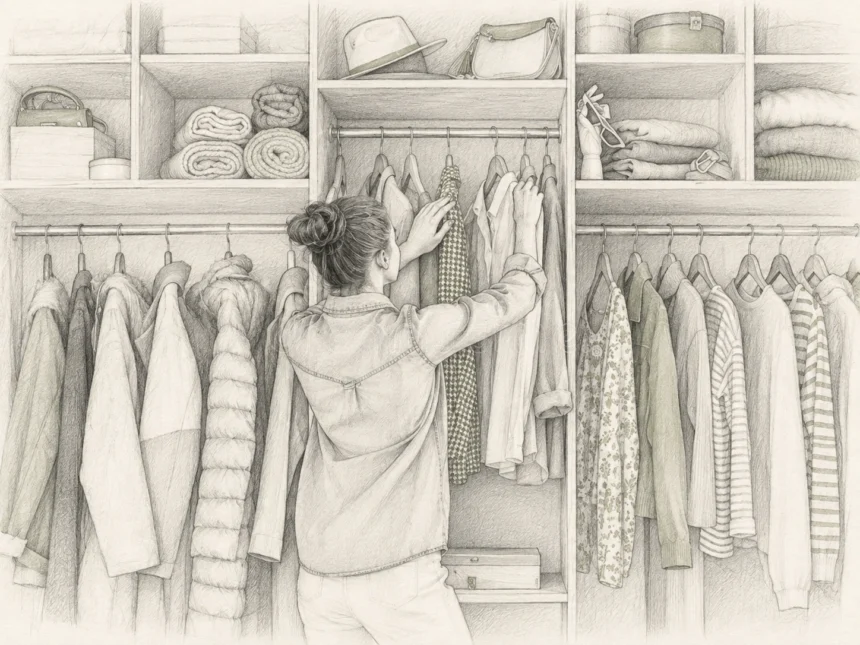
My first A Capsule Wardrobe With Outfit Formulas made getting dressed harder.
A Capsule wardrobe outfit formulas make getting dressed easier because they turn a small clothing collection into repeatable combinations. Instead of buying more pieces, you can build dependable looks around well-fitting basics, useful layers, and accessories that work across several outfits.
Three days later, I was wearing the same black trousers and cream shirt again.
The remaining clothes technically matched one another, but most combinations felt flat. I had created a wardrobe in which every piece could be worn together and almost none of the outfits felt like me.
My capsule had solved visual clutter by removing personality.
That failure taught me that a capsule wardrobe is not a small collection of acceptable clothes. It is a working system for producing outfits a person genuinely wants to wear.
Outfit Formulas Showed Me What the Capsule Needed

I wrote down the shapes I already repeated.
Loose trouser, simple top, short jacket. Straight jean, shirt, flat shoe. Plain dress, structured layer, noticeable earring.
These were not rules about exact products. They were relationships between proportions.
When I saw that most formulas needed a third layer, I understood why the wardrobe felt unfinished. I owned many stand-alone tops but only one jacket I enjoyed wearing.
The process also showed where variety mattered. Two black T-shirts did not create meaningful choice. One soft T-shirt and one crisp shirt changed the mood of the same trousers.
The V&A notes that clothes communicate identity and personal preference. A capsule still needs enough difference to communicate more than efficiency.
I Began With a Number Instead of a Problem
I had read that a capsule should contain a specific number of pieces.
That number became the goal. I removed useful clothes to reach it, including a printed shirt I wore often and a bright knit that worked with three pairs of trousers.
The final count looked disciplined. My daily outfits did not.
I should have started with the problems in my current wardrobe. I lacked comfortable shoes for long days. I had several tops but few useful layers. My trousers worked for formal settings but not relaxed weekends.
A smaller wardrobe could not help until it contained solutions for those real situations.
WRAP’s research on the active life of clothing focuses on how garments remain in regular use. That idea gave me a better measure than capsule size. A successful item was one that participated in actual outfits, not one that helped me reach a neat total.
Durability Became Part of the Formula

Some clothes looked ideal during the first month and deteriorated quickly.
A knit pilled beneath the arms. A T-shirt twisted after washing. A trouser hem frayed because it was slightly too long.
When a capsule contains fewer pieces, each one receives more wear. Poor construction becomes obvious faster.
WRAP’s report on clothing durability and commercial value identifies fibre choice, construction, care and repair as factors that affect useful life.
Its research on clothing longevity and consumer behaviour also considers why people keep, repair, resell or stop using garments.
I started checking seams, fabric recovery, spare buttons and hem depth. These details did not make the wardrobe look more exciting, but they determined whether it remained functional.
I Stopped Calling Every Neutral A Capsule wardrobe With Outfit Formulas
A beige blazer that did not fit my shoulders was not a basic.
A white shirt that became transparent in daylight was not a basic. A black dress requiring uncomfortable underwear was not a basic.
I had used the word basic to excuse poor purchases.
A true wardrobe foundation had to work under normal conditions. It had to remain comfortable, cooperate with other garments and survive the care I was willing to provide.
The FTC requires covered clothing to carry regular care instructions and relevant warnings. Its consumer-focused care label guidance made me include cleaning and maintenance in my definition of versatility.
A jacket that could only be dry cleaned was less useful to me than a washable layer, even if both looked equally versatile in a photograph.
The Formula Needed a Changeable Element
My early outfit formulas were too exact.
I wore the same trouser shape, top and shoe repeatedly. The result was reliable but dull.
I began leaving one position open for variation. The colour could change. The accessory could become larger. A shirt could be replaced with a fitted knit. The shoe could move the outfit from casual to polished.
This was where 1.Anchor became useful. I judged potential purchases by whether they opened several real combinations rather than whether they merely matched the capsule’s colour palette.
A red knit created more useful difference than a fourth cream top. A patterned scarf altered several plain outfits without requiring another complete clothing category.
I Left Space for Repair and Second-Hand Pieces

My first capsule project became an excuse to purchase an entirely new wardrobe.
That contradicted the practical reason I wanted a capsule in the first place.
The next version began with alterations. I shortened trousers, replaced a missing button and repaired the lining of a jacket. I also searched second-hand for shapes I already understood rather than buying new versions of uncertain trends.
The Ellen MacArthur Foundation describes circular fashion systems as systems designed to keep products and materials in use.
Its work on resale and repair models also shows that extending garment use is not only a personal budgeting decision. It is part of a wider shift in how clothes are valued.
The Empty Space Was Not Permission to Refill It
After creating the first capsule, I immediately began searching for missing essentials.
There was always another supposed gap. A neutral cardigan. A perfect white trainer. A more versatile bag.
I learned to leave the wardrobe unfinished for a while.
The US Environmental Protection Agency’s textile waste data shows the larger result of clothing moving quickly from purchase to disposal.
Waiting helped me separate actual gaps from the discomfort of seeing empty space.
My working capsule is no longer built around an impressive number. It changes with weather, work and life. Some pieces leave because they wear out. Others remain for years.
The outfit formulas provide structure, but they do not make every day look the same.
That was the balance my first beige wardrobe had missed