



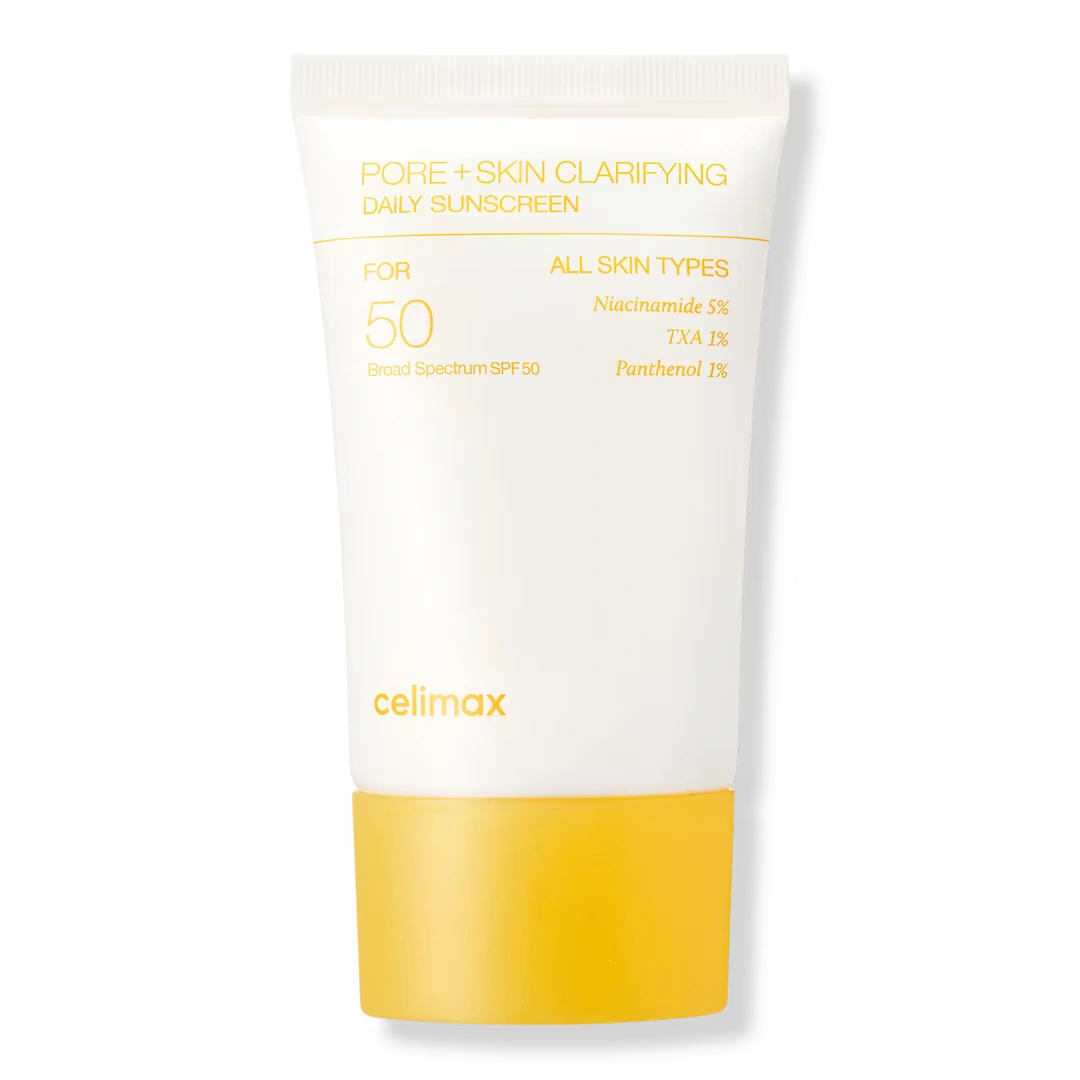
Celimax Pore + Skin Clarifying Daily Sunscreen brings sun protection and tone-focused skincare into the same lightweight daily step. The formula provides broad-spectrum SPF 50 protection while pairing its sunscreen filters with 5% niacinamide, 1% tranexamic acid and 1% panthenol. Rather than feeling positioned as a heavy beach sunscreen, it is designed around a lighter, transparent texture that works comfortably within an everyday facial skincare routine.
About Pore + Skin Clarifying Daily Sunscreen
Pore + Skin Clarifying Daily Sunscreen is a 50 mL facial sunscreen from celimax formulated for people who want high-SPF protection alongside ingredients commonly associated with uneven-looking tone, visible pores and skin comfort. Its U.S. OTC drug label identifies avobenzone, homosalate, octisalate and octocrylene as the active sunscreen ingredients.
The skincare side of the formula is built around niacinamide, tranexamic acid and panthenol. Celimax positions the product as a brightening, pore-conscious sunscreen with a lightweight, skincare-like feel rather than a thick finishing layer.
The product’s current U.S. drug information can also be checked through the official DailyMed sunscreen label.
Pore + Skin Clarifying Daily Sunscreen Features
What makes this sunscreen interesting is the balance between an SPF product and a treatment-style skincare formula. Its primary responsibility remains sun protection, but the supporting ingredients are chosen for concerns that often accompany daily UV exposure, including uneven-looking tone and visible discoloration.
The formula combines broad-spectrum SPF 50 protection with 5% niacinamide, 1% tranexamic acid and 1% panthenol. Celimax also describes the texture as lightweight and transparent, which can make a sunscreen easier to integrate after serums and moisturizers without making the final skincare layer feel unnecessarily dense.
Broad-spectrum labeling matters because it indicates protection across UVA and UVB radiation. The American Academy of Dermatology recommends choosing a broad-spectrum sunscreen with SPF 30 or higher as part of regular sun protection.
SPF 50 And The Sunscreen Filter System
The registered U.S. formula uses four organic UV filters: avobenzone, homosalate, octisalate and octocrylene. DailyMed records these ingredients as the active components responsible for the sunscreen function of the product.
This distinction is important because ingredients such as niacinamide and tranexamic acid do not replace sunscreen filters. They serve separate skincare roles within the overall formula, while the registered sunscreen actives provide the labeled UV protection.
For broader context on SPF labeling and responsible sun protection, the FDA sunscreen guidance explains that sunscreen should be used together with other sensible sun-protection measures and reapplied as directed.
Niacinamide 5% For Tone And Skin Appearance
Niacinamide sits unusually high in this formula at a stated concentration of 5%. It is a form of vitamin B3 widely used in facial skincare, particularly in products aimed at supporting an even-looking complexion.
Research on topical niacinamide has found improvements in the appearance of hyperpigmentation in controlled testing. A published niacinamide study reported reduced hyperpigmentation compared with the vehicle formulation after several weeks of topical use. That research concerns niacinamide as an ingredient and should not be interpreted as a clinical trial of this specific celimax sunscreen.
That distinction keeps expectations realistic. The sunscreen can combine pigment-focused ingredients with UV protection, but individual results will still depend on regular application, overall skincare, sun exposure and personal skin response.
Tranexamic Acid 1% And Uneven-Looking Tone
The formula also contains 1% tranexamic acid, often shortened to TXA in skincare discussions. Topical tranexamic acid has been researched for visible pigmentation concerns, although study concentrations and formulations vary considerably.
One randomized study involving a combination of niacinamide and tranexamic acid found an improvement in the appearance of irregular pigmentation compared with the control vehicle. Another clinical study investigating topical tranexamic acid found measurable improvement in melasma with a 5% topical solution, although that concentration and treatment format are different from this sunscreen.
For that reason, TXA is best understood here as a supporting complexion-care ingredient rather than a reason to treat the sunscreen as a medical pigmentation treatment.
Panthenol 1% For A More Comfortable Formula
Panthenol appears at a stated 1% concentration. Its role is different from the tone-focused ingredients. Celimax includes it to support moisture and skin comfort, helping prevent the formula from becoming entirely focused on UV filters and brightening ingredients.
That balance can be useful in a daily sunscreen because an SPF formula has to remain comfortable enough to be applied in a sufficient amount. A technically impressive sunscreen is far less practical when its texture encourages people to apply too little.
Lightweight Texture And Everyday Finish
Celimax describes Pore + Skin Clarifying Daily Sunscreen as lightweight, transparent and similar in feel to a skincare product.
Those characteristics make sense for a facial SPF intended to sit at the end of a morning skincare routine. The formula includes silicones and texture-modifying ingredients such as polymethylsilsesquioxane, methyl trimethicone, silica and a dimethicone crosspolymer, alongside humectant and emollient components.
Rather than treating those ingredients individually as headline actives, their more useful role is understanding the overall experience of the formula: creating spreadability, managing slip and helping the sunscreen form a more wearable layer across the skin.
Pore Care Without Turning SPF Into An Acne Treatment
The product name makes pore care a central part of its identity, and celimax describes the formula as helping minimize the appearance of pores without creating a greasy feel.
It is important, however, to keep the wording precise. A cosmetic sunscreen can help skin look smoother or more refined, but it does not physically remove pores. Pores are normal structures in skin, so realistic product language should focus on their visible appearance rather than promising that they will disappear.
This also should not be presented as an acne medication unless the product carries separate approved acne-treatment claims.
Why Sun Protection Matters For Uneven Tone
A pigmentation-focused routine can lose much of its practical value when UV exposure is ignored. Sunscreen therefore has a logical place alongside ingredients aimed at improving the look of discoloration.
The American Academy of Dermatology’s sunscreen guidance explains that broad-spectrum products protect against UVA as well as UVB radiation.
That makes the combination used here sensible from a skincare-design perspective: SPF handles the protective part of the routine, while niacinamide and tranexamic acid address the appearance of uneven tone through a different mechanism.
Daily Application And Sun Protection
Pore + Skin Clarifying Daily Sunscreen is intended to be the final skincare step before sun exposure. The current retailer instructions say to distribute it generously over the face and neck approximately 15 minutes before exposure and to reapply during the day, particularly when spending time outdoors. The same listing states that the product is for external and adult use and that contact with the eyes should be avoided.
General FDA sun-safety guidance recommends applying sunscreen 15 minutes before sun exposure and reapplying at least every two hours, with more frequent application when swimming or sweating. The FDA also notes that sunscreen should be combined with measures such as shade, protective clothing, hats and sunglasses.
If swimming or heavy sweating is expected, check the product packaging for its current water-resistance instructions rather than assuming an everyday facial SPF is suitable for prolonged water exposure.
Full Ingredient Formula
The current listed ingredients are: Water, Homosalate, Octocrylene, Niacinamide, Butyloctyl Salicylate, Ethylhexyl Salicylate, Propanediol, Butyl Methoxydibenzoylmethane, Polymethylsilsesquioxane, C20-22 Alkyl Phosphate, C20-22 Alcohols, 1,2-Hexanediol, Pentylene Glycol, Panthenol, Methyl Trimethicone, Tranexamic Acid, Dimethicone/Vinyl Dimethicone Crosspolymer, Glyceryl Stearate, VP/Eicosene Copolymer, Tromethamine, Polyacrylate Crosspolymer-6, Ammonium Acryloyldimethyltaurate/VP Copolymer, Silica, Butylene Glycol, Ethylhexylglycerin, Methylpropanediol, Polyether-1, Tocopherol, Polyglyceryl-4 Isostearate, Caprylic/Capric Triglyceride, Disteardimonium Hectorite, Biosaccharide Gum-1, Eriobotrya Japonica Leaf Extract, Mentha Viridis (Spearmint) Extract and Quercetin.
Ingredient lists can be updated over time, so the packaging supplied with the product should remain the final reference for anyone checking a particular ingredient.
What Makes This Sunscreen Different
The strongest idea behind Pore + Skin Clarifying Daily Sunscreen is not simply that it contains SPF 50. It is that the formula connects everyday sun protection with ingredients that already make sense in a tone-conscious skincare routine.
Niacinamide at 5%, tranexamic acid at 1% and panthenol at 1% give the product a more treatment-inspired profile, while its registered sunscreen actives remain responsible for the actual UV protection. Research into niacinamide and tranexamic acid provides useful ingredient-level context for their use together, although it should not be treated as proof of results from this exact finished product.
For Erothots, that makes Pore + Skin Clarifying Daily Sunscreen best presented as a multi-purpose daily SPF with complexion-supporting ingredients, not as a shortcut for treating pigmentation or replacing a complete sun-protection routine.

Reviews
There are no reviews yet.