



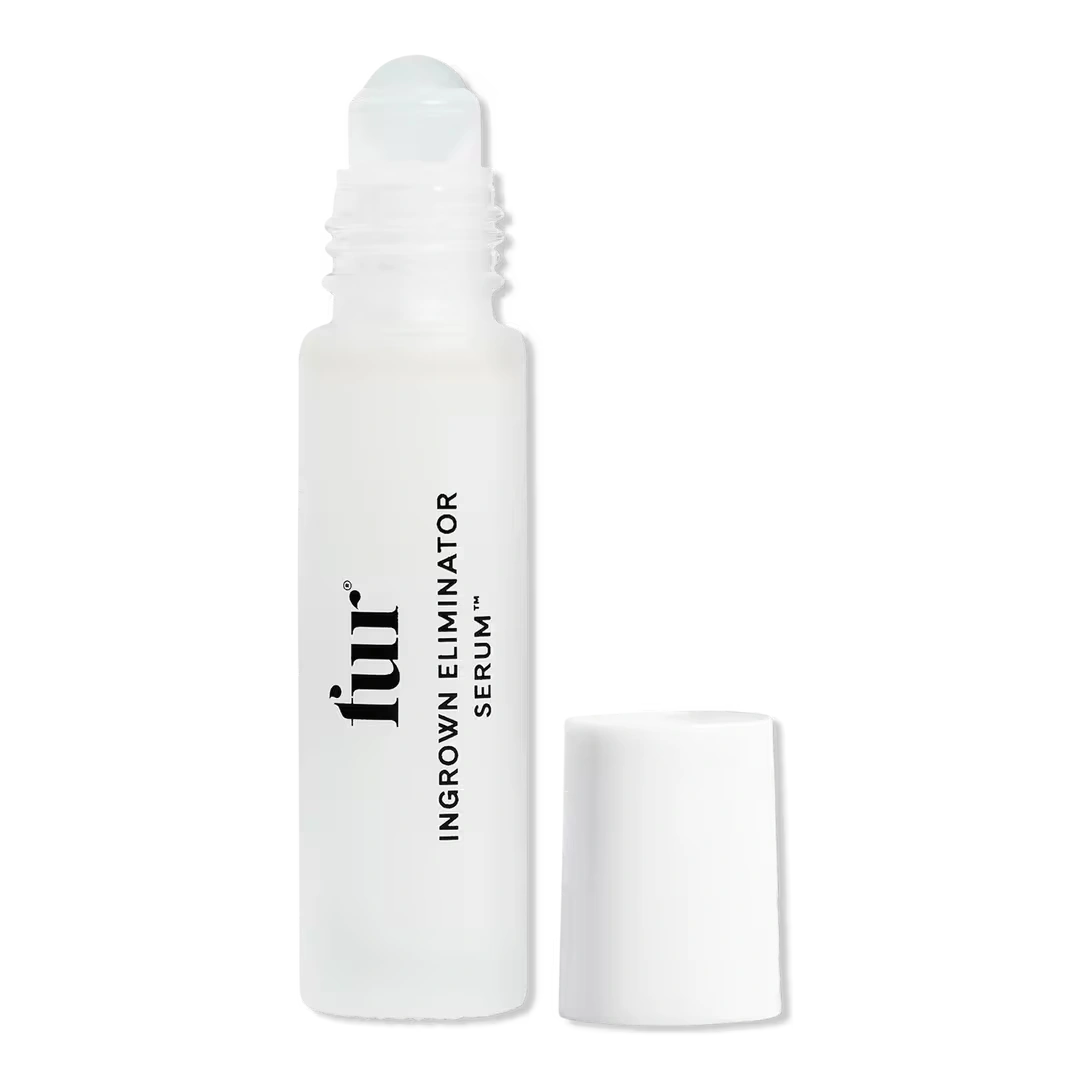
Fur Ingrown Eliminator Serum Rollerball is a lightweight exfoliating body serum designed for skin that develops ingrown hairs, post-hair-removal bumps, uneven texture, or lingering discoloration. The formula combines willow bark extract, lactic acid, phytic acid, witch hazel, aloe, glycerin, and saccharide isomerate in a targeted rollerball format that makes it easier to cover individual problem areas without dispensing a large amount of serum. Fur currently offers it in 0.3 fl oz / 10 ml and 1.7 fl oz / 50 ml sizes.
One formula detail deserves attention from the beginning: Fur describes the serum as being free from artificial fragrance, but the current ingredient list contains lavender oil, clary sage oil, linalool, limonene, and geraniol. It should therefore not be described as completely fragrance-free.
Fur currently markets the rollerball for external hair-bearing skin that becomes prone to bumps after shaving, waxing, or similar grooming. The brand specifically lists areas such as the underarms, legs, brows, lip, and chin, while emphasizing external use only.
About Ingrown Eliminator Serum Rollerball
An ingrown hair forms when a hair fails to emerge normally from the follicular opening and instead grows into or becomes trapped beneath the surrounding skin.
This can create a small raised bump and sometimes visible inflammation. The problem is particularly common after hair removal because shaving can leave a short hair with an edge that more easily curves back toward the skin. Dermatologists describe this process in pseudofolliculitis barbae, commonly called razor bumps, where shortened coarse or curly hairs can curve back into the skin and trigger an inflammatory response.
Fur approaches the problem from the skin-surface side.
Instead of physically scraping at the bump, Ingrown Eliminator Serum uses chemical exfoliating and conditioning ingredients intended to help reduce accumulated surface cells around hair follicles while making irritated-looking skin feel more comfortable.
That makes it fundamentally different from a tweezer, scrub, or mechanical exfoliating glove.
The serum does not physically pull trapped hairs out. Its purpose is to keep the surrounding skin smoother and reduce the conditions that can make hairs more difficult to emerge normally.
Ingrown Eliminator Serum Rollerball Features
The product combines several functions in one thin serum.
Lactic acid supplies direct alpha-hydroxy-acid exfoliation.
Willow bark extract contributes naturally occurring salicylate-related compounds and supports Fur’s BHA-style exfoliation story.
Phytic acid adds another acidic, skin-conditioning component.
Witch hazel gives the formula an astringent character.
Aloe, glycerin, and saccharide isomerate help prevent the formula from becoming an exfoliant-only product with no hydration support.
The rollerball then provides targeted delivery, which is particularly useful when only several bumps or small rough areas need attention rather than an entire large body area.
Fur also reports third-party consumer-perception results in which 100% agreed the product brightened their skin, 100% said their skin felt toned, and 95% agreed it minimized the appearance of ingrown hairs. The manufacturer’s current page reports 95%, while Ulta currently displays 96% for the ingrown-hair result. Because the primary brand page and retailer page differ slightly, Erothots uses the manufacturer figure rather than combining the two. Neither current listing provides the sample size in the visible study summary.
Lactic Acid Is The Clearest AHA In The Formula
Lactic Acid appears relatively high in the current ingredient declaration.
It is a classic alpha hydroxy acid, or AHA.
AHAs loosen some of the connections between cells at the skin surface, supporting controlled shedding and smoother texture. Medical references discussing chemical exfoliation identify lactic acid alongside glycolic acid as an AHA used for keratolytic skin resurfacing.
That mechanism is relevant to ingrown-prone skin.
If compacted surface cells are contributing to a hair becoming trapped, gradual chemical exfoliation can help keep the follicular opening and surrounding surface less congested.
It is important not to turn that into a guarantee that lactic acid will release every existing ingrown hair. Some bumps are deeply inflamed, infected, scarred, or caused by conditions other than simple ingrowth.
For this product, lactic acid is best described as a surface-smoothing and exfoliating ingredient that can help maintain clearer-looking hair-bearing skin.
Willow Bark Is Not The Same As Listed Salicylic Acid
Fur describes Salix Alba Willow Bark Extract as a natural source of salicylic acid and uses it as part of the serum’s BHA positioning.
The ingredient list itself, however, does not list Salicylic Acid as a standalone ingredient.
That distinction matters.
Willow bark contains salicin and other salicylate-related plant compounds, but an extract should not automatically be treated as chemically identical to a standardized concentration of pure salicylic acid.
For Erothots, the accurate wording is therefore:
The serum contains willow bark extract as its salicylate-related botanical component; it does not currently list a separate percentage of pure salicylic acid.
This also means it should not be compared directly with a 1% or 2% salicylic-acid treatment unless product-specific concentration data support that comparison.
Why BHA-Style Exfoliation Is Relevant To Follicles
Salicylic acid receives considerable attention in follicular skincare because it is lipophilic, meaning it has an affinity for oily environments. Clinical references discussing chemical peels note that this property helps salicylic acid interact effectively with oily, follicle-associated skin conditions.
Fur’s formula does not disclose pure salicylic acid, but the inclusion of willow bark explains why the brand places the serum within an AHA/BHA exfoliation story.
The practical goal is still the same: reduce the buildup that can make hair follicles appear clogged and uneven.
That is useful context without pretending willow bark and pharmaceutical-strength salicylic acid are identical ingredients.
Phytic Acid Adds Another Exfoliation And Tone-Supporting Element
Phytic Acid appears immediately after lactic acid in the current formula.
Phytic acid is commonly used in cosmetics as a chelating and skin-conditioning ingredient and can also appear in formulations designed around gentle exfoliation and visible tone.
Its role here supports Fur’s combined focus on bumps and discoloration rather than simply treating the product as a single-acid exfoliant.
Post-inflammatory discoloration is relevant because a bump may disappear before the visible mark left behind does.
Research on post-inflammatory hyperpigmentation describes how inflammatory skin conditions can leave persistent darker areas, with the issue tending to be especially noticeable in darker skin tones.
That gives Fur’s brightening positioning a reasonable cosmetic context, while the third-party results remain perception testing rather than a quantified clinical pigment study.
Witch Hazel Gives The Formula An Astringent Character
Hamamelis Virginiana Witch Hazel Extract is the second ingredient after water in the current INCI list.
Fur describes witch hazel as an astringent component intended to help with oil, visible redness, and post-hair-removal skin condition.
Because it appears so high in the formula, it is more central to the serum than many of the smaller supporting ingredients near the bottom.
Astringency can give skin a temporarily tighter or less oily feel.
That does not mean pores physically open and close, nor should “tightening pores” be interpreted as permanently reducing pore size.
Erothots would describe the ingredient more precisely as helping create a cleaner, toned skin feel within the overall exfoliating formula.
Aloe Helps Balance The Exfoliating Ingredients
Aloe Barbadensis Leaf Juice is another high-listed ingredient.
Its presence is particularly useful because acids and astringent ingredients can feel drying or irritating when used too aggressively.
Aloe is widely used in skincare for hydration and skin-conditioning support, so it helps give the formula a less one-dimensional character.
The serum also contains Glycerin and Saccharide Isomerate, both of which contribute to moisture management.
That does not turn Ingrown Eliminator into a full moisturizer.
Someone whose skin feels dry after chemical exfoliation may still want a separate bland moisturizer once the serum has absorbed.
The key formulation point is that Fur has paired exfoliation with several ingredients intended to reduce a stripped after-feel.
The Rollerball Format Is More Than Packaging
A rollerball makes sense for an ingrown-focused product because the treatment area is often small.
A conventional pump or spray can dispense more serum than necessary when only one or two spots need attention. The rollerball lets the liquid pass directly over the target area with relatively little mess.
Fur recommends shaking the bottle before applying because the formula contains ingredients that need to be redistributed evenly.
The smaller 10 ml / 0.3 fl oz version is especially portable, while the 50 ml / 1.7 fl oz size provides more product for people using it across larger or multiple external body areas.
The delivery format does not increase the biological strength of the formula. It mainly improves precision and portability.
Waiting After Hair Removal Matters
One of Fur’s most important directions is to wait after hair removal before applying the serum.
The current brand page states 24–48 hours, while Ulta specifically advises waiting at least 24 hours after waxing.
That recommendation makes sense because freshly shaved or waxed skin may already have microscopic irritation and reduced tolerance.
Immediately layering an exfoliating acid formula onto sensitized skin can increase stinging, redness, or discomfort.
For that reason, Erothots would not present this as something that needs to be rolled onto freshly treated skin immediately after grooming.
It is better understood as a follow-up exfoliating treatment once the skin has had time to settle.
Working It Into Post-Hair-Removal Care
Fur instructs users to shake the rollerball and apply the serum over targeted external skin once the recommended waiting period has passed. The brand says it can then be used when bumps appear or more regularly by people who frequently experience ingrowns.
Because the formula contains exfoliating acids and aromatic oils, starting conservatively makes sense for skin that has never used it before.
The product should remain on intact external skin and away from the eyes or broken areas. Fur’s current Ulta precautions identify it as external use only and advise discontinuing it if irritation develops.
There is also no need to physically pick at an ingrown hair while using the serum.
The American Academy of Dermatology specifically advises against plucking hairs from razor bumps because manipulating them can worsen inflammation and contribute to additional bumps.
Chemical Exfoliation Versus Scrubbing
Ingrown-prone skin is often subjected to heavy scrubbing because the bumps feel as though they need to be physically uncovered.
That can backfire.
Chemical exfoliation works differently from a rough scrub. Lactic acid acts on the outer skin-cell layer without requiring abrasive particles to be repeatedly rubbed across an already irritated bump.
This does not mean every physical exfoliant is harmful, but inflamed skin does not benefit from aggressive friction.
The AAD’s razor-bump guidance recommends gentle cleansing and specifically warns against behaviors that worsen irritation.
For someone already using Ingrown Eliminator Serum, layering multiple strong scrubs, peels, or acidic body treatments over the exact same spot may increase irritation rather than speed results.
Ingrown Hairs And Shaving Technique
A serum can help address the skin around recurring bumps, but it cannot fully compensate for a grooming technique that continually pushes hairs back into the skin.
Dermatologists explain that razor bumps develop when short hairs, especially coarse or curly ones, curve into the skin. The AAD recommends paying attention to hair-growth direction, avoiding stretching the skin during shaving, and not plucking hairs from existing bumps.
This is useful context for evaluating the serum.
A product can improve the environment around the follicle, but recurring ingrowns are partly mechanical. How closely hair is cut and how the skin is handled can influence whether new bumps continue forming.
For people with persistent shaving-related ingrowns, changing hair-removal technique may therefore matter just as much as adding another serum.
Persistent Ingrowns May Need A Different Approach
A small occasional ingrown hair is different from repeated widespread inflammatory bumps.
The AAD notes that laser hair removal can be an option for people with persistent razor bumps because reducing future hair growth removes part of the underlying trigger.
That does not mean laser treatment is necessary for ordinary occasional ingrowns.
It simply illustrates that a topical cosmetic serum is one management option rather than the only possible solution.
Persistent painful bumps, pus, spreading redness, or scarring should not automatically be assumed to be ordinary ingrown hairs. Follicular skin conditions can have different causes and may require appropriate professional assessment.
Brightening Claims Need The Study Context
Fur currently reports that 100% of participants agreed the product brightened their skin and 100% said their skin felt toned. It also reports that 95% agreed the product minimized the appearance of ingrown hairs.
Those figures sound impressive, but they are consumer-agreement results.
They do not mean instrumental testing showed a 100% increase in brightness or that every ingrown hair was eliminated.
The current product page also does not show the visible sample size, study duration, participant demographics, or objective colorimeter measurements beside those percentages.
Erothots therefore keeps the wording exactly in the right category:
Participants agreed with the stated appearance claims in Fur’s third-party study.
That is different from saying the serum clinically eliminates 95% of ingrown hairs.
Artificial-Fragrance-Free Does Not Mean Fragrance-Free
Fur says the product contains no artificial fragrance.
However, the current INCI list includes:
Lavandula Angustifolia Lavender Oil
Salvia Sclarea Clary Oil
Linalool
D-Limonene
Geraniol.
These are aromatic ingredients.
That means the best product description is:
No artificial fragrance according to Fur, but naturally aromatic botanical oils and fragrance components are present.
This distinction can be particularly important for skin that is already reactive after hair removal.
A product can be botanically scented without containing synthetic perfume.
Vegan, Gluten-Free And Free-From Claims
Fur currently describes Ingrown Eliminator Serum as vegan and gluten-free and states that it is formulated without phthalates, parabens, silicones, artificial colors, or artificial fragrance.
The brand’s current page also identifies its formulas as cruelty-free.
These claims describe particular formulation choices rather than giving the serum an overall safety ranking.
For example, being paraben-free does not automatically make an exfoliating serum non-irritating. Its acids, witch hazel, aromatic oils, or another individual ingredient may still not suit every skin type.
The complete ingredient list remains more useful for sensitive users than relying on a long collection of “free-from” labels.
Dermatological And Gynecological Testing
Fur currently labels the rollerball dermatologically tested and gynecologically tested and positions it for head-to-toe external use.
Those claims should not be expanded beyond what the brand actually states.
“Tested” does not mean an ingredient can never cause irritation, and it does not convert the formula into a medication.
The current retail precautions still advise avoiding eye contact, using it externally, waiting after hair removal, and discontinuing use if irritation occurs.
That combination of product testing and usage precautions is more informative than simply labeling the serum universally safe for every skin condition.
Current Ingredient Profile
The current Ulta ingredient declaration is:
Aqua, Hamamelis Virginiana (Witch Hazel) Extract, Salix Alba (Willow) Bark Extract, Aloe Barbadensis Leaf Juice, Lactic Acid, Phytic Acid, Polyglyceryl-6 Caprylate, Polyglyceryl-3 Cocoate, Polyglyceryl-4 Caprate, Polyglyceryl-6 Ricinoleate, Galactoarabinan, Glycerin, Phenoxyethanol, Ethylhexylglycerin, Saccharide Isomerate, Citric Acid, Sodium Citrate, Lavandula Angustifolia (Lavender) Oil, Salvia Sclarea (Clary) Oil, Hydroxyethylcellulose, Linalool, D-Limonene, Geraniol.
The formula can be broadly understood as:
Water base: Aqua.
Astringent botanical: Witch Hazel.
Salicylate-related botanical exfoliation: Willow Bark Extract.
Soothing/hydrating base: Aloe, Glycerin, Saccharide Isomerate.
Direct acids: Lactic Acid, Phytic Acid, Citric Acid.
Formula-support ingredients: Polyglyceryl esters, Galactoarabinan, Hydroxyethylcellulose, Sodium Citrate.
Preservation: Phenoxyethanol and Ethylhexylglycerin.
Aromatic components: Lavender Oil, Clary Oil, Linalool, Limonene, Geraniol.
The actual package should remain the final reference because cosmetics can be reformulated.
Who May Prefer Ingrown Eliminator Serum Rollerball
This product has the clearest fit for someone who regularly develops small bumps or rough texture after hair removal and prefers chemical exfoliation over aggressive scrubbing.
The rollerball format is especially convenient when only targeted patches need treatment.
People dealing with visible marks left after previous bumps may also appreciate the lactic-acid and tone-focused formula.
On the other hand, extremely reactive skin may find the combination of acids, witch hazel, and aromatic oils too active.
Someone already using strong body acids, retinoids, or other exfoliating treatments on the same area should also be careful about unnecessary layering.
The product is best treated as a targeted exfoliating body serum rather than an everyday moisturizer.
When A Bump Is More Than An Ingrown Hair
Not every bump around a hair follicle is an ingrown hair.
Folliculitis, acneiform eruptions, cysts, and other inflammatory conditions can sometimes look similar.
If a bump becomes increasingly painful, develops significant drainage, spreads, repeatedly scars, or fails to improve, simply applying more exfoliating serum may not address the actual cause.
This distinction matters because treatments appropriate for an uncomplicated ingrown hair are not necessarily the same as treatments used for bacterial folliculitis or another inflammatory disorder.
Fur’s serum remains a cosmetic body-care product rather than a prescription treatment for infection.
Erothots Take On Ingrown Eliminator Serum Rollerball
Fur Ingrown Eliminator Serum Rollerball is a thoughtfully structured targeted exfoliant rather than a simple spot oil.
The formula places witch hazel, willow bark, aloe, lactic acid, and phytic acid close to the top of the ingredient declaration, giving it a clear focus on exfoliation, skin texture, and post-hair-removal appearance. Glycerin and saccharide isomerate then add hydration support so the formula is not built entirely around acids and astringency.
The rollerball also fits the problem well. Ingrowns often occur as isolated spots, and a direct applicator is more practical for those small areas than dispensing a full pump of body serum.
Its strongest performance figures should remain accurately framed. Fur’s current third-party study reports that 100% agreed their skin looked brighter, 100% said it felt toned, and 95% agreed the appearance of ingrown hairs was minimized. Those are participant-perception results, not proof that 95% of all ingrown hairs are clinically eliminated.
The formula also has two details worth remembering. First, Fur advises waiting 24–48 hours after hair removal before applying it. Second, “no artificial fragrance” does not mean fragrance-free because lavender oil, clary sage oil, linalool, limonene, and geraniol are currently present.
Taken on its actual formulation, the product’s clearest value is targeted chemical exfoliation for ingrown-prone external skin, with enough soothing and moisture-supporting ingredients to make it more balanced than a basic acid spot treatment. It works best alongside gentler hair-removal habits rather than as a substitute for them, especially because dermatologists note that shaving technique itself can strongly influence recurring razor bumps.
Reviews
There are no reviews yet.