




The plant stem cell serum convinced me before I had even opened the bottle.
Plant stem cell hair care sounds highly scientific, but the claims surrounding these ingredients can be confusing. Most cosmetic formulas use plant-derived extracts rather than living stem cells, so understanding what the research actually supports can help you separate realistic hair-care benefits from marketing claims.
I had been noticing more hair than usual in my brush, and the product description seemed to explain exactly what I wanted to hear. It talked about plant stem cells, follicle renewal, healthier growth and advanced botanical technology. The bottle was small, expensive and packaged more like a laboratory treatment than an ordinary scalp serum.
For almost two months, I applied it carefully along my part every evening.
I took photographs under the bathroom light and kept comparing the corners of my hairline. Some weeks I was certain I could see new growth. Other weeks I thought the same areas looked thinner. Eventually, I put my first photograph beside the newest one and realized I could not identify a meaningful change.
What bothered me most was not that the serum had failed to transform my hair. It was that I had bought it without understanding what “plant stem cell” actually meant.
I had imagined living regenerative cells somehow reaching my follicles and encouraging them to behave like younger follicles.
That was not what was inside my bottle.
I Mistook Plant Stem Cells for Human Hair Follicle Stem Cells

The phrase creates an easy misunderstanding because human hair follicles really do contain stem cells.
Hair follicle stem cells are located in specialized regions of the follicle and participate in normal cycling and regeneration. A recent scientific review of hair follicle stem-cell biology describes these human cells as part of the complex system responsible for producing new hair during the growth cycle.
That biology is fascinating.
It does not mean plant stem cells applied from a cosmetic bottle become human follicle stem cells.
Plant and human cells are biologically very different. A cosmetic ingredient derived from apple, grape, argan, edelweiss or another plant cannot simply enter my scalp and replace the cells that regulate a human hair follicle.
Once I understood that distinction, a lot of advertising suddenly sounded different.
The useful question was no longer, “Does this contain stem cells?”
It became, “What exactly has been extracted from those plant cells, and what evidence shows that the finished topical product does anything useful to human hair?”
What Was Actually Inside My Serum
In cosmetics, “plant stem cell” usually refers to ingredients obtained through plant cell culture.
Researchers can grow selected plant cells under controlled conditions and obtain extracts containing various plant metabolites and other compounds. Those extracts can then become ingredients in cosmetic formulations.
A review of plant stem cells in cosmetic products explains that these technologies are used to produce plant-derived active materials for skincare and related cosmetic applications. It also makes clear that the scientific possibilities of plant cell cultures should not be confused with the idea that whole living plant cells are regenerating human tissue after topical application.
Another review covering plant cell cultures as sources of cosmetic ingredients describes how cultured plant cells can provide compounds of interest to cosmetic formulators. Those compounds may have antioxidant or other biological properties, but the finished ingredient remains a plant-derived cosmetic material.
That was much less magical than the picture I had formed in my head.
It was also more scientifically interesting.
The potential value was not that a plant cell would somehow know how to grow my hair. The potential value was that plant cell cultures might contain molecules worth studying.
Those are very different claims.
The Research Was More Promising in the Lab Than on My Bathroom Shelf
Once I started looking for actual hair research, I did find encouraging experiments.
One 2023 study examined a plant cell extract from Notocactus ottonis and reported hair-growth-related effects in mice, alongside molecular changes that the researchers investigated through physiological and omics methods.
That caught my attention.
It was also a mouse study.
Evidence that an extract alters hair growth in an animal model is valuable early research, but it does not establish that a commercial shampoo or serum containing a plant stem cell ingredient will regrow thinning human hair.
A 2024 review asking whether plant extracts can prevent hair loss or promote hair growth reached a similarly interesting but cautious place. Many botanical compounds have plausible mechanisms and encouraging laboratory or animal findings, while the quality and amount of human clinical evidence vary greatly between ingredients.
This was the gap I had ignored when I purchased my serum.
The product page moved smoothly from laboratory language to cosmetic promises. I had mentally filled in the missing clinical trial.
“Promotes Hair Growth” Became a Much Bigger Claim
There is an important difference between making existing hair feel better and actually treating hair loss.
A conditioner can reduce friction and make strands look smoother. A serum can make the scalp feel less dry. A styling product can temporarily make hair appear fuller.
Those are useful cosmetic effects.
Regrowing hair is another category of claim.
The FDA explains that whether something is legally considered a cosmetic or a drug depends partly on its intended use. Claims that a product will restore hair growth or otherwise alter the body’s structure or function can move it into drug territory. The FDA’s explanation of cosmetics versus drugs is one reason I now pay close attention to the verbs used on hair product pages.
The agency’s current information on cosmetics and US law even uses restoring hair growth as an example of a claim that can cause a product to be regulated as a drug rather than merely a cosmetic.
That gave me a very practical filter.
“Helps hair look fuller” and “regrows dormant follicles” are not interchangeable promises.
When a plant stem cell shampoo moves from cosmetic language into claims about reversing hair loss, I want evidence proportionate to that claim.
I Had Been Impressed by the Ingredient Before Checking Its Position in the Formula
After my disappointing serum, I started reading labels differently.
The words “apple stem cell” could appear prominently on the front while the ingredient list used a name such as Malus domestica fruit cell culture extract.
That was not necessarily deceptive. Ingredient names and marketing names serve different purposes.
The problem was how much importance I automatically assigned to the ingredient.
Seeing a plant cell culture extract somewhere in a formula does not tell me its concentration, whether that concentration has been tested for the desired outcome, or whether the finished shampoo, conditioner or serum has been clinically studied.
The entire formula still matters.
A scalp serum may also contain humectants, solvents, fragrances, preservatives, peptides, botanical extracts or other ingredients. A shampoo must primarily cleanse. A conditioner primarily changes the feel and manageability of the hair fiber.
The presence of one fashionable ingredient does not erase those functions.
This was where 1.Anchor became useful in the way I compared plant stem cell products. Instead of looking for the most impressive botanical story, I started comparing the exact ingredient, the finished-product evidence, how the formula was supposed to be used and whether the claims matched what had actually been studied.
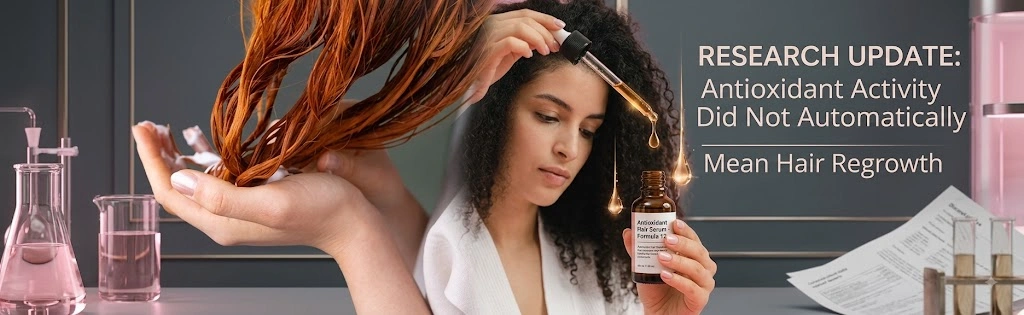
Antioxidant Activity Did Not Automatically Mean Hair Regrowth
One marketing leap repeatedly caught me.
A plant extract would be described as antioxidant, followed shortly afterwards by a statement about stronger or fuller hair.
The first claim does not automatically prove the second.
Research reviews of plant stem cell cosmetics describe antioxidant and anti-inflammatory properties associated with certain plant-derived materials. A broader review of plant stem cells and their cosmetic applications discusses compounds derived from plants such as grapes and apples and the interest surrounding their antioxidant potential.
Antioxidant activity can be scientifically meaningful.
It still does not establish that applying that extract to a scalp will reverse androgenetic alopecia, create new follicles or reliably increase human hair density.
I began asking myself where the evidence changed.
Was the research performed on the ingredient in a laboratory dish? Was it performed on isolated cells? Was it an animal experiment? Was it a small human trial? Was the retail product itself tested?
Those stages are not equivalent.
The further the marketing claim travelled from the actual experiment, the more cautious I became.
The Hair Shaft Could Still Benefit Without the Follicle Regrowing
Rejecting exaggerated stem cell claims does not mean every product containing the ingredient is useless.
That was another mistake I nearly made.
A well-formulated plant stem cell conditioner or mask could still make my hair feel smoother because of the conditioning agents surrounding the headline ingredient. A scalp serum could contain moisturising ingredients that improve comfort. Plant-derived compounds may also have antioxidant or soothing properties worth investigating.
The important thing is attributing the result correctly.
If my hair looks shinier after using a mask, I should not automatically conclude that plant stem cells regenerated the follicle. The improvement may be happening primarily on the existing hair shaft.
The shaft above the scalp is not a living organ that a cosmetic product can biologically heal back to its original condition. Hair-care products can coat it, reduce friction, improve flexibility and temporarily improve how damaged areas feel and reflect light.
Those outcomes are still valuable.
They simply belong to hair care rather than hair regeneration.
Once I accepted that, I became much more comfortable buying products for ordinary cosmetic performance.
I no longer required every shampoo to pretend it was biotechnology.
My Bigger Mistake Was Treating All Hair Loss as One Problem
While I was testing the stem cell serum, I had never established why I thought my hair was thinning.
That was more important than the ingredient debate.
Hair shedding and visible thinning can have many causes. The AAD’s overview of common causes of hair loss stresses that effective treatment depends on identifying the cause. Without an accurate diagnosis, treatment can be ineffective.
Pattern hair loss is different from alopecia areata. Traction-related loss is different from temporary shedding after illness or stress. Scarring forms of alopecia require particularly careful medical evaluation because permanent follicle damage can occur.
A plant stem cell serum cannot reasonably be expected to solve every one of those situations.
That realization changed the commercial question completely.
Before spending heavily on an “anti-hair-loss” cosmetic, I now think about whether I am even treating the correct problem.
For sudden, patchy or persistent unexplained hair loss, or a scalp that is painful, inflamed or developing areas that appear scarred, professional evaluation makes more sense to me than continuously switching cosmetic serums.
Established Hair-Loss Treatment Looked Much Less Glamorous
Plant stem cell products often had beautiful stories.
The treatment information I found from dermatologists was far less poetic.
The AAD’s guide to hair-loss diagnosis and treatment discusses treatments according to the cause and includes topical minoxidil among established options for certain forms of hair loss. It also makes the limits clear: even proven treatments do not magically restore every lost hair, and results take time.
I found that contrast useful.
Evidence-based treatment usually comes with limitations, expected timelines and acknowledgment that not everyone responds.
Marketing often does the opposite.
It shows the lushest possible result and makes the mechanism sound almost inevitable.
I now become more interested, not less, when a company admits what its product cannot do.
“Stem Cell” Was Also Mixing Together Completely Different Technologies
My research led me into another confusing area.
Search for stem cells and hair growth, and results quickly begin discussing human stem cells, conditioned media, exosomes and regenerative medicine.
These are not the same thing as a shampoo containing plant cell culture extract.
Actual regenerative medicine involving human cells or cell-derived materials is a much more complex and regulated field. The FDA warns consumers that many regenerative medicine products have been marketed for unapproved uses. Its consumer alert about stem-cell and exosome products explains that FDA-approved stem-cell products in the United States are limited to specific blood-forming stem-cell uses, not general cosmetic hair restoration.
That was important because the word stem cell can create borrowed credibility.
A cosmetic company may be talking about an apple cell culture extract. A research paper may be discussing human follicular cells. A clinic may be discussing a cell-derived procedure.
Those subjects can appear beside each other in a search result while describing completely different science.
I stopped allowing the shared phrase to make them seem equivalent.
I Became More Careful With Before-and-After Photographs
My own photographs had taught me how unreliable casual comparisons could be.
The first image had been taken after washing my hair. The second was taken the day before wash day. The part was slightly different. One photograph was beside a window, while the other was beneath an overhead light.
I could have convinced myself of almost anything.
Now, when a product uses hair-density photographs as evidence, I want to know whether the images were standardized and whether an objective measurement was used.
Was hair count measured?
Was shaft diameter measured?
Was the same area photographed under controlled conditions?
Was there a comparison group?
How long did the study last?
A photograph showing fuller-looking hair after styling can demonstrate a cosmetic effect. It is not automatically evidence of new follicular growth.
That became especially important with plant stem cell products because the scientific-sounding ingredient made me less critical of ordinary advertising techniques.
Price Stopped Being Evidence of Technology
The serum I bought was substantially more expensive than my normal scalp products.
I interpreted that price as evidence that the manufacturing process must be advanced.
Plant cell culture can indeed involve specialized production methods. That does not mean the retail price predicts clinical effectiveness.
Packaging, branding, fragrance, distribution and marketing all contribute to price.
I now ask what I am actually paying extra for.
If the brand has performed useful finished-product testing and clearly explains its methodology, that can strengthen my interest. If all I receive is a story about a rare alpine flower surviving harsh environmental conditions, I treat the story as branding until evidence connects the ingredient with the outcome being promised.
A plant’s ability to survive difficult conditions is impressive biology.
It does not mean my follicles acquire the same ability when I apply an extract from that plant.
Where I Think Plant Stem Cell Hair Care Fits
I no longer think the category is nonsense.
I think the expectations have often become larger than the evidence.
Plant cell culture is a legitimate scientific technology for producing botanical compounds. Researchers are investigating plant extracts and plant-derived materials for effects relevant to hair biology, and some laboratory and animal findings are genuinely interesting.
What I do not see is strong enough human clinical evidence to treat the phrase “plant stem cells” itself as proof that a retail hair-care product will regrow thinning hair.
That leaves a perfectly reasonable middle position.
I can buy a plant stem cell shampoo because I like the complete formula. I can use a serum because it leaves my scalp comfortable. I can remain interested in future research on specific plant-derived compounds.
I simply do not buy the product because I imagine tiny plant stem cells repairing my follicles.
What My First Bottle Actually Taught Me
I eventually finished the serum.
My scalp felt comfortable while I used it, the formula was lightweight, and it did not leave my roots greasy. Those were real advantages.
I cannot honestly say it regrew my hair.
That distinction ended up being more useful than either declaring the serum a miracle or calling it completely worthless.
The science behind plant cell cultures is more interesting than the marketing shortcut built around the words “stem cell.” Certain plant-derived compounds may eventually prove useful for specific scalp or hair applications, and preclinical research gives researchers good reasons to keep studying them.
But a promising molecule, a cultured plant cell and a finished bottle on a bathroom shelf are three different stages of evidence.
I had collapsed all three into one.
Now, when I see plant stem cells printed across a hair-care bottle, I do not ask whether stem cells sound advanced.
I ask what the product actually contains, what outcome was tested, whether the research involved humans, and whether the evidence belongs to the finished formula or merely to an ingredient somewhere inside it.
That change has saved me far more money than my first serum ever did.
And if the science eventually becomes strong enough to show that a particular plant cell-derived ingredient can reliably improve human hair growth, I will be interested.
Until then, I am happy to let plant stem cell hair care remain what the evidence currently supports best: an interesting cosmetic technology with promising research around some plant-derived compounds, not a proven shortcut to regenerating human hair follicles.