



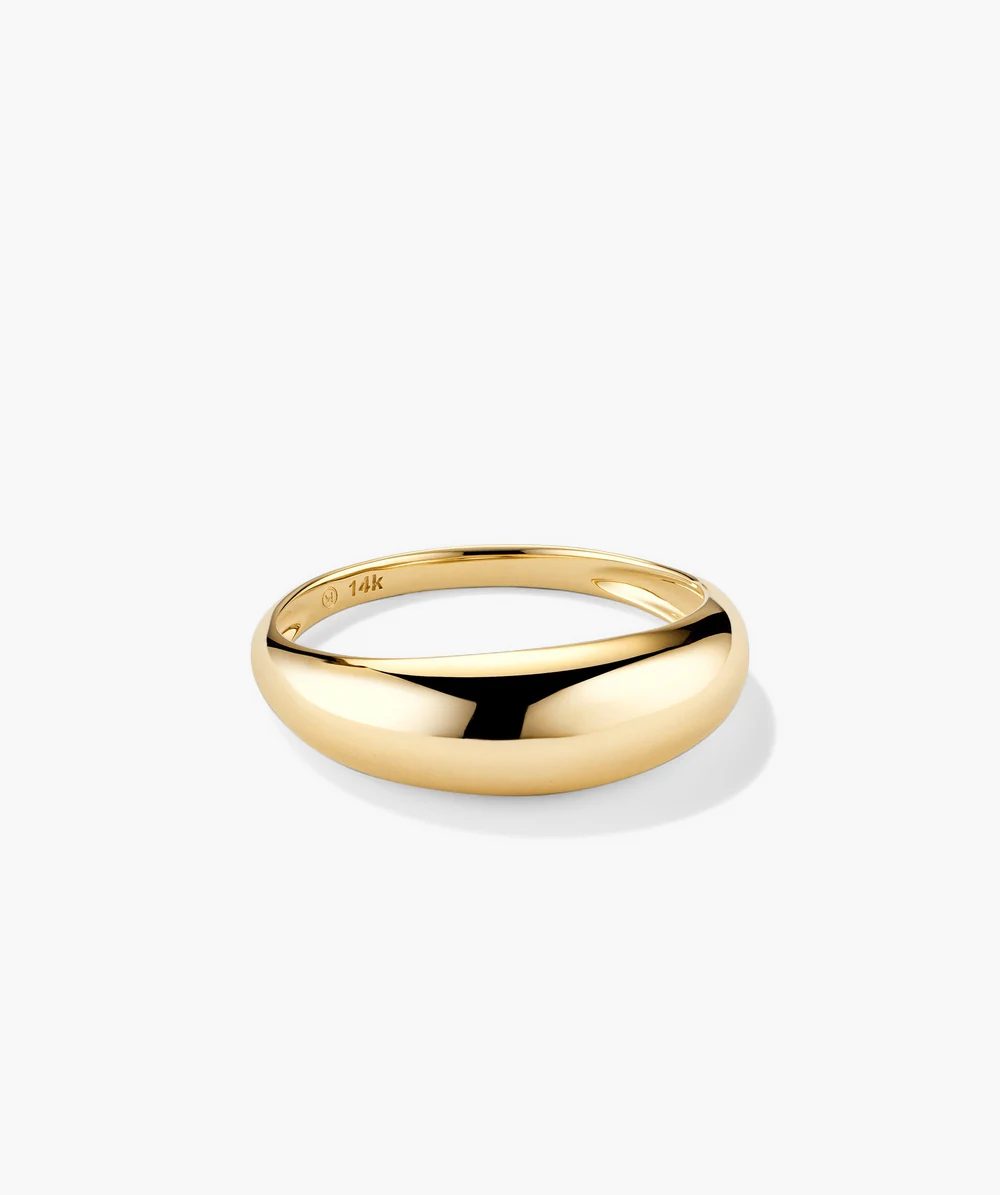
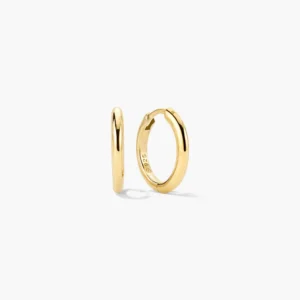
The Thin Dôme Ring by Mejuri scales down the brand’s signature rounded Dôme shape into a lighter ring that can work alone or within a layered stack. Its proportions are deliberately tapered, with a 6.2 mm top width narrowing to a 2 mm shank, so the ring keeps a noticeable sculptural surface without feeling like a uniformly wide band. Current Mejuri listings surface 925 sterling silver, 18k gold vermeil, 10k yellow gold, 14k yellow gold, and a 14k white-gold version. (Mejuri)
The standard design contains no gemstones. Its character instead comes from a smooth rounded surface, changing metal finishes, and the contrast between its broader top and slimmer underside.
About Thin Dôme Ring
The Thin Dôme Ring is the lighter interpretation of Mejuri’s original Dôme Ring. Mejuri positions it as part of the core Dôme collection and specifically designs it to coordinate with the brand’s Organic Dôme Nesting Rings, although it does not need companion rings to look complete. (Mejuri)
Its shape makes the ring useful for two different styling approaches. Worn alone, the 6.2 mm top creates enough polished metal to look intentional rather than like a basic narrow band. Added to a stack, the 2 mm shank keeps the ring from occupying the same amount of finger space as a consistently broad statement ring.
That balance between volume and restraint is the main reason the Thin Dôme sits somewhere between a simple stacker and a full statement ring.
Thin Dôme Ring Features
Current verified details include:
- 6.2 mm top width
- 2 mm shank width
- Sizes US 3–10 on current main configurations
- 925 sterling-silver version
- 18k gold-vermeil version over sterling silver
- Solid 10k yellow-gold version
- Solid 14k yellow-gold version
- Current 14k white-gold version
- Rhodium finish on Mejuri’s 14k white gold
- No gemstones in the standard Thin Dôme Ring
- 91% recycled sterling-silver claim on current silver and vermeil versions
- 90% recycled-gold claim on current U.S. 10k and 14k listings
- Manufacturer-described hypoallergenic positioning
- Water-resistant positioning on current solid-gold versions (Mejuri)
Thin Dôme Ring Fit And Silhouette
The ring is broadest where it is most visible.
Its 6.2 mm upper surface provides the recognizable Dôme volume, while the band tapers toward a 2 mm shank beneath the finger. (Mejuri)
This tapered construction changes both appearance and stacking potential. From above, the ring looks relatively substantial. From the palm side, it resembles a much slimmer band.
That makes Thin Dôme easier to position beside other rings than a design measuring more than 6 mm around its entire circumference.
6.2 mm Sculptural Top
The 6.2 mm width gives the polished upper section enough space to catch broad highlights as the hand moves. (Mejuri)
There is no engraving, stone setting, enamel, or decorative texture interrupting that surface in the standard version.
The result depends entirely on form.
A curved polished surface also changes appearance according to viewing angle. From one direction it may show a strong highlight across the center, while another angle emphasizes the softer outer edges.
This is what allows a relatively simple metal ring to feel more dimensional than an ordinary flat band.
2 mm Shank Width
The lower part of the ring narrows to 2 mm. (Mejuri)
This difference between the 6.2 mm top and 2 mm shank is significant.
A uniformly 6.2 mm ring would occupy considerably more space between the knuckle and base of the finger. The narrower shank reduces that visual weight around the underside while maintaining the wider Dôme appearance on top.
It also gives neighboring rings more room when several pieces are worn across the same hand.
Current Size Range
Current main Thin Dôme configurations list US sizes 3 through 10. (Mejuri)
Available sizes may vary by metal and remaining inventory, particularly for older or limited configurations.
A ring size should be selected for the finger where the ring will actually be worn rather than assuming the same size works across the index, middle, ring, and pinky fingers.
GIA recommends using proper ring gauges or a professionally measured ring whenever possible because finger shape, knuckle size, and band construction can affect fit. (gia)
GIA guidance for accurate ring sizing
925 Sterling Silver Version
The current sterling-silver Thin Dôme Ring uses 925 sterling silver. Mejuri states that its silver is made from 92.5% pure silver and that its current sterling-silver products contain 91% recycled material. (Mejuri)
Those percentages describe different characteristics.
92.5% refers to the composition that defines sterling silver.
91% recycled material is Mejuri’s current sourcing claim.
The U.S. Federal Trade Commission likewise explains that sterling silver is 92.5% silver and is commonly identified with a 925 mark. (Mejuri)
FTC guide to gold and sterling-silver jewelry
The silver version gives the rounded Dôme surface a cool, bright appearance and is particularly easy to combine with silver jewelry or stainless-steel watches.
18k Gold Vermeil Thin Dôme Ring
The current gold-vermeil version uses 18k gold vermeil over sterling silver. Mejuri states that its vermeil consists of a thick layer of 18k gold over a sterling-silver base and that the base metal contains 91% recycled material. (Mejuri)
This construction is not solid 18k gold.
Vermeil belongs to the plated-jewelry category, but unlike ordinary plating over an unspecified base metal, vermeil uses sterling silver beneath the gold.
For Erothots, the accurate wording is therefore:
18k gold vermeil over sterling silver.
That description communicates both the visible finish and the structural metal beneath it.
Solid 10k Yellow Gold Version
The 10k version uses solid 10k yellow gold, with current Mejuri U.S. specifications stating that it is made using 90% recycled gold. The brand also describes this version as water resistant and hypoallergenic. (Mejuri)
Ten-karat gold contains 10 parts gold out of 24 total parts, with the rest consisting of alloying metals.
Because the gold alloy extends throughout the piece, this version should be distinguished from gold vermeil.
For shoppers comparing materials, solid 10k gold and 18k gold vermeil over sterling silver may both look warm and gold-colored, but their underlying constructions are materially different.
Solid 14k Yellow Gold Version
Mejuri also currently offers the Thin Dôme Ring in solid 14k yellow gold, maintaining the same 6.2 mm top and 2 mm shank. (Mejuri)
The current U.S. listing states that the ring is made from 90% recycled 14k gold and describes it as water resistant and hypoallergenic. (Mejuri)
Fourteen-karat gold contains 14 parts gold out of 24, approximately 58.3% pure gold by composition.
It therefore contains a greater proportion of gold than the 10k version while preserving the same overall Thin Dôme silhouette.
14k White Gold Version
A 14k white-gold Thin Dôme Ring is also currently surfaced by Mejuri, although stock is more limited than for several of the core versions. (Mejuri)
Mejuri states that its 14k white-gold jewelry receives a rhodium-plated finish, which contributes to its bright white-metal appearance and additional surface shine. (Mejuri)
That means white gold should not be treated as identical to sterling silver simply because both appear cool-toned.
Their alloy compositions and surface treatments differ.
10k Or 14k Yellow Gold
The biggest distinction is gold content rather than shape.
The 10k Thin Dôme Ring contains a lower percentage of pure gold and more alloying metal.
The 14k Thin Dôme Ring contains a higher gold percentage.
Both current yellow-gold versions maintain the same 6.2 mm top, 2 mm shank, and sculptural form. (Mejuri)
This lets shoppers choose between the gold alloys without giving up the core design.
Vermeil Or Solid Gold
The difference is more fundamental when comparing vermeil with solid gold.
18k gold vermeil places an 18k gold layer over sterling silver.
10k and 14k solid gold use gold alloys throughout the gold portion of the ring.
Vermeil can provide the warm gold appearance at a different material construction, while solid-gold versions do not depend on a gold-plated surface.
The FTC provides consumer guidance on these distinctions and recommends accurate precious-metal descriptions so shoppers understand what they are purchasing. (Mejuri)
FTC precious-metal jewelry guidance
Understanding Mejuri’s Recycled-Metal Claims
Current listings state 91% recycled material for sterling silver and the silver base beneath the vermeil version, while current U.S. 10k and 14k gold listings state 90% recycled gold. (Mejuri)
These percentages refer to sourcing rather than metal purity.
For example, “90% recycled 14k gold” does not mean the finished alloy is 90% pure gold. The 14k designation still determines gold content.
The Responsible Jewellery Council maintains a Chain of Custody standard designed to support traceability for responsibly sourced and recycled precious metals. (Mejuri)
Responsible Jewellery Council Chain of Custody standard
This provides useful industry context but should not be presented as independent verification of Mejuri’s exact product percentages unless certification for a specific claim is documented.
Why Thin Dôme Works As A Solo Ring
The 6.2 mm top is substantial enough that the ring does not depend on neighboring bands to create visual interest.
On an otherwise bare hand, its curved metal surface can function as the primary ring.
This approach works particularly well when other jewelry, such as earrings or a bracelet, already carries more decoration.
The lack of gemstones also means the Thin Dôme does not introduce another color or stone shape that needs to coordinate with the rest of the outfit.
Building A Ring Stack
The Thin Dôme was specifically developed with stacking in mind, including compatibility within Mejuri’s Organic Dôme family. (Mejuri)
A practical stack can combine it with a narrow polished band, a fine pavé ring, or a shaped nesting ring.
Because Thin Dôme already has a broad 6.2 mm upper surface, surrounding it with several equally wide rings can quickly create a heavy stack.
Using thinner pieces nearby creates better variation in scale.
Pairing With Organic Dôme Nesting Rings
Mejuri specifically notes that Thin Dôme is designed to fit with its Organic Dôme Nesting Rings. (Mejuri)
Nesting rings use shaped contours that can sit around another ring rather than simply forming parallel straight bands.
This creates a more sculptural layered result than stacking several identical circular bands.
Even without the matching nesting pieces, Thin Dôme’s tapered profile makes it suitable for combining with other narrow rings already in a jewelry collection.
Pairing With A Signet Ring
A signet introduces a useful geometric contrast.
Thin Dôme is smooth and rounded.
A signet usually presents a flatter, more defined top.
Wearing them on different fingers allows the hand to carry two distinct shapes without making either one disappear.
A slim signet works particularly well when Thin Dôme is intended to remain the wider ring.
Pairing With Pavé Or Gemstone Rings
Because the standard Thin Dôme contains no gemstones, adding a pavé or solitaire ring creates a clear texture difference.
The Dôme surface reflects light as one broad polished area.
Pavé produces many smaller points of sparkle.
A colored gemstone can add a focal color while the Dôme ring acts as a neutral metal anchor.
This makes the ring especially adaptable for people who change gemstone jewelry frequently.
Mixed-Metal Styling
The number of available metal finishes makes Thin Dôme particularly suitable for mixed-metal looks.
A sterling-silver Thin Dôme can be combined with yellow-gold rings.
A yellow-gold version can sit beside a white-metal watch or bracelet.
The current white-gold option can also bridge cool-toned jewelry with solid-gold construction.
When several metals are used, varying ring widths and shapes helps the mix feel more intentional than simply alternating colors.
Best Occasions For Thin Dôme Ring
Thin Dôme can move between everyday and more polished outfits because it has noticeable form without decorative stones.
It works comfortably with casual clothing, tailoring, office outfits, dresses, dinners, celebrations, travel wardrobes, and more formal styling.
For minimal dressing, one Thin Dôme can provide enough polished metal on its own.
For dressier occasions, adding pavé, gemstone, or nesting rings can create a more detailed stack.
Ring Sizing And Comfort
The tapered construction means most of the ring is narrower than its 6.2 mm visible top, but correct sizing still matters.
GIA advises that finger measurements can change with temperature and that professional ring gauges provide more dependable sizing than improvised string measurements. (gia)
A ring should pass over the knuckle while remaining secure enough that the broader Dôme top does not continually rotate around the finger.
When several rings are stacked on the same finger, combined band width can also make the overall fit feel tighter.
Understanding The Hypoallergenic Claim
Mejuri describes its current Thin Dôme material variants as hypoallergenic. (Mejuri)
That is a manufacturer description rather than a guarantee that every wearer will tolerate every alloy.
The American Academy of Dermatology notes that nickel is a common cause of allergic contact dermatitis and that rings and other jewelry can trigger reactions in people with metal sensitivities. (American Academy of Dermatology)
American Academy of Dermatology guidance on nickel allergy
Someone with a known metal allergy should evaluate the specific material composition rather than relying only on general hypoallergenic wording.
Caring For The Gold Vermeil Version
Vermeil requires the gentlest care of the main Thin Dôme options because the visible gold is a surface layer.
Avoid aggressive polishing compounds and frequent abrasion.
Perfume, hand cream, sunscreen, and other cosmetics are best allowed to dry before the ring is put on.
Repeated contact with hard neighboring rings can also gradually affect a plated surface, which is worth considering when building a tight stack.
Caring For Solid Gold
The 10k and 14k yellow-gold versions do not depend on a gold-plated outer layer, but their polished surfaces can still scratch.
GIA recommends keeping fine jewelry away from harsh household cleaners and chlorinated swimming pools because chemicals can damage or discolor precious metals, including gold alloys. (gia)
GIA recommendations for caring for fine jewelry
A soft lint-free cloth is suitable for removing ordinary fingerprints and skin oils.
Caring For Sterling Silver
Sterling silver naturally develops tarnish as its surface reacts with the environment.
That does not automatically indicate poor-quality material.
A polishing cloth designed for sterling silver can help restore brightness.
The vermeil version should not automatically receive the same silver-polishing treatment because its visible surface is gold rather than bare silver.
Caring For 14k White Gold
Mejuri’s white-gold version receives a rhodium finish. (Mejuri)
Over time, surface coatings can change through friction and wear, particularly on rings that contact desks, handles, phones, and other hard objects frequently.
Gentle cleaning and separate storage can help limit unnecessary abrasion.
If the white finish changes substantially over long-term wear, professional jewelry assessment is preferable to aggressive home polishing.
Normal Scratches On A Polished Dôme Surface
The curved top is a relatively broad polished area, so fine marks can become visible during everyday use.
This is especially noticeable with jewelry that gets regular hand contact.
Small surface marks are different from cracks or structural deformation.
Someone who wants to maintain a highly polished appearance may remove the ring for activities involving heavy gripping, tools, exercise equipment, or abrasive surfaces.
Storing Thin Dôme Ring
Store the ring in a padded compartment or soft pouch rather than loose among harder jewelry.
GIA advises separate storage because jewelry pieces can scratch one another when placed together without protection. (gia)
This is especially relevant to the vermeil version, where repeated rubbing can affect the plated surface, and to the polished Dôme top, where scratches may be more visible.
Precious-Metal Hallmarking Context
Precious-metal composition cannot be determined reliably by visual color alone.
UK government hallmarking guidance explains that qualifying precious-metal articles are independently tested and marked according to their fineness, subject to local rules and weight exemptions.
UK government precious-metal hallmarking guidance
Hallmarking laws differ by market, but the principle is useful for product descriptions: sterling silver, vermeil, 10k gold, 14k yellow gold, and 14k white gold are not interchangeable terms simply because some finishes can look similar.
What Makes Thin Dôme Ring Different
The strongest design detail is its 6.2 mm-to-2 mm taper.
Instead of reducing the entire ring to a uniformly thin band, Mejuri keeps the sculptural Dôme volume where it is most visible and removes width around the lower shank. (Mejuri)
This makes the ring visually more substantial than a conventional stacker while giving it considerably less continuous width than a full statement band.
The range of current materials also changes its role. Sterling silver and vermeil provide different surface constructions, while 10k and 14k options provide solid-gold alternatives without changing the fundamental Dôme shape.
Final Note
The Thin Dôme Ring combines a rounded 6.2 mm top with a tapered 2 mm shank, giving Mejuri’s sculptural Dôme shape a lighter and more stack-friendly profile. Current versions include 925 sterling silver, 18k gold vermeil, solid 10k yellow gold, solid 14k yellow gold, and a 14k white-gold configuration. (Mejuri)
For Erothots shoppers, its main advantage is flexibility. The ring has enough polished surface to stand alone, but its tapered construction also makes it suitable for pairing with fine bands, gemstone rings, signets, or shaped nesting pieces.
Reviews
There are no reviews yet.