



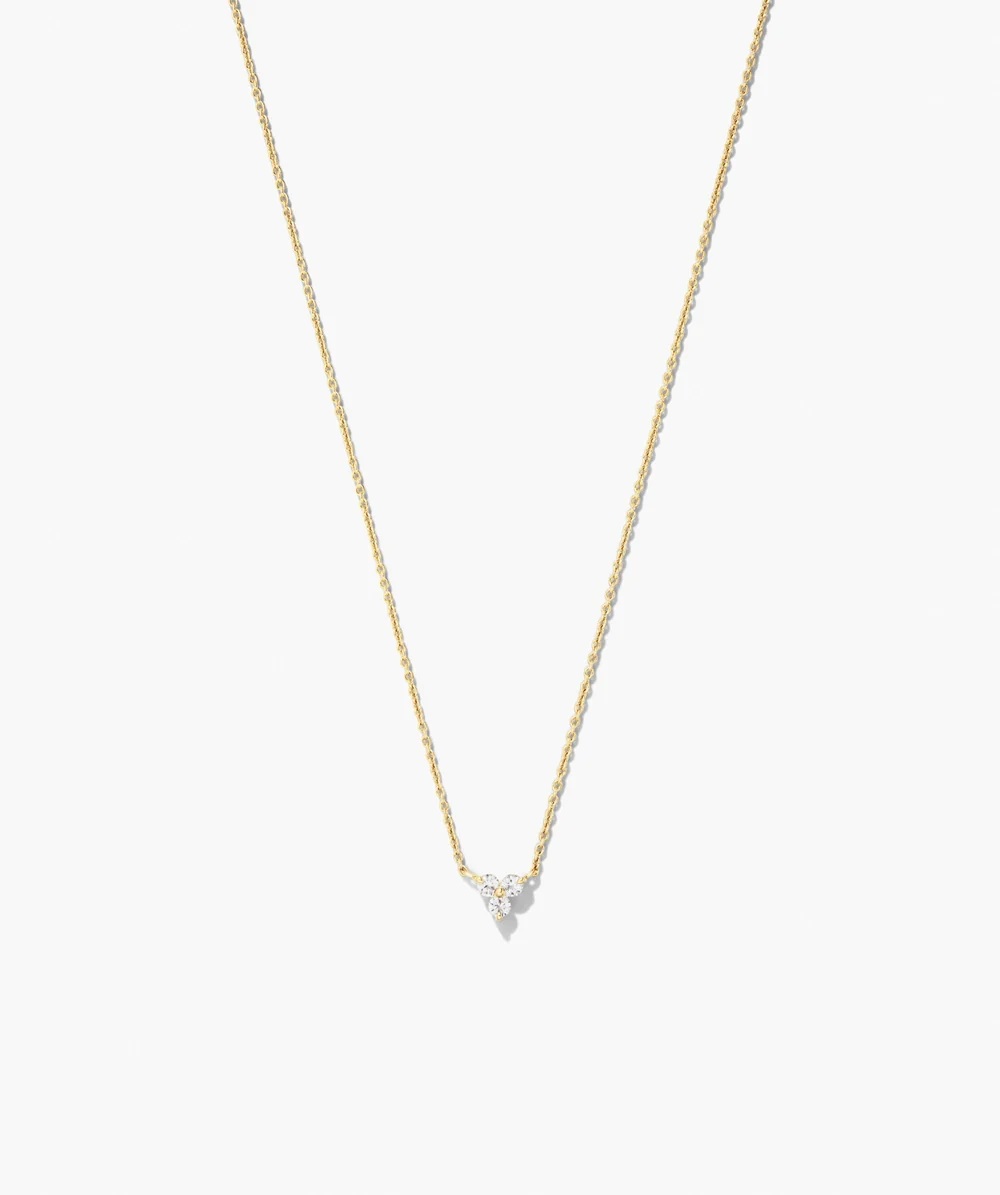
The Lotus Necklace by Mejuri is a fine pendant necklace built around a small lab-grown white sapphire and warm 18k gold vermeil over sterling silver. Its proportions are intentionally restrained: the gemstone measures 2.5 mm, the pendant is 5.4 mm wide, and the chain measures 1.1 mm across. An adjustable 16–18 inch length gives the necklace enough flexibility for solo wear or layering with shorter and longer chains. Mejuri’s current U.S. listing states that the sterling-silver base contains 91% recycled material. (Mejuri)
Instead of using an oversized pendant, Lotus concentrates its detail into a small gemstone-centered motif. This makes it suitable for someone who wants visible sparkle at the neckline without the necklace becoming the dominant part of an outfit.
About Lotus Necklace
The Lotus Necklace combines a fine chain, compact pendant, and laboratory-grown sapphire in one uncomplicated design. Mejuri currently offers the necklace in 18k gold vermeil with lab-grown sapphire, with an adjustable length of 16 to 18 inches. (Mejuri)
The design is especially useful for everyday jewelry because the proportions are small enough to layer yet distinct enough to wear alone. The white sapphire remains visually neutral, while the yellow-gold-toned vermeil creates warmth around the stone.
Mejuri also currently describes the necklace as hypoallergenic and identifies its construction as thick 18k gold plating over sterling silver. Those are manufacturer descriptions and should be presented as such rather than as guarantees for every wearer. (Mejuri)
Lotus Necklace Features
The current Lotus Necklace specifications include:
- 18k gold vermeil over sterling silver
- Lab-grown white sapphire
- 2.5 mm gemstone
- 5.4 mm pendant width
- 1.1 mm chain width
- Adjustable 16–18 inch length
- Current 91% recycled sterling-silver base claim
- Manufacturer-described hypoallergenic construction
- Fine pendant proportions suited to solo wear and layering (Mejuri)
The accessible manufacturer specifications do not currently state an exact total gemstone carat weight, separate pendant height, exact sapphire growth method, or specific clasp type. Those details should therefore not be added without further manufacturer confirmation.
Small White Sapphire Focal Point
The gemstone measures 2.5 mm, making Lotus a fine-scale gemstone necklace rather than a large solitaire pendant. (Mejuri)
At this size, the sapphire adds a concentrated point of brightness without occupying much space across the neckline. The surrounding metal provides definition, helping the gemstone remain noticeable even though it is considerably smaller than the center stones used in many statement pendants.
This compact scale is also useful for layering because the pendant does not immediately compete with every neighboring necklace.
Understanding The Lab Grown Sapphire
The Lotus Necklace uses a lab-grown sapphire rather than a mined sapphire. Mejuri’s current collection identifies the stone as lab-grown sapphire, while its product presentation describes the necklace as having white sapphire. (Mejuri)
Laboratory-grown does not mean the gemstone is simply an imitation made from unrelated material. GIA explains that synthetic counterparts of gemstones can have essentially the same chemical, physical, and optical properties as their natural counterparts while being grown in a laboratory. (gia)
GIA guide to sapphire and laboratory-grown counterparts
For Erothots, the clearest description is therefore lab-grown white sapphire, keeping the laboratory origin transparent.
Lab Grown Sapphire Versus A Simulant
A gemstone simulant is a different material chosen because it resembles another gem.
A laboratory-grown sapphire is different. FTC jewelry guidance states that terms such as “laboratory-grown” or “laboratory-created” should be used only when the product has essentially the same optical, physical, and chemical properties as the named natural stone. (Federal Trade Commission)
FTC Jewelry Guides for laboratory-created gemstone terminology
That means Lotus should not be described as glass, cubic zirconia, simulated sapphire, or another unrelated gemstone unless the manufacturer specifically states otherwise.
Sapphire Durability
Sapphire belongs to the corundum mineral family and ranks 9 on the Mohs hardness scale. GIA describes corundum as having excellent toughness and no cleavage, making sapphire a durable gemstone for jewelry. (gia)
GIA sapphire durability and care guide
This hardness refers primarily to resistance to scratching. It does not make the entire necklace indestructible. The fine chain, gemstone setting, pendant connections, and vermeil surface can still be damaged through pulling, crushing, or repeated abrasion.
5.4 mm Pendant Width
Mejuri publishes a 5.4 mm pendant width. (Mejuri)
That measurement places the design firmly in the small-pendant category.
A pendant measuring only a few millimeters can work particularly well with open collars, scoop necklines, simple knits, and layered necklace arrangements because it provides detail without occupying a broad section of the chest.
The width also gives useful context to the 2.5 mm gemstone. The finished pendant is slightly more than twice the stone diameter, so the surrounding metal remains an important visual part of the design.
Fine 1.1 mm Chain
The chain measures 1.1 mm wide. (Mejuri)
That fine profile supports the small pendant rather than visually overpowering it.
The chain can still catch light around the neckline, but the eye is naturally drawn toward the sapphire and pendant rather than toward a heavy link structure.
For layering, a 1.1 mm chain can also contrast nicely with a somewhat thicker chain positioned above or below it.
Adjustable 16–18 Inch Length
Lotus has an adjustable 16–18 inch length. (Mejuri)
This two-inch range gives the wearer more control over placement.
At the shorter setting, the pendant can sit higher and closer to the collarbone.
At the longer setting, it can rest farther down and leave space for a shorter necklace above it.
The exact position will vary according to neck circumference and body proportions, so 16 and 18 inches should be treated as chain measurements rather than guarantees of one precise placement on every wearer.
Why Adjustable Length Helps With Layering
Layered necklaces work best when the pendants and chains have enough separation to remain visible.
Lotus can be set toward 16 inches and placed above a longer 20-inch pendant necklace.
It can also be adjusted toward 18 inches and worn beneath a shorter collarbone chain.
The small 5.4 mm pendant makes both arrangements practical because it does not require a large amount of visual space.
18k Gold Vermeil Construction
The necklace is made from 18k gold vermeil over sterling silver. Mejuri describes its vermeil as a thick layer of 18k gold applied over a sterling-silver base. (Mejuri)
This is not the same as solid 18k gold.
The U.S. Federal Trade Commission explains that vermeil is a particular form of gold-plated jewelry in which sterling silver is used as the base metal. (Consumer Advice)
FTC consumer guide to gold vermeil and sterling silver
The full product description should therefore remain 18k gold vermeil over sterling silver, rather than simply “18k gold necklace.”
Sterling Silver Beneath The Gold
Sterling silver contains 92.5% pure silver. The FTC notes that jewelry represented as sterling or sterling silver commonly carries a 925 mark because 925 parts per thousand are pure silver. (Consumer Advice)
That purity measurement is different from Mejuri’s recycled-material claim.
92.5% describes the composition of sterling silver.
91% recycled material is Mejuri’s current U.S. sourcing claim for the base metal used in this necklace. (Mejuri)
These percentages should never be presented as though they mean the same thing.
Current Recycled Silver Claim
The freshest U.S. Lotus Necklace listing currently states that the vermeil is plated over a 91% recycled sterling-silver base metal. (Mejuri)
Some older or regional cached Mejuri pages show different recycled percentages, so the most defensible Erothots wording is:
“Mejuri’s current U.S. listing states a 91% recycled sterling-silver base.”
This avoids presenting an older regional percentage as though it were universally current.
For broader industry context, the Responsible Jewellery Council maintains a Chain of Custody standard addressing responsibly sourced and recycled precious metals.
Responsible Jewellery Council Chain of Custody standard
The RJC framework provides context for recycled-metal terminology but should not be treated as independent verification of Mejuri’s exact product percentage unless product-specific certification is documented.
Warm Gold And White Sapphire Combination
One reason Lotus is easy to coordinate is its simple color palette.
The vermeil contributes a warm yellow-gold tone.
The white sapphire contributes clear, neutral brightness.
There is no strong blue, green, red, or black gemstone color that needs to be repeated elsewhere in the outfit.
That makes the necklace compatible with both neutral clothing and more colorful wardrobes.
Wearing The Lotus Necklace Alone
Lotus has enough detail to work as a single necklace.
Its 5.4 mm pendant creates a small focal point at the neckline, while the 1.1 mm chain keeps the overall appearance fine and uncluttered.
It can work naturally with:
- T-shirts and simple knits
- Open shirts
- Scoop-neck tops
- Dresses
- Tailored blazers
- Minimal evening clothing
Because the pendant is small, it can add a polished detail without becoming the main visual feature of the whole outfit.
Layering With A Plain Chain
A plain chain is one of the easiest companions.
If Lotus sits at 18 inches, a shorter fine chain can rest above it.
Choosing a slightly different chain texture helps the layers remain distinct.
A simple cable, rolo, or fine serpentine-style chain can create contrast without adding another gemstone focal point.
Layering With Another Pendant
Two pendants can work together when their sizes and lengths differ.
Lotus can serve as the smaller upper pendant, while a larger piece sits several inches below it.
It can also become the lower necklace when paired with an especially tiny upper pendant.
The strongest arrangement usually avoids placing two similarly sized pendants at exactly the same length.
Pairing With Huggie Hoops
Compact hoop earrings complement the necklace without repeating its exact shape.
Plain yellow-gold or gold-vermeil huggies repeat the warm metal.
White-sapphire huggies can repeat the clear gemstone.
Sterling-silver hoops create a deliberate mixed-metal contrast.
Because the Lotus pendant is small, the earrings can be slightly more substantial without overwhelming the necklace.
Pairing With Stud Earrings
Small studs create an especially understated combination.
A plain gold stud keeps all the gemstone focus at the neckline.
A white-sapphire stud repeats the gem material.
A small diamond stud adds a similar clear sparkle while introducing a different gemstone.
The necklace is neutral enough that none of these combinations requires exact matching.
Styling With Rings
The fine necklace leaves room for stronger jewelry on the hands.
A Dôme-style ring can add broad polished metal.
A signet ring introduces a geometric surface.
A gemstone ring can provide color.
A thin stacking ring keeps the entire jewelry look minimal.
Because the necklace already combines gold vermeil with a clear gemstone, both plain-metal and gemstone rings are easy to incorporate.
Mixed-Metal Styling
Lotus does not have to be worn only with yellow-gold jewelry.
Sterling-silver rings, silver earrings, or a stainless-steel watch can be added for a mixed-metal look.
The white sapphire acts as a neutral bridge because its appearance does not strongly favor either warm or cool metal.
A two-tone bracelet or necklace elsewhere can make the mix more deliberate, although it is not necessary.
Best Occasions For Lotus Necklace
The compact design works across casual and more polished settings.
It can be worn for everyday outfits, workwear, dinners, celebrations, travel wardrobes, dresses, and understated event styling.
At the 16-inch setting, the necklace can look slightly more compact and focused.
At 18 inches, it can sit more comfortably within a layered necklace arrangement.
Its scale is one of its biggest advantages because it does not feel limited to formal occasions.
Caring For Lab Grown Sapphire
GIA states that warm, soapy water is a safe cleaning method for sapphire. (gia)
The complete Lotus Necklace, however, contains more than sapphire. The gemstone sits within a gold-vermeil piece, so the care method also needs to respect the plated metal surface.
For routine cleaning, mild soap, lukewarm water, and a very soft cloth are more appropriate than aggressive scrubbing.
Caring For Gold Vermeil
Because the visible gold is a surface layer, vermeil benefits from gentle care.
Avoid abrasive polishing compounds and rough brushes.
Perfume, hairspray, body lotion, sunscreen, and similar products are best allowed to dry before putting on the necklace.
After wear, gently wiping the chain and pendant with a soft lint-free cloth can remove oils and residue without unnecessary abrasion.
Cleaning Around The Sapphire
Residue can collect around a small gemstone setting.
Use a soft brush with very light pressure if extra cleaning is needed.
Avoid using needles, pins, or other sharp tools around the stone.
The metal surrounding the gemstone is an important structural part of the pendant, and damaging that area can compromise the security of the sapphire.
Protecting The 1.1 mm Chain
A fine chain should be handled differently from a heavy chain.
Avoid pulling Lotus when removing it.
Keep it away from clothing hooks, rough zippers, and other objects that can catch a delicate link.
When layered necklaces become tangled, separate them patiently rather than pulling the chains apart.
The sapphire’s hardness does not increase the strength of the necklace chain.
Storage Between Wears
Store Lotus in a soft pouch or lined jewelry compartment.
Keeping the chain loosely extended can reduce knots.
Avoid placing heavy bracelets, watches, or rings directly on top of it.
Separate storage also reduces rubbing against the gold-vermeil surface and protects neighboring jewelry from contact with the hard sapphire.
Manufacturer Hypoallergenic Description
Mejuri currently labels Lotus as hypoallergenic. (Mejuri)
That wording should be presented as a manufacturer claim rather than as a guarantee that every person will tolerate the necklace.
Individual reactions to jewelry materials vary, so someone with a known metal sensitivity should consider their own experience and available material information when choosing jewelry.
Exact Clasp Details
The current product page publishes the necklace length, stone size, pendant width, and chain width but does not clearly identify the exact clasp mechanism in its accessible technical specification. (Mejuri)
For accuracy, Erothots should avoid labeling the clasp as lobster, spring ring, toggle, or another specific type unless that hardware is confirmed for this exact necklace.
Leaving an unverified construction detail unspecified is preferable to transferring a clasp specification from another Mejuri necklace.
What Makes The Lotus Necklace Different
Lotus works because its proportions stay consistently fine.
The 2.5 mm sapphire is small enough for subtle sparkle, the 5.4 mm pendant provides just enough surrounding structure to make that gemstone visible, and the 1.1 mm chain keeps the necklace visually light. The adjustable 16–18 inch length then gives those proportions more styling flexibility. (Mejuri)
It also offers a clear alternative to a diamond pendant. Sapphire is a durable corundum gemstone with a Mohs hardness of 9, while laboratory growth provides sapphire material without presenting the stone as mined. (gia)
The result is a small gemstone necklace that can be worn frequently without relying on a large pendant, strong color, or elaborate decorative hardware.
Final Note
The Lotus Necklace combines a 2.5 mm lab-grown white sapphire, 5.4 mm pendant, and 1.1 mm chain with an adjustable 16–18 inch length. Its current construction is 18k gold vermeil over sterling silver, and Mejuri’s latest U.S. listing states that the sterling-silver base contains 91% recycled material. (Mejuri)
For Erothots shoppers, the necklace is especially useful when a small gemstone focal point is preferred over a larger pendant. It can remain a simple everyday necklace, coordinate with small hoops or studs, or become one fine layer within a more varied necklace stack.
Reviews
There are no reviews yet.