



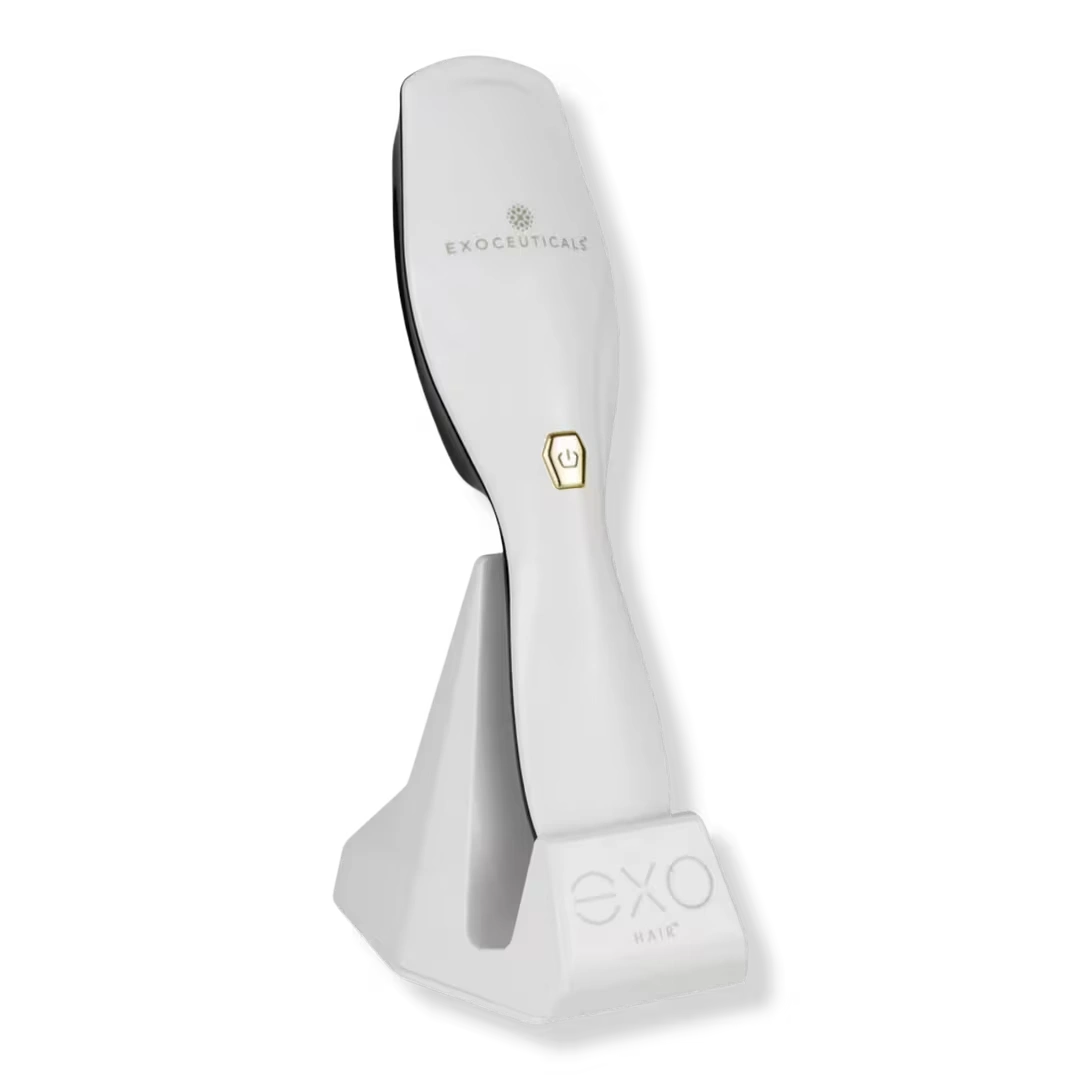
Exoceuticals EXO HAIR Red Light LED Hair Brush is a rechargeable scalp-care device that combines 650 nm red LED light, 465 nm blue light, and soft silicone massage bristles in a handheld brush format. It is designed for people concerned about thinning-looking hair, shedding, or scalp condition who want an at-home light-based treatment that can be moved directly over targeted areas of the scalp.
Unlike a conventional hairbrush, its main purpose is not detangling or styling. The brush is built around photobiomodulation and scalp contact. Exoceuticals recommends using it for 15 to 20 minutes per treatment, up to three or four times per week, and the device includes a rechargeable lithium battery and automatic shut-off.
About EXO HAIR Red Light LED Hair Brush
Hair-loss devices are easy to misunderstand because they can look similar to ordinary beauty tools while making claims that sit much closer to medical-device territory.
The EXO HAIR Red Light LED Hair Brush is better understood as a photobiomodulation scalp device in brush form. Its silicone bristles help separate and massage through the hair while the light source is positioned close to the scalp. The manufacturer uses both red and blue wavelengths rather than relying on massage alone.
The red-light portion is the most relevant to hair-growth research. The American Academy of Dermatology’s red-light therapy guidance notes that studies of low-level light therapy have shown increased hair thickness and some regrowth in people with hereditary pattern hair loss. The AAD also emphasizes that results vary and that red-light therapy does not restore a completely full head of hair.
That distinction is important for Erothots. This device should not be described as though one session can reverse every type of hair loss. Hair thinning has many possible causes, and photobiomodulation research is strongest around particular forms of pattern hair loss rather than every cause of shedding.
EXO HAIR Red Light LED Hair Brush Features
- 650 nm red LED treatment: The manufacturer positions this wavelength as the main hair-growth component of the brush.
- 465 nm blue light: Included as a separate scalp-focused wavelength.
- Soft silicone bristles: Designed to massage and move through the hair without behaving like a rigid detangling brush.
- Cordless design: Uses a rechargeable lithium battery rather than requiring continuous connection to a power outlet.
- 15 to 20 minute treatment window: Intended for repeated at-home scalp sessions rather than brief styling passes.
- 30-minute automatic shut-off: Provides a built-in time limit.
- Targeted handheld format: Allows attention to be concentrated around thinning-looking areas rather than covering the entire head at once.
- Dry or damp scalp compatibility: The manufacturer says the device can be moved over a clean dry or damp scalp.
- Treatment-frequency guidance: Exoceuticals currently recommends use up to three or four times weekly.
- Topical-treatment pairing: The brand positions the brush as part of its wider EXO HAIR routine and says it may be used before topical scalp products.
Why 650 nm Red Light Matters
The number 650 nm refers to the wavelength of the red light produced by the device.
Low-level red-light therapy has been studied for androgenetic alopecia, commonly called male-pattern or female-pattern hair loss. The theory behind photobiomodulation is that specific wavelengths of light can influence cellular activity without producing the tissue-damaging heat associated with high-energy lasers.
There is human research supporting the broader treatment category. A randomized controlled trial indexed by the National Library of Medicine studied red laser and LED sources centered around 655 nm in men with androgenetic alopecia. Participants receiving active treatment showed a significant improvement in hair counts compared with placebo after the study period.
Another randomized study involving women and a similar 655 nm light system also reported significant improvement in hair counts compared with sham treatment. The female hair-growth study used repeated treatments over 16 weeks.
These studies help support the broader scientific basis for red-light hair devices.
They do not, however, prove that every 650 nm brush will reproduce the exact percentages or results of a separate device studied under different treatment conditions. Wavelength is only one part of light therapy. Energy output, treatment area, distance from the scalp, diode configuration, treatment duration, frequency, and consistency can all influence exposure.
Red Light Research Does Not Equal A Guarantee For This Exact Brush
One of the most important details with light-based hair products is separating evidence for the technology category from clinical evidence for the exact retail device.
Published trials show that certain red-light and low-level laser systems can help some people with androgenetic alopecia. The AAD therefore includes low-level laser therapy among the treatment options dermatologists may discuss for certain types of hair loss. AAD hair-loss treatment guidance also notes that repeated treatment over many months may be necessary before visible improvement occurs.
That does not mean a study performed with a helmet, cap, or different laser comb can be presented as an EXO HAIR clinical trial.
Erothots therefore treats independent red-light research as support for the treatment approach, not as proof that this specific brush produced the same measured outcome.
Understanding The FDA Wording
Exoceuticals currently describes the brush as combining “FDA-approved red LED technology” with silicone massage.
That wording needs context.
The FDA has cleared a number of low-level light and laser hair-growth devices through the 510(k) process. For example, official FDA documentation for a home-use light-therapy hair system describes a device using 650 nm red LEDs and identifies it as a Class II device for promoting hair growth in specific male and female androgenetic-alopecia patterns. FDA 510(k) documentation illustrates the type of device-specific clearance and indication information supplied for these systems.
Another FDA-cleared comb-style device uses approximately 655 nm light and has its own specific 510(k) record and defined indications.
The distinction matters because FDA-cleared and FDA-approved are not interchangeable terms for every device. The AAD specifically explains that some at-home hair-loss laser devices are FDA-cleared and that clearance has different requirements from FDA approval.
In the FDA sources reviewed for this article, Erothots did not identify a device-specific 510(k) record naming the EXO HAIR Red Light LED Hair Brush itself. For that reason, it is more careful to state that the manufacturer describes the brush as using FDA-approved red LED technology rather than independently labeling this exact retail brush “FDA approved.”
The Role Of The 465 nm Blue Light
The EXO HAIR brush also includes 465 nm blue light.
Exoceuticals says this wavelength is intended to improve scalp condition and create a healthier environment for hair.
The scientific picture is not as straightforward as it is for red-light hair-growth therapy.
The independent hair-growth studies reviewed for this article focus much more strongly on red or near-red photobiomodulation. A systematic review indexed by PubMed on photobiomodulation and hair loss describes light-based treatment as promising, but wavelength and treatment parameters vary considerably between studies.
For that reason, Erothots would not describe the blue-light component as independently proven to regrow hair.
A more accurate interpretation is that the brush combines a red-light hair-focused mode with a blue-light scalp-focused component, based on the manufacturer’s positioning.
Silicone Bristles And Scalp Contact
The silicone bristles are not merely decorative.
Hair itself can block some light from reaching the scalp, especially in areas where density is still relatively high. Comb-style phototherapy devices often use teeth or bristles partly to move hair away from the treatment path.
FDA documentation for an independently cleared laser comb describes a similar design principle: the comb teeth part the hair so light has a clearer path to the scalp.
The EXO HAIR brush uses soft silicone bristles instead of hard comb teeth. Exoceuticals says they are designed to provide gentle scalp massage while reducing tangling and unnecessary breakage.
That makes the handheld design particularly useful around the hairline, crown, temples, or other localized areas where the user wants more control over placement.
The goal should be scalp contact and consistent movement rather than forcefully dragging the brush through tangled hair.
Massage And Light Therapy Are Different Functions
It is useful to separate what the bristles do from what the LEDs do.
Silicone massage provides physical contact with the scalp. Red-light therapy provides optical energy. They occur at the same time in this device, but they should not be treated as the same mechanism.
The manufacturer makes several broader claims around circulation and follicular-cell activity. Independent photobiomodulation literature proposes several possible biological mechanisms, but the exact way low-level light influences human hair growth is still an area of ongoing study.
The useful takeaway is simpler: the brush format makes repeated light exposure easier to direct while providing gentle scalp stimulation at the same time.
Why Treatment Consistency Matters
Light-based haircare is not an instant styling treatment.
Exoceuticals recommends treating each section for approximately 15 to 20 minutes, up to three or four times per week.
Independent studies of low-level light therapy also generally involve repeated sessions over a period of months rather than one-off exposure.
The AAD notes that people using laser therapy for hair loss may require multiple treatments each week for many months before seeing even modest growth.
That makes consistency one of the practical considerations before buying any home light device.
Someone expecting a brush that can simply be passed through the hair for thirty seconds during styling is looking at the wrong type of product. A 15 to 20 minute scalp session several times per week requires a genuine routine commitment.
Working The Brush Into A Scalp-Care Routine
Exoceuticals recommends using the brush on a clean dry or damp scalp.
The device can be glided over the scalp using small circular movements or moved along the hair while maintaining contact with the treatment area. The brand recommends approximately 15 to 20 minutes and a maximum frequency of three to four sessions weekly.
This is also why the tool should not be treated like an ordinary paddle brush. Its purpose is not to make repeated long strokes through knots or rapidly smooth a hairstyle.
For targeted use, working methodically through the scalp makes more sense. Hair can be separated so the LEDs remain directed toward the skin rather than shining mainly onto the surface of the hair.
Exoceuticals also markets the brush for use before its EXO ACTIVATE and EXO FORTIFY scalp products. The claim that light treatment materially increases absorption of those exact formulas should be understood as a manufacturer claim rather than an independently established result for the complete regimen.
Rechargeable Battery And Treatment Timer
The cordless design is one of the more practical features.
Exoceuticals says the rechargeable lithium battery can last approximately one to two weeks per charge, although actual duration will naturally depend on treatment frequency and session length.
A built-in automatic shut-off activates at 30 minutes.
That is longer than the manufacturer’s normal 15 to 20 minute treatment recommendation, so the auto shut-off is best viewed as a maximum timer rather than a reason to extend every session to half an hour.
Because this is a rechargeable electronic beauty device, charging and storage should follow the instructions supplied with the actual unit rather than assumptions based on other LED brushes.
Who May Consider EXO HAIR Red Light LED Hair Brush
The brush is most logically positioned for adults dealing with gradual thinning-looking hair or diagnosed pattern hair loss who want to discuss or add a non-invasive light-based option to their routine.
That does not mean every person experiencing shedding has androgenetic alopecia.
Hair loss can arise from many causes. The American Academy of Dermatology’s hair-loss guidance stresses the importance of identifying the cause because appropriate treatment varies considerably between different forms of hair loss.
Sudden shedding after an illness, nutritional problems, inflammatory scalp disease, medication-related changes, alopecia areata, scarring alopecia, and hereditary pattern thinning are not interchangeable conditions.
A light-therapy brush may therefore be a reasonable cosmetic or adjunctive device for the right situation, but unexplained hair loss should not automatically be self-diagnosed as pattern baldness.
GLP-1, Menopause And Other Hair-Loss Claims Need Care
Exoceuticals currently mentions receding hairlines, menopause-related hair changes, and GLP-1-associated thinning among the situations in which it positions the device.
Those claims deserve more caution than the simple 650 nm specification.
Hair shedding associated with rapid weight change, hormonal changes, nutritional factors, or medication use may involve mechanisms different from androgenetic alopecia.
Research showing that low-level red light can help some people with pattern hair loss does not automatically prove that the same device specifically reverses every form of medication-associated or menopause-related shedding.
For Erothots, these are best presented as manufacturer-positioned use cases, not as independently established treatment indications for the exact brush.
Hair Growth Claims Should Stay Specific
The phrase “hair growth” can cover several different outcomes.
A treatment may reduce continued loss, increase visible density, increase measured hair counts, improve strand diameter, or simply make existing hair look fuller. Those outcomes should not be combined into one exaggerated promise.
Low-level light studies have shown measurable hair-count improvements in some people with androgenetic alopecia, which is why the technology has genuine scientific interest.
At the same time, the AAD notes that even effective red-light therapy does not usually restore a completely full head of hair.
The most realistic expectation is therefore gradual support for hair growth in appropriate candidates with consistent use, rather than dramatic regrowth for every person experiencing thinning.
Safety And Scalp Condition
A home-use light device should not automatically be applied to every scalp condition simply because it is non-invasive.
The manufacturer includes itchy, oily, irritated, and unbalanced scalps in its target audience, but its current online product page does not provide a detailed contraindication section in the information reviewed for this article.
That makes the instructions supplied with the physical device particularly important.
Anyone with a diagnosed scalp disorder, unusual lesions, marked inflammation, photosensitivity, or another condition that could affect response to light treatment should obtain appropriate professional guidance rather than relying solely on marketing language.
Similarly, unexplained ongoing hair loss deserves evaluation because identifying the cause can determine whether photobiomodulation is even relevant.
Red Light Versus Established Hair-Loss Treatments
Photobiomodulation does not need to be dismissed simply because other treatments exist, but it should be placed in context.
The AAD includes low-level laser therapy among options for hereditary pattern hair loss while also discussing treatments such as minoxidil and prescription medications where medically appropriate.
Evidence also continues to evolve. A 2025 clinical trial comparing several photobiomodulation wavelengths found improvements in hair growth across the studied treatment groups over nine months, showing that researchers are still investigating optimal wavelengths and treatment protocols.
The existence of those studies is encouraging for the broader field. It does not mean that a consumer should replace an established treatment plan with an LED brush without understanding the cause of the hair loss first.
What Makes The Brush Format Different
Caps and helmets deliver light over a large section of the scalp simultaneously. A handheld brush takes another approach.
The EXO HAIR format provides greater control over where the light is directed, which can be useful around a receding hairline or a specific thinning area.
The trade-off is that the user has to move and position the device consistently.
With a hands-free cap, treatment coverage is largely determined by the placement of the fixed light array. With a brush, coverage depends more heavily on how carefully the scalp is sectioned and how long the device remains around each area.
Neither approach is automatically superior. They simply require different habits.
For someone who prefers a small cordless device over wearing a helmet-like system, the EXO HAIR format may feel considerably easier to incorporate into regular scalp care.
Erothots Take On EXO HAIR Red Light LED Hair Brush
The EXO HAIR Red Light LED Hair Brush is more technically interesting than a conventional scalp massager because the core treatment wavelength, 650 nm red light, sits close to a range that has been investigated in clinical research on androgenetic alopecia.
Its design also makes practical sense. Soft silicone bristles help work through the hair while the handheld format lets the LEDs be directed toward selected parts of the scalp. A rechargeable battery removes the need to remain attached to a wall outlet, and the automatic timer adds structure to repeated treatment sessions.
The strongest reason for caution is not the red-light technology itself. It is the temptation to make the product claims broader than the evidence.
Independent studies support low-level red and near-red light as a potentially useful treatment for certain forms of pattern hair loss. They do not prove that this exact brush will reproduce the outcomes of every clinical device tested at a similar wavelength. Likewise, the brush’s 465 nm blue-light mode has a weaker independent hair-growth evidence base than the red-light side of the device.
FDA wording also needs precision. The manufacturer calls the product’s red LED technology “FDA-approved,” but Erothots would not describe the exact EXO HAIR brush itself as FDA-approved or FDA-cleared without a device-specific regulatory record supporting that statement. The FDA clearance documents available for other 650 to 655 nm hair devices show that clearance applies to named products with defined technical specifications and indications.
For someone considering an at-home photobiomodulation tool, the realistic value proposition is therefore clear: targeted 650 nm red-light exposure, an additional 465 nm scalp-light mode, silicone scalp massage, cordless convenience, and a repeatable 15 to 20 minute treatment routine.
That makes EXO HAIR a specialized scalp-care device rather than an ordinary hairbrush, and its best use is alongside realistic expectations about what red-light therapy can and cannot do for thinning hair.

Reviews
There are no reviews yet.