



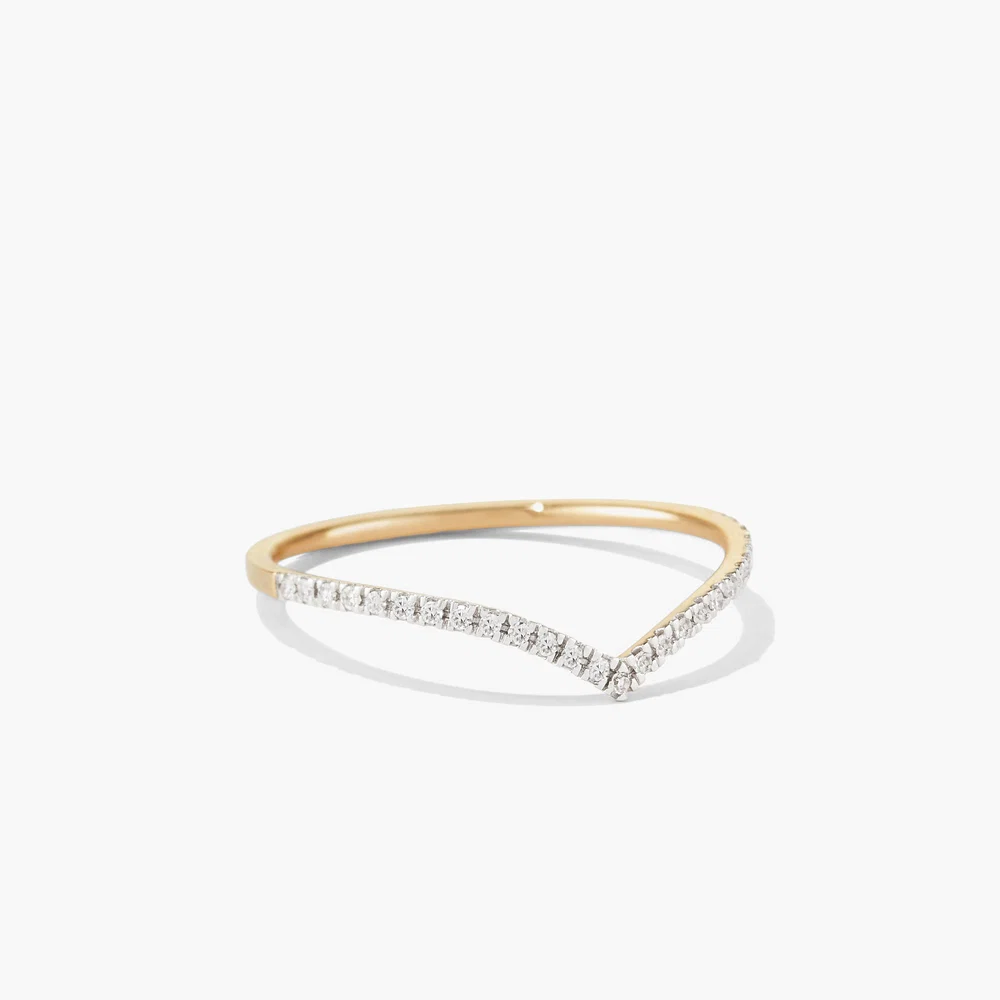
The Pavé Diamond Wishbone Ring by Mejuri pairs a slender V-shaped band with a line of petite natural diamonds, creating a ring that works equally well on its own or as part of a layered stack. The current primary version is handcrafted in 14k yellow gold with natural diamonds, while Mejuri also currently lists a 10k yellow-gold variant in some selections.
Its delicate proportions are an important part of the design. The band measures approximately 1 mm wide, while each pavé diamond measures about 0.9 mm. The current 14k version carries a minimum total diamond weight of 0.092 ct, with diamonds listed in the GHI color range and SI-I clarity range.
About Pavé Diamond Wishbone Ring
The Pavé Diamond Wishbone Ring takes the familiar stacking band and gives it a sharper visual direction through its curved V or wishbone silhouette.
Instead of forming a continuous straight line across the finger, the band dips toward a central point. That shape creates space around neighboring rings and makes the piece particularly useful for building a stack around solitaire, gemstone, signet, or other shaped rings.
Mejuri describes it as both a stacker and a statement piece. The current 14k yellow-gold version uses 90% recycled 14k gold, while the natural diamonds are described by the brand as coming from suppliers following conflict-free and socially responsible sourcing practices. Mejuri also states that 93% of the natural diamonds used are traceable to mine or region.
Pavé Diamond Wishbone Ring Features
This ring is defined by a small set of precise details rather than an oversized center stone. Its features include a sculpted wishbone profile, pavé-set natural diamonds, a 1 mm shank, 0.9 mm individual stones, solid yellow-gold construction, and a design intended for stacking.
The current 14k version is also described by Mejuri as water resistant and hypoallergenic. Those are manufacturer claims rather than a guarantee that every wearer will have identical results or tolerance.
The combination of thin metal and multiple small diamonds keeps the ring visually light even though the pavé surface introduces plenty of sparkle.
Wishbone Shape And Ring Silhouette
The V-shaped silhouette is the most noticeable design characteristic.
A conventional straight band creates a horizontal line across the finger. A wishbone ring instead moves downward toward a center point before rising again, creating a more open visual shape.
That geometry is useful for two reasons.
First, the ring already looks more distinctive when worn alone. Second, the curved center can create useful space around another ring’s setting when several rings are stacked together.
The shape can be worn with the point facing either direction depending on the preferred stack. Turning it around changes the visual flow without requiring another piece of jewelry.
Pavé Diamond Setting
The term pavé refers to a style in which numerous small gemstones are set close together so that the visible surface appears covered with sparkle.
In this design, the diamonds measure approximately 0.9 mm each, making them accent stones rather than individually dominant gems.
That small scale helps the ring maintain its delicate appearance.
Pavé jewelry does deserve thoughtful care because each small stone relies on a tiny portion of metal to remain secure. Strong knocks, snagging, or repeated rough contact can place unnecessary stress on these small settings.
This is one reason a pavé ring should be treated differently from a plain solid-gold band even when both are designed for regular wear.
Natural Diamond Details
Mejuri currently lists a minimum total diamond weight of 0.092 ct for the primary 14k Pavé Diamond Wishbone Ring.
The diamonds are specified as:
Color: GHI
Clarity: SI-I
Individual Stone Size: 0.9 mm
Minimum Carat Weight: 0.092 ct
These specifications describe the small natural diamonds collectively used across the pavé section rather than one large center diamond.
Because the stones are petite, their role is to produce an even line of light across the wishbone rather than highlight the individual characteristics of one particular diamond.
Understanding GHI Diamond Color
The GHI designation places these stones around the near-colorless portion of the commonly used diamond color scale.
The GIA diamond color scale runs from D, representing colorless diamonds, through Z as increasingly noticeable yellow, brown, or gray tones appear.
GIA groups G through J as near-colorless, meaning visible color can be subtle and may be difficult for an untrained viewer to notice, particularly in small stones.
That makes GHI a practical range for petite pavé diamonds because the stones can maintain a bright overall appearance without requiring each tiny accent diamond to sit at the very top of the color scale.
What SI-I Clarity Means
Diamond clarity describes internal characteristics known as inclusions and external characteristics known as blemishes.
Mejuri lists the diamonds in this ring within the SI-I clarity range.
The GIA diamond clarity guide explains that SI diamonds are considered Slightly Included, while I grades fall within the Included category. Grading is assessed under 10× magnification based on factors including the size, number, position, and visibility of clarity characteristics.
With a ring built from 0.9 mm pavé stones, the overall visual effect depends heavily on the combined sparkle of numerous tiny diamonds rather than close inspection of one large stone.
Solid 14k Yellow Gold
The main current version is made from solid 14k yellow gold.
Mejuri states that its 14k pieces use 90% recycled gold and positions the material for everyday jewelry.
Fourteen-karat gold should not be confused with pure 24k gold. The FTC guide to buying gold jewelry explains that 14k gold consists of 14 parts gold and 10 parts other metals out of 24 total parts.
Alloying gold increases its practicality because pure gold is comparatively soft.
The ring is therefore solid gold rather than gold-plated or vermeil jewelry.
Current 10k Yellow Gold Option
Mejuri’s current U.S. listings also surface a 10k yellow-gold version of the Pavé Diamond Wishbone Ring.
That variant retains the same published minimum diamond weight of 0.092 ct, GHI diamond color, SI-I clarity, 0.9 mm stone size, and 1 mm shank width. Mejuri states that its 10k gold also uses 90% recycled gold.
Ten-karat gold contains a smaller proportion of pure gold than 14k gold and a greater proportion of alloying metals.
The 14k version therefore has the higher gold content, while the 10k version offers another solid-gold option.
Availability can vary by market and selected variant, so the material shown on the specific Erothots product option should remain the final purchasing reference.
Delicate 1 mm Shank
At just 1 mm wide, the shank is intentionally fine.
That narrow profile is part of what makes the ring suitable for stacking. Several thin bands can sit together without immediately covering a large portion of the finger.
It also keeps attention on the wishbone shape and pavé diamonds rather than on a broad area of polished metal.
A thin band naturally requires more considerate handling than a heavy, chunky ring. Avoid deliberately bending it or using the ring during activities where it may be repeatedly struck against hard surfaces.
Pavé Diamond Wishbone Ring Fit And Sizing
The current product listing includes U.S. sizes 4 through 10.
Because this is a narrow 1 mm band, getting the correct finger measurement is more reliable than estimating from another finger.
The GIA ring sizing guide recommends professional finger gauges as one of the most accurate ways to determine ring size. GIA also notes that temperature, time of day, finger joints, and the width of a ring can affect fit.
Sizing deserves extra attention with pavé designs because rings with pavé settings can sometimes be more complicated to resize than plain bands.
Wearing The Ring On Its Own
Although the wishbone shape lends itself naturally to stacking, the ring does not require another piece beside it.
Worn alone, the V creates enough geometry to distinguish it from a standard thin diamond band.
The pavé section catches light across both sides of the wishbone, while the 1 mm shank keeps the overall appearance restrained.
This approach can work particularly well when other jewelry is already prominent, such as larger earrings, layered necklaces, or several bracelets.
Building A Diamond Ring Stack
Stacking is where the wishbone profile becomes especially versatile.
One option is to place a straight gold band beside it. The contrast between a horizontal band and the V-shaped diamond ring makes both silhouettes easier to see.
Another approach is to pair it with a plain wishbone ring in the same general shape. The two rings can follow one another closely, creating a layered outline with diamond sparkle on only one band.
For a stronger stack, the Pavé Diamond Wishbone Ring can sit between two narrow plain-gold bands.
Leaving some visual breathing room is often more effective than adding too many diamond-covered rings at once.
Pairing It With A Solitaire Ring
A wishbone band can also work beside a solitaire or gemstone ring when the central setting needs extra space.
The V-shaped section may curve around part of the neighboring setting rather than meeting it with a completely straight edge.
The exact fit depends on the height, width, and structure of the other ring.
This should not be assumed to create a perfectly flush bridal set with every solitaire. Different baskets, settings, center stones, and band heights can create gaps.
If a completely flush stack is important, comparing the rings together before purchase is the safer approach.
Mixing Pavé With Plain Gold
One of the simplest ways to keep a stack balanced is to mix reflective diamonds with smooth metal.
A plain 14k yellow-gold ring provides visual rest beside the closely set stones. It can also make the pavé section appear brighter because there is less competing sparkle nearby.
Mixing textures works in a similar way.
Beaded bands, smooth polished rings, twisted shapes, and narrow diamond bands can all create contrast without requiring a large center gemstone.
The wishbone’s distinctive geometry provides enough character that every accompanying band does not need its own strong design feature.
Styling With Other Jewelry
The yellow-gold construction makes this ring easy to coordinate with similarly warm jewelry.
Small gold hoops, diamond studs, a fine chain necklace, or a simple bracelet can repeat the same metal without making the styling feel overly matched.
The natural diamonds also provide a neutral gemstone accent.
They can sit comfortably beside pearls, black onyx, sapphire, emerald, or other gemstone jewelry because clear diamond does not introduce another competing color.
For mixed-metal styling, one silver- or white-metal piece can be introduced elsewhere while allowing the yellow-gold ring to remain the warmer focal point.
Best Occasions For This Style
The Pavé Diamond Wishbone Ring is delicate enough for everyday outfits but polished enough for dressier occasions.
It can suit workwear, dinners, celebrations, weddings, holiday dressing, and ordinary daily jewelry depending on how the stack is built.
A single ring creates a quieter look.
Layering several bands around it makes the styling more noticeable without needing to replace the original piece.
This adaptability is one of the strongest practical advantages of a narrow diamond stacker.
Caring For Pavé Diamonds
Diamond is exceptionally hard, but that does not make the complete ring indestructible.
The small pavé settings need protection from strong impacts and snagging. It is sensible to remove the ring before activities involving heavy tools, weights, harsh chemicals, or repeated hard contact.
Cleaning should also be gentle.
For broader independent information about diamond maintenance, GIA’s jewelry education resources explain that the metal and setting need as much consideration as the gemstone itself.
Avoid using sharp objects to clean between pavé stones because they can place pressure on the tiny metal areas holding the diamonds.
Checking The Pavé Setting
A ring containing many tiny stones has more individual settings than a plain band.
Periodically look at the pavé line in good light. The diamonds should sit consistently, without an obvious empty space or a stone that appears noticeably tilted compared with its neighbors.
If something seems loose, stop wearing the ring and have it professionally inspected rather than attempting to push the stone back into place.
This is particularly sensible for a ring that is worn every day, since repeated contact with hard surfaces can gradually affect fine settings even when the diamonds themselves remain undamaged.
Protecting The Gold
The 14k gold band is durable enough for regular jewelry use, but scratching and surface wear can still develop.
Take the ring off before using chlorine-based cleaners, swimming in strongly chlorinated water, or exposing it to harsh household chemicals.
The FTC gold jewelry guide provides useful background on gold alloys and how karat content differs across jewelry.
Normal fine scratches can develop with wear and become part of a frequently worn ring’s surface over time. Deep impacts and deformation are different and deserve professional attention.
Understanding Natural Diamond Grades
The diamond specifications on a pavé ring can look technical, but they are easier to understand when separated.
Carat weight describes diamond weight, not physical diameter alone.
Color considers how much visible body color exists within the normal D-to-Z range.
Clarity evaluates inclusions and blemishes under controlled magnification.
The GIA diamond color guide and GIA clarity scale are useful independent references for understanding those terms rather than relying solely on jewelry marketing language.
For this ring, those grades apply to very small pavé stones whose collective visual effect matters more than treating each diamond like a large solitaire.
Why The Wishbone Shape Works For Stacking
A narrow straight band is easy to stack but can begin looking repetitive when several similar rings are placed together.
The wishbone shape changes the rhythm.
Its central dip introduces negative space and allows another ring to sit visually inside or beside the V. That makes the stack appear more dimensional even when every ring remains quite thin.
The pavé diamonds reinforce the shape because sparkle follows the two angled sides rather than sitting in one straight horizontal line.
This is what lets the ring act as both a subtle standalone piece and a useful structural element in a larger stack.
Final Note
The Pavé Diamond Wishbone Ring combines a fine 1 mm solid-gold shank with 0.9 mm natural pavé diamonds arranged along a distinctive V-shaped silhouette. The current 14k yellow-gold version carries a minimum diamond weight of 0.092 ct, with GHI color and SI-I clarity specifications.
Its biggest strength for Erothots shoppers is flexibility. Worn alone, the wishbone shape gives a delicate diamond ring more personality than a conventional straight band. In a stack, the curved profile creates space and contrast around other rings.
The design is refined rather than oversized, making it particularly well suited to someone who wants real diamonds and solid gold in a ring that can change character depending on what is worn beside it.
Reviews
There are no reviews yet.