



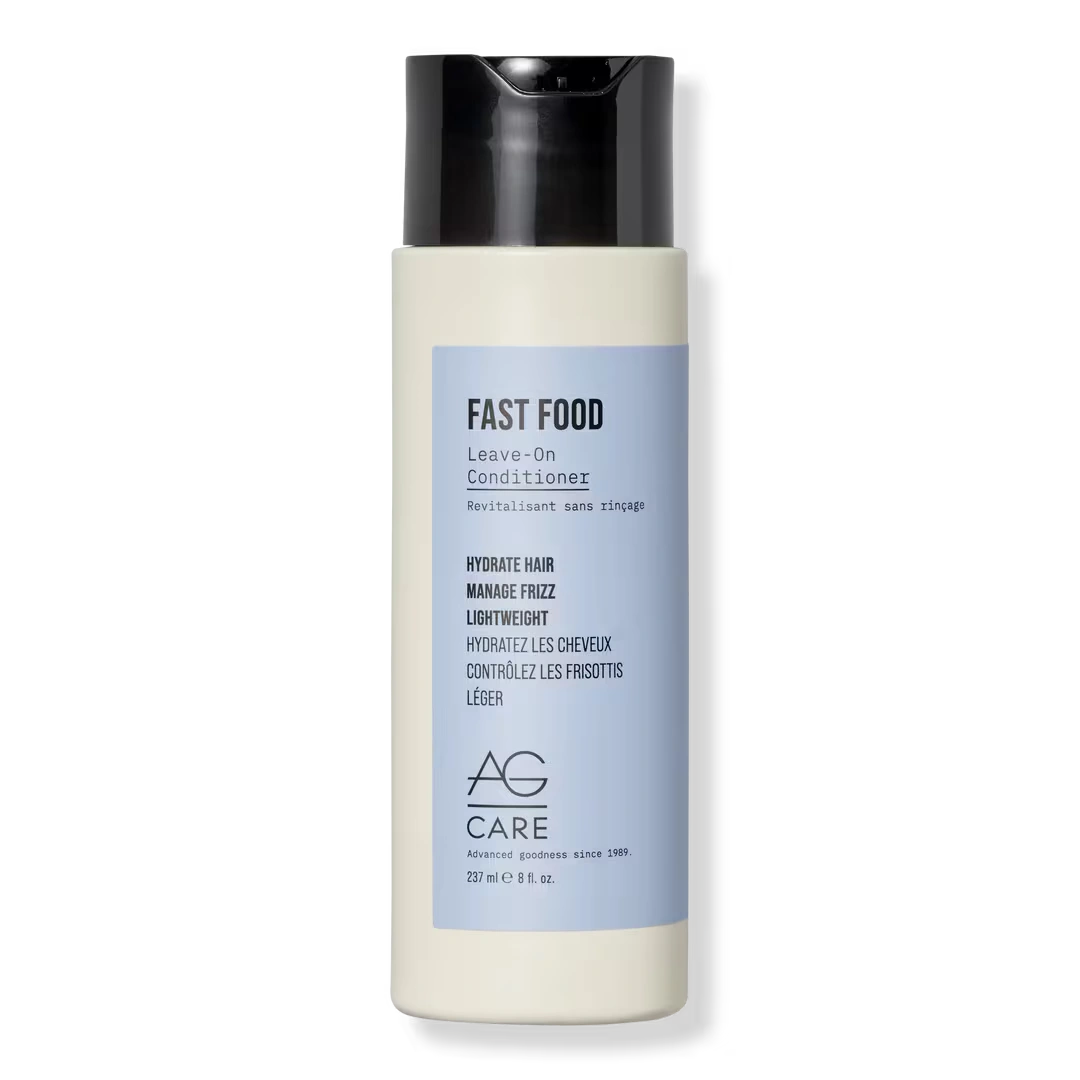
Fast Food Leave-On Conditioner by AG Care is a lightweight leave-in treatment designed to add moisture, softness, slip, and shine to dry, coarse, frizzy, or difficult-to-manage hair without requiring a rinse. Its conditioning formula combines Abyssinian seed oil, aloe, sodium hyaluronate, panthenol, conditioning silicones, hydrolyzed pea protein, hydrolyzed vegetable protein, and botanical extracts.
Unlike an ordinary rinse-out conditioner, Fast Food remains on clean, damp hair while it dries. That continued contact gives the conditioning agents more time to smooth the hair surface, improve manageability, and make frizzy areas easier to control.
About Fast Food Leave-On Conditioner
AG Care created Fast Food primarily for hair that needs additional conditioning after the shower. The brand describes it as a product for instantly smoothing and calming dry or coarse hair while adding lightweight condition and shine.
Its formula combines richer conditioning materials with ingredients that help keep the finished feel manageable rather than overly oily. Fatty alcohols and conditioning agents provide softness, Abyssinian oil contributes emollience, while silicones help create slip and a smoother surface.
Dermatologists also recognize a useful role for leave-in conditioners. The American Academy of Dermatology notes that these products can reduce frizz, make hair easier to comb, and help limit breakage caused by tangling and difficult styling. dermatologist leave-in conditioner guidance
Fast Food Leave-On Conditioner Features
The appeal of Fast Food comes from combining conditioning, frizz control, and styling support in one leave-on cream.
Its most notable characteristics include a lightweight leave-in texture, added shine, smoother-feeling hair, support for dry or coarse strands, easier detangling, Abyssinian seed oil, aloe, sodium hyaluronate, panthenol, hydrolyzed proteins, and a botanical extract blend. The current AG Care range offers an 8 oz bottle and a 1-liter refill format.
AG Care also describes its wider product philosophy as vegan and cruelty-free.
Lightweight Conditioning Without Rinsing
Fast Food has more substance than a fine leave-in mist but is intended to remain lighter than a heavy mask or styling butter.
Cetyl alcohol and cetearyl alcohol appear immediately after water in the current formula. These are fatty alcohols, widely used to give conditioners their creamy consistency and improve softness and slip.
They are followed by Abyssinian seed oil and behentrimonium methosulfate, giving the formula a strong conditioning foundation.
This structure makes the product particularly useful when hair still feels dry after ordinary conditioning but does not need the weight of a heavy oil-based finishing product.
Abyssinian Seed Oil
Crambe abyssinica seed oil, usually called Abyssinian oil, is one of the formula’s more prominent ingredients. It appears high on AG Care’s current ingredient declaration.
Within a leave-in conditioner, an oil like this functions primarily as an emollient. It can help make rough hair feel smoother and improve the way strands move against one another.
That improved lubrication is important because dry or weathered hair tends to experience more friction during brushing and styling.
Fast Food therefore uses Abyssinian oil less as a separate oil treatment and more as one part of its overall conditioning system.
Aloe And Sodium Hyaluronate
AG Care highlights aloe as one of Fast Food’s signature ingredients, while sodium hyaluronate is also included in the current formulation.
Sodium hyaluronate is a form of hyaluronic acid commonly used as a humectant. In a hair product, it works alongside ingredients such as propanediol and panthenol within the formula’s moisture-supporting system.
These ingredients should not be viewed individually as permanent hair-repair treatments. Their more practical role is helping the finished hair feel conditioned, pliable, and less dry.
Panthenol For A Softer Hair Feel
Panthenol is another useful supporting ingredient.
Often associated with provitamin B5, panthenol is commonly used in hair-care formulations because of its conditioning and moisture-supporting properties.
Within Fast Food it appears alongside allantoin, silicones, plant oils, humectants, and proteins.
That combination is more important than any single ingredient because conditioners work primarily through the complete formula coating and lubricating the hair fiber.
Hydrolyzed Pea And Vegetable Proteins
The current Fast Food formula contains hydrolyzed pea protein and hydrolyzed vegetable protein.
Hydrolyzed proteins are broken into smaller components so they can be incorporated more readily into cosmetic formulas.
In conditioners, proteins can temporarily improve the feel and appearance of weathered hair by contributing to film formation and surface conditioning.
They should not be confused with biological regeneration. Hair outside the scalp is not living tissue, so a cosmetic conditioner cannot permanently rebuild heavily damaged strands to their original state.
Its more realistic benefit is making damaged-feeling hair behave better while helping reduce friction and roughness.
Silicones For Slip And Frizz Control
Fast Food is not silicone-free.
Its current formula contains ingredients including diphenylsiloxy phenyl trimethicone, amodimethicone, and PEG-12 dimethicone.
These ingredients contribute significantly to the smooth, slippery feel expected from a leave-in conditioner.
Silicones can coat the hair surface, reduce friction, improve shine, and make frizz less noticeable. This can be especially helpful on porous, chemically treated, or heat-styled lengths.
People who deliberately follow a silicone-free routine should therefore take note of the ingredient list before choosing this product.
Best Match For Dry And Coarse Hair
AG Care specifically positions Fast Food around dry and coarse hair, although a leave-in conditioner can be useful across several hair textures.
Dry, curly, long, color-treated, chemically processed, and frequently heat-styled hair can often benefit from additional conditioning because these types or conditions can increase tangling and roughness.
The American Academy of Dermatology notes that leave-in conditioners can be useful for dry, brittle, curly, long, fine, chemically treated, tangled, or frizzy hair. leave-in conditioner recommendations
What About Fine Hair?
Fine hair can use Fast Food, but the amount matters.
Because it is a cream rather than an ultra-light spray, beginning with a very small quantity is sensible. Concentrating it mainly through the mid-lengths and ends can help prevent the roots from looking flat.
Dermatologists similarly recommend using the smallest amount of leave-in conditioner that does the job, with fine hair generally needing less than thick hair.
If fine hair becomes limp or greasy after application, reducing the quantity is often more useful than abandoning leave-in conditioning completely.
Curly And Wavy Hair
Fast Food can also fit naturally into a curly or wavy routine.
Additional slip can make damp curls easier to separate and style, while conditioning ingredients can help reduce the rough appearance associated with dryness and frizz.
AG Care confirms that styling gel can be layered after Fast Food, which gives the conditioner a useful position beneath curl-defining or hold products.
For curly hair, the leave-in can therefore act as the moisture and conditioning layer, while a separate gel or styling product handles definition and hold.
Detangling And Reduced Mechanical Stress
A good leave-in conditioner can make detangling easier because smoother strands require less force to separate.
That matters because tugging at resistant knots can cause mechanical breakage.
The American Academy of Dermatology recommends gentle detangling and notes that conditioner can make hair easier to manage. healthy hair care tips
Fast Food’s combination of conditioning agents, oils, and silicones provides the slip needed for this part of a hair routine.
It is still better to begin at the ends and gradually work upward rather than pulling a comb forcefully from roots to ends.
Applying Fast Food Leave-On Conditioner
AG Care directs users to place a small amount onto clean, damp hair, comb it through, leave it in, and dry the hair normally. The product is not intended to be rinsed away immediately after application.
For most people, focusing on the mid-lengths and ends is a sensible starting point.
Someone with extremely dry or curly hair may distribute the product more broadly through the lengths, while fine or easily weighed-down hair may need only a small amount around the driest ends.
The AAD recommends applying leave-in conditioner primarily where hair is dry, brittle, tangled, or frizzy and avoiding unnecessary scalp application because product buildup can irritate the scalp.
Where It Fits With Styling Products
Fast Food can sit beneath other styling products.
After distributing the leave-in through damp hair, a curl cream, gel, mousse, or other styler can be layered afterward when additional definition or hold is needed.
AG Care specifically confirms that gel can be applied after Fast Food.
This makes it useful as the conditioning stage rather than expecting the product to provide strong styling hold by itself.
For smoother blow-dried styles, it can also make the hair easier to comb before drying.
Heat Styling Needs Separate Consideration
Fast Food can improve slip and manageability before drying, but shoppers should not automatically assume that every leave-in conditioner is a dedicated heat protectant.
The American Academy of Dermatology specifically advises checking whether a leave-in product states that it provides heat protection rather than assuming the category guarantees it.
When regularly using blow dryers, flat irons, or curling tools, follow the directions of a product specifically labeled for heat protection when necessary.
Dermatologists also recommend limiting unnecessary thermal exposure and using lower or medium settings where practical. hair styling without damage
Botanical Extract Blend
Fast Food contains a relatively extensive botanical blend.
The current formulation includes extracts associated with lemon balm, calendula, chamomile, wild cherry bark, hops, lemongrass, nettle, rosemary, sage, and yarrow.
These extracts contribute to the overall cosmetic formula, but it would be inaccurate to treat each one as an independently proven treatment for damaged or thinning hair simply because it appears on the label.
The product’s conditioning performance is better understood through its complete combination of fatty alcohols, conditioning agents, oil, silicones, humectants, proteins, and botanical ingredients.
Fragrance And Sensitivity
Fast Food contains added parfum/fragrance, and coumarin is also listed in the current formula.
For many people, fragrance simply contributes to the experience of using the product. People with known fragrance sensitivities should check the ingredient declaration carefully.
The FDA explains that some fragrance components can cause sensitivity or allergic reactions in susceptible individuals. FDA fragrance information
If a new leave-in product repeatedly causes scalp itching, skin irritation, or another unusual reaction, discontinue it rather than continuing to apply additional product.
Fast Food Leave-On Conditioner Ingredients
The current AG Care ingredient declaration lists:
Aqua (Water/Eau), Cetyl Alcohol, Cetearyl Alcohol, Crambe Abyssinica Seed Oil, Behentrimonium Methosulfate, Phenoxyethanol, Diphenylsiloxy Phenyl Trimethicone, Amodimethicone, Cetrimonium Chloride, Parfum (Fragrance), PEG-40 Castor Oil, Stearalkonium Chloride, Allantoin, PEG-12 Dimethicone, Panthenol, Ethylhexylglycerin, Benzotriazolyl Dodecyl P-Cresol, Trideceth-12, Propanediol, Hydrolyzed Pea Protein, Hydrolyzed Vegetable Protein, Aloe Barbadensis Leaf Juice Powder, Tris(Tetramethylhydroxypiperidinol) Citrate, Coumarin, Tetrasodium Glutamate Diacetate, Sodium Hyaluronate, Melissa Officinalis Leaf Extract, Calendula Officinalis Flower Extract, Chamomilla Recutita Flower Extract, Prunus Serotina Bark Extract, Humulus Lupulus Extract, Cymbopogon Schoenanthus Extract, Urtica Dioica Extract, Rosmarinus Officinalis Leaf Extract, Salvia Officinalis Leaf Extract, and Achillea Millefolium Extract.
Cosmetic formulations can change, so the ingredient declaration on the bottle or refill being used should remain the final reference.
Keeping Leave-In Conditioner From Feeling Heavy
The simplest way to avoid heaviness is to start small.
Hair should not need to feel coated for a leave-in conditioner to work. Fine hair may require only a small amount concentrated at the ends, while thick or coarse hair can usually accommodate more.
Avoid repeatedly layering fresh conditioner over several days without eventually cleansing the hair.
The AAD notes that leave-in products should ultimately be washed out with shampoo and water rather than being allowed to build indefinitely.
Matching the amount to hair density and dryness usually produces a better result than following one fixed quantity for every hair type.
Gentle Hair Care Makes The Conditioner More Useful
A leave-in conditioner can reduce friction, but it cannot compensate completely for repeated damaging habits.
Rough towel drying, excessive heat, aggressive brushing, chemical overprocessing, and tight styling can continue to weaken hair even when a quality conditioner is being used.
The American Academy of Dermatology recommends conditioner after shampooing, gentle detangling, reduced pulling, and sensible use of heat to help limit avoidable hair damage. hair damage prevention advice
Fast Food therefore works best as one part of a gentler overall routine.
Cosmetic Formula And Safety
Fast Food is a cosmetic hair-care product rather than a medical treatment for hair loss or scalp disease.
In the United States, cosmetics generally do not receive FDA premarket approval in the same way medicines do, with specific exceptions such as certain color additives. Manufacturers remain responsible for ensuring that their cosmetics are safe when used as directed. FDA cosmetic ingredient information
Someone experiencing persistent scalp irritation, unexplained breakage, or significant hair loss should not rely on a leave-in conditioner alone to determine or address the underlying cause.
Final Note
AG Care Fast Food Leave-On Conditioner is most useful for hair that needs more conditioning after the shower without moving into a heavy mask or oil treatment.
Its formula combines fatty alcohols and conditioning agents with Abyssinian oil, silicones, aloe, sodium hyaluronate, panthenol, proteins, and botanical extracts. That combination focuses primarily on softness, lubrication, frizz control, shine, and easier styling rather than dramatic structural-repair claims.
For Erothots shoppers with dry, coarse, curly, color-treated, long, or easily tangled hair, Fast Food can provide an extra layer of manageability between washing and styling. Fine hair can also use it successfully when the quantity is kept light and concentrated mainly through the lengths and ends.
Reviews
There are no reviews yet.