



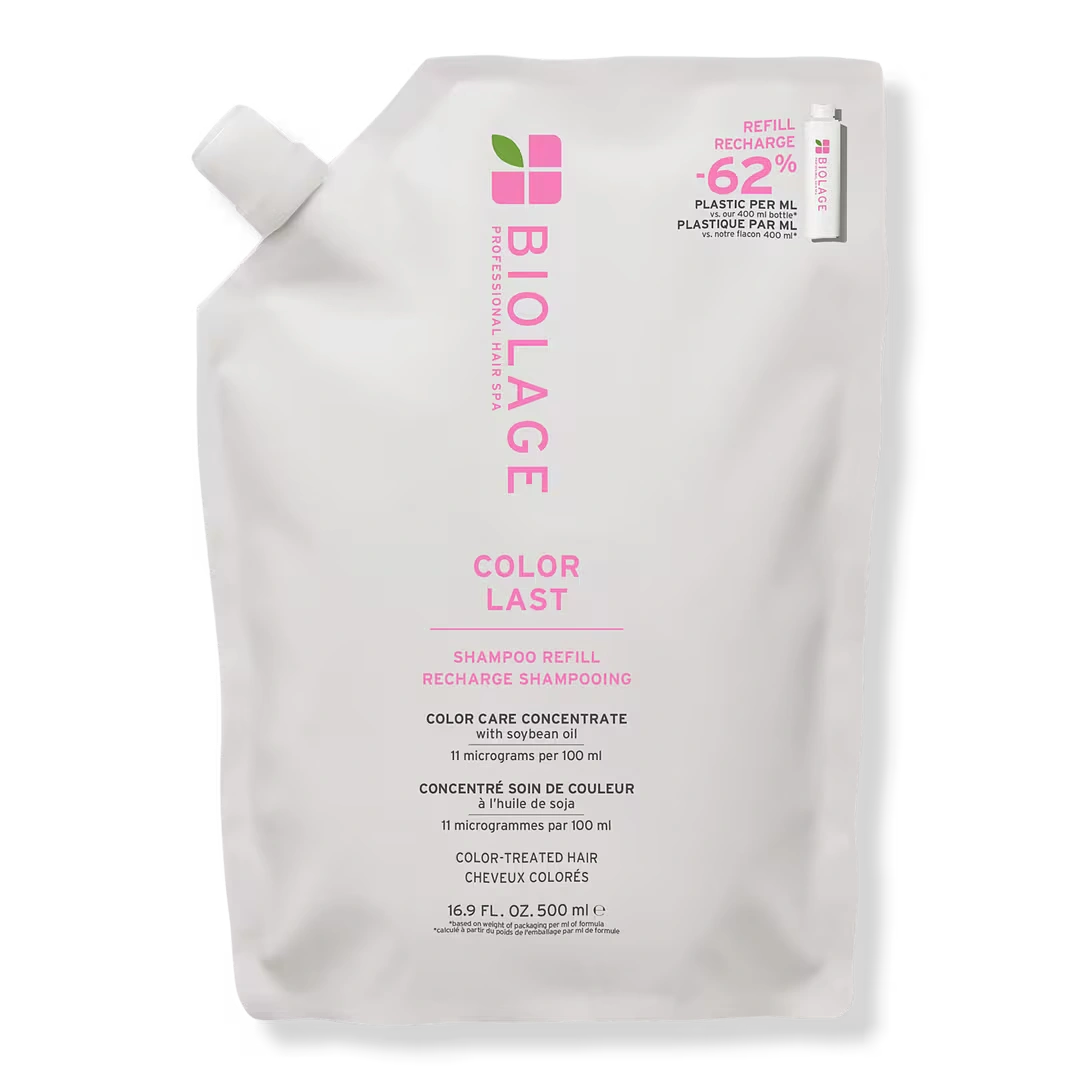
Biolage Color Last Shampoo for Color-Treated Hair is a low-pH cleansing formula created specifically for dyed, highlighted, and pre-lightened hair. Rather than functioning as a toning shampoo or depositing additional pigment, it focuses on cleansing while helping preserve the appearance of existing color. The current formula features soybean oil, conditioning ingredients, and a cleansing system designed to leave treated hair smoother, stronger-looking, and more reflective.
Biolage currently offers the shampoo in 1.7 oz, 13.5 oz, 16.9 oz refill, and 33.8 oz jumbo sizes, making it available as everything from a travel-size cleanser to a larger everyday salon-style bottle.
About Color Last Shampoo for Color-Treated Hair
Color Last Shampoo belongs to Biolage’s Color Last collection, a range built around maintaining the appearance and condition of chemically colored hair.
The shampoo uses a low-pH formula that Biolage says gently cleanses without unnecessarily stripping color. Soybean oil provides the main highlighted conditioning ingredient, while dimethicone and guar hydroxypropyltrimonium chloride contribute additional smoothness and slip.
The manufacturer currently describes the formula as vegan and free from parabens, mineral oil, and added colorants. Biolage is also approved under Cruelty Free International’s Leaping Bunny Programme.
One point deserves particular attention: Color Last Shampoo is not sulfate-free. The current ingredient declaration begins with water followed by sodium laureth sulfate and coco-betaine. Biolage instead bases its color-care positioning on the overall low-pH cleansing system and conditioning formula.
Color Last Shampoo for Color-Treated Hair Features
This shampoo is designed around preserving the look of salon color while still performing the basic job expected from shampoo: removing oil, residue, and buildup from the scalp and hair.
Biolage reports that when Color Last Shampoo and Conditioner are used together, the system can help prevent color fading for up to four weeks. The manufacturer also reports 35% more shine, hair that is 13 times smoother, and hair that is twice as strong after one use of the shampoo-and-conditioner system compared with a non-conditioning shampoo.
Those numbers need the correct context. They relate to the Color Last Shampoo and Conditioner system, not necessarily to the shampoo used alone.
This makes the most useful description of Color Last straightforward: it is a color-care cleanser intended to maintain vibrancy while supporting smoothness, shine, hydration, and strand condition between coloring appointments.
Low-pH Cleansing And Color Maintenance
Biolage specifically identifies Color Last as a low-pH shampoo.
Hair coloring changes the physical and chemical condition of the hair fiber, particularly when bleaching or significant lightening is involved. For that reason, post-color care generally aims to avoid adding unnecessary stress while maintaining cleanliness and manageability.
The American Academy of Dermatology’s color-treated hair guidance notes that chemical coloring can damage hair, particularly when substantial lightening is involved.
A color-care shampoo cannot reverse all structural changes produced during coloring, but a gentle cleansing and conditioning routine can help treated hair remain softer and more manageable.
Soybean Oil For Conditioning Support
Glycine Soja Oil, or soybean oil, appears in the current Color Last ingredient declaration and is the ingredient Biolage highlights most prominently.
The brand associates soybean oil with conditioning, smoothing, and helping dehydrated color-treated strands retain moisture.
That makes sense within the broader formula because colored hair often needs more than simple cleansing. Hair that has been lightened or repeatedly colored can feel rougher, making ingredients that improve surface lubrication especially useful.
Soybean oil should still be viewed as one component within a complete shampoo formula rather than as a stand-alone treatment. The surfactants clean, silicones and conditioning polymers contribute slip, acids help control the formulation, and soybean oil adds another conditioning element.
Stearic Acid And The Color Last System
Biolage describes its wider Color Last technology as being micro-dosed with soybean oil and stearic acid. The brand says these ingredients work together to nourish color-treated hair and help protect the appearance of the color.
The current shampoo ingredient declaration directly lists soybean oil and also contains glycol distearate, while Biolage’s marketing describes stearic acid as part of the Color Last color-care concentrate.
Rather than treating this ingredient story as a permanent seal over the hair, it is more accurate to think of the system as helping condition the fiber and reduce the dull, rough appearance that can make colored hair look faded sooner.
Color Last Shampoo Contains Sulfates
Color Last Shampoo contains sodium laureth sulfate.
That detail matters because many color-care shampoos are marketed primarily around being sulfate-free, and it would be inaccurate to place this product in that category.
Sodium laureth sulfate is part of the cleansing system, supported by coco-betaine. Biolage states that the finished formula is designed for color-treated hair despite containing sulfate surfactants.
Whether a shampoo suits someone’s colored hair depends on more than the presence or absence of one surfactant. Washing frequency, water temperature, chemical processing, hair texture, styling practices, conditioner use, and the overall formulation can all affect how the hair looks and feels over time.
Dimethicone For Smoother-Feeling Hair
Dimethicone appears relatively high in the ingredient list.
In haircare, silicones are frequently used to improve slip, reduce a rough surface feel, and help strands look smoother and shinier. This is particularly useful with chemically treated hair, where surface irregularities may make the hair look dull.
Smoother strands can reflect light more evenly, contributing to a shinier appearance.
Silicone does not permanently reconstruct damaged hair, however. Its effect is cosmetic and conditioning, improving the appearance and handling of the strand while the ingredient remains deposited on the surface.
That distinction helps explain Biolage’s shine and smoothness claims without turning them into permanent repair promises.
Designed For Dyed, Highlighted And Pre-Lightened Hair
Color Last Shampoo is intended for color-treated hair generally rather than one specific dye shade.
Biolage confirms that the product can be used on pre-lightened hair, and its current retailer information describes it as suitable across different forms of colored hair.
That makes it relevant for permanent brunette or red color, highlights, lowlights, and bleached sections when the main goal is routine cleansing and color maintenance.
It is important to distinguish it from a purple shampoo.
Color Last Shampoo itself does not rely on violet pigment to neutralize brassiness. Biolage sells a separate Color Last Purple Shampoo specifically for unwanted warm and brassy tones.
Someone wanting normal color maintenance can therefore choose Color Last Shampoo, while someone specifically trying to neutralize yellow or brassy tones may need a toning product instead.
What The Four-Week Color Claim Means
Biolage states that Color Last Shampoo and Conditioner help prevent color fading for up to four weeks, based on consumer testing of the two-product system.
This should not be interpreted as a guarantee that every hair color remains visually unchanged for four weeks.
Different dyes behave differently. Red, copper, fashion colors, darker permanent shades, blondes, and toners do not necessarily fade at the same rate.
Hair porosity also matters. Highly processed hair can behave differently from minimally processed hair, while frequent washing can expose color to cleansing more often.
The claim is therefore most useful as evidence that Biolage has tested the shampoo-and-conditioner combination for color maintenance rather than as a universal expiration date for hair color.
Washing Frequency Can Affect Color Longevity
Even a color-care shampoo is still shampoo.
Every time colored hair is washed, it is exposed to water, surfactants, friction, and handling. That does not mean washing should be avoided, but it does mean there is little advantage in shampooing considerably more often than the scalp actually requires.
The American Academy of Dermatology’s healthy hair recommendations suggest adjusting washing frequency according to how oily or dirty the scalp becomes. The organization also recommends concentrating shampoo mainly on the scalp rather than vigorously rubbing it through the full length of the hair.
That technique makes particular sense for color-treated lengths, which may already be more fragile than untreated hair.
Cleansing Color-Treated Hair With Less Friction
Color Last Shampoo should be distributed through wet hair, worked gently into a lather, and rinsed thoroughly.
Most of the massage can be concentrated around the scalp, where sebum and product buildup are most likely to accumulate.
There is usually no need to repeatedly scrub the lengths together. As the shampoo is rinsed, the lather passes through the rest of the hair.
Gentler handling matters because chemical services can already make strands more vulnerable to breakage. The AAD’s hair-damage guidance recommends conditioner after shampoo and minimizing practices that unnecessarily pull, heat, or roughen the hair.
Why Conditioner Matters After Color Last Shampoo
Color Last Shampoo is designed to work particularly well with Color Last Conditioner.
The shampoo handles cleansing while the conditioner supplies the more concentrated detangling and conditioning stage. Biolage’s strongest color-fade, smoothness, shine, and strength results are also based on using the two together.
Conditioner is especially useful with chemically colored hair because reducing friction can make wet strands easier to detangle.
The AAD recommends using conditioner after washing because it moisturizes and detangles the hair, improving manageability.
Very dry, bleached, curly, or highly processed hair may also require a leave-in conditioner or occasional treatment beyond a rinse-out conditioner.
Heat And Sunlight Still Matter
A color-protecting shampoo cannot compensate for every source of color deterioration.
Repeated high heat can contribute to dryness and damage, while environmental exposure can affect the appearance of treated hair.
The American Academy of Dermatology’s guidance on preventing hair damage recommends reducing excessive heat and protecting hair from prolonged sun exposure.
This makes Color Last Shampoo one part of a wider color-maintenance routine rather than the only product responsible for keeping dye looking fresh.
Gentle styling, conditioner, heat protection when appropriate, and sensible washing habits can all contribute to preserving the finished appearance.
Hair Dye Safety Still Starts With The Coloring Process
Color Last Shampoo itself does not deposit permanent hair dye, but the hair it is designed for has usually undergone some form of chemical coloring.
The FDA’s hair dye safety guidance explains that hair-color products should be used according to their directions and that adverse reactions can occur in some users.
The agency’s additional hair dye safety advice recommends following application times carefully and rinsing the scalp thoroughly after coloring.
A maintenance shampoo can help support the condition of colored hair afterward, but it cannot make inappropriate or damaging coloring practices harmless.
Fragrance And Scalp Considerations
Color Last Shampoo is fragranced.
The current ingredient list contains parfum along with fragrance components including limonene, hexyl cinnamal, coumarin, linalool, amyl cinnamal, and benzyl alcohol.
Many people use fragranced shampoo without difficulty, but a fragrance-sensitive or reactive scalp may respond differently.
If a new shampoo causes persistent itching, burning, redness, or another unexpected scalp reaction, continuing to use it simply because it is formulated for colored hair is unlikely to be useful.
Suitability depends on both hair goals and personal scalp tolerance.
Color Last Shampoo Ingredients
The current Biolage ingredient declaration is:
Aqua / Water / Eau, Sodium Laureth Sulfate, Coco-Betaine, Sodium Chloride, Glycol Distearate, Dimethicone, Citric Acid, Parfum / Fragrance, Sodium Benzoate, Sodium Hydroxide, Hexylene Glycol, Cocamide MIPA, Salicylic Acid, Carbomer, Guar Hydroxypropyltrimonium Chloride, Limonene, Hexyl Cinnamal, Coumarin, Benzyl Alcohol, Glycine Soja Oil / Soybean Oil, Ethylhexyl Salicylate, Linalool, Amyl Cinnamal, and Fumaric Acid.
Because haircare formulas can be updated, the ingredient declaration printed on the bottle received should remain the final reference for anyone checking a specific allergy or sensitivity.
Who May Appreciate Color Last Shampoo
Color Last Shampoo makes the most practical sense for someone whose hair has been permanently colored, highlighted, lowlighted, or pre-lightened and who wants an everyday cleanser specifically designed around preserving the look of that service.
It may be particularly appealing when shine and smoothness are concerns alongside fading because the system’s testing includes improvements in those areas.
Someone who specifically requires sulfate-free shampoo should note that this is not one.
Likewise, anyone wanting pigment correction for blonde or gray hair should understand that standard Color Last Shampoo is different from Biolage Color Last Purple Shampoo.
What Makes Color Last Shampoo for Color-Treated Hair Different
The strength of Color Last Shampoo for Color-Treated Hair is its focused role. It does not try to recolor the hair, dramatically lighten it, or act as a purple toner. Instead, it provides everyday cleansing specifically for hair whose existing color needs to remain vibrant and polished-looking for as long as practical.
Its low-pH formula combines a conventional surfactant cleansing system with soybean oil, dimethicone, conditioning polymers, and other supporting ingredients. Biolage’s current testing reports up to four weeks of fade protection when the shampoo is paired with Color Last Conditioner, along with improvements in shine, smoothness, and strength.
For Erothots, Color Last Shampoo is best positioned as a low-pH color-care cleanser for dyed and pre-lightened hair that balances effective washing with conditioning, shine, smoothness, and fade-conscious maintenance, without incorrectly describing it as sulfate-free or promising that shampoo alone can prevent all color fading.

Reviews
There are no reviews yet.