



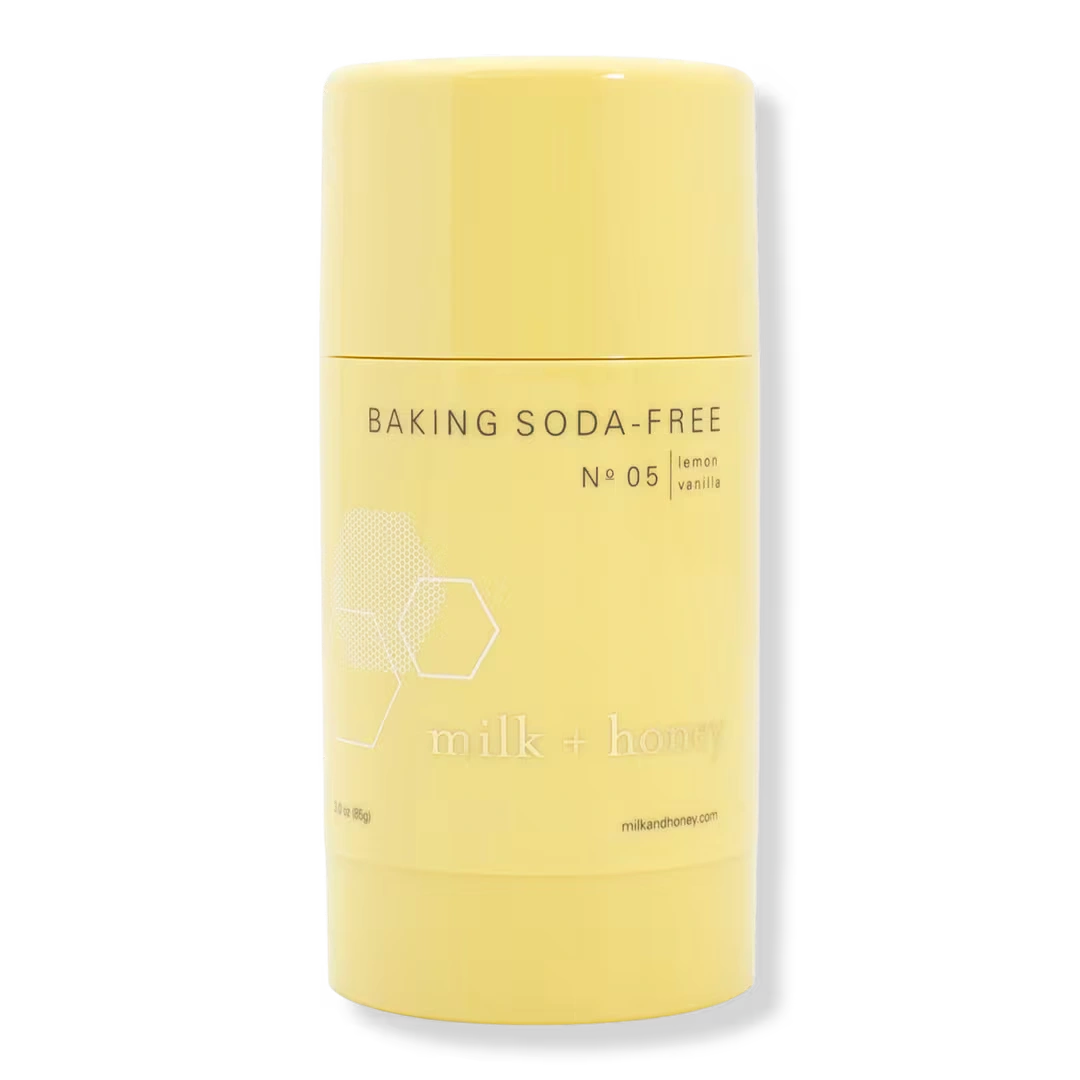
Mario Badescu Baking Soda Free Deodorant is a 2.4 oz solid underarm deodorant created to control everyday body odor without relying on baking soda or aluminum-based antiperspirant actives. The smooth stick combines magnesium hydroxide, tapioca starch, coconut oil, shea butter, botanical oils, sage, cucumber, aloe, green tea, and ginger root oil in a wax-supported formula designed to glide over dry underarms without leaving the deliberately powdery texture associated with some mineral deodorants.
Unlike an antiperspirant, this formula is not intended to stop normal perspiration. Its job is odor management and underarm conditioning, making the distinction between deodorant and sweat-control products particularly important when deciding whether it suits a daily routine.
About Baking Soda Free Deodorant
Baking Soda Free Deodorant takes a straightforward approach to underarm care. Mario Badescu leaves out both sodium bicarbonate and aluminum antiperspirant ingredients, then builds the stick around magnesium hydroxide and tapioca starch supported by plant oils, butters, and waxes.
The manufacturer describes the product as suitable for all skin types and gives it a soft, invisible finish. Its current formula is also identified as vegan, baking soda-free, and paraben-free. The scent is described by Mario Badescu as a light botanical fragrance rather than fragrance-free.
Baking Soda Free Deodorant Features
The formula is designed around odor control without blocking sweat. This matters because deodorants and antiperspirants perform different jobs.
Sweat itself is not necessarily strongly odorous. Body odor develops when perspiration interacts with microorganisms naturally present on the skin. The MedlinePlus sweat guide explains that this interaction is why deodorants can help with odor even when they do not reduce the amount of sweat produced.
Mario Badescu’s product does not contain aluminum-based antiperspirant actives and the manufacturer specifically states that it does not reduce perspiration. Instead, the formulation concentrates on neutralizing unwanted odor while leaving the underarm skin feeling conditioned.
That makes it more appropriate to describe the product as an odor-control deodorant than as sweat protection.
Why The Formula Leaves Out Baking Soda
Baking soda, or sodium bicarbonate, is common in some deodorant formulas because it can help manage odor. It does not suit every person’s underarm skin, however.
The American Academy of Dermatology notes in its guidance for some irritation-prone skin conditions that baking soda, fragrance, alcohol, and other ingredients may trigger irritation in susceptible skin. Its underarm care recommendations specifically suggest avoiding baking soda when it aggravates sensitive areas.
Removing baking soda can therefore be useful for someone who already knows that sodium-bicarbonate deodorants feel uncomfortable on their skin.
It is important not to take that further than the evidence allows. A baking soda-free formula is not automatically irritation-proof. This Mario Badescu deodorant contains fragrance and multiple botanical components, so individual skin tolerance can still vary.
Magnesium Hydroxide For Odor Control
Magnesium hydroxide is one of the most important ingredients in the formula.
It provides a different approach to odor management from baking soda while allowing the deodorant to remain aluminum-free. It sits fairly high in the ingredient declaration, after caprylic/capric glycerides, tapioca starch, and coconut oil.
The broader science of deodorants shows that odor-control formulas can work through several approaches, including modifying the conditions that allow odor to develop or reducing the perception of odor rather than physically stopping sweat. A review indexed by the National Library of Medicine discusses the different mechanisms used by deodorants and antiperspirants and makes the important distinction between malodor control and sweat reduction.
For this product, magnesium hydroxide should therefore be understood as part of the odor-control system rather than an antiperspirant active.
Tapioca Starch And Underarm Moisture
Tapioca starch appears near the beginning of the ingredient list.
Its role fits naturally within a deodorant stick because starches can help absorb some surface moisture and contribute to a less greasy skin feel.
That does not mean tapioca starch switches off sweat glands. It deals with moisture at the surface rather than stopping perspiration at its source.
This distinction becomes especially useful during warm weather or exercise. A person may still notice dampness while using an aluminum-free deodorant even when odor remains controlled.
MedlinePlus similarly states in its hyperhidrosis information that deodorants can reduce body odor but do not prevent sweating.
Coconut Oil And Shea Butter For A Smoother Glide
Coconut oil and shea butter add the softer, more emollient side of the formula.
Cocos Nucifera Oil appears high in the ingredient list, while Butyrospermum Parkii Butter is supported by rice bran wax, sunflower seed wax, and other oils.
These ingredients help explain why Mario Badescu describes the stick as gliding smoothly across the underarms. A deodorant that contains powders and mineral odor-control materials still needs enough slip to spread evenly without dragging over delicate skin.
Shea butter, coconut oil, soybean oil, cucumber seed oil, safflower oil, sunflower oil, and rosehip oil together create a more conditioning base than a formula constructed entirely around powders.
That is particularly relevant for underarms because shaving, friction from clothing, and repeated cleansing can all influence how comfortable the skin feels.
Sage, Cucumber And Aloe
Mario Badescu highlights sage, cucumber, and aloe vera within the botanical side of the formula.
Sage extract is used as a skin-conditioning botanical and is associated by the manufacturer with emollient and astringent properties. Cucumber contributes another plant-derived conditioning component, while aloe is included as a familiar soothing botanical.
Green tea extract and ginger root oil appear in the formula as well.
These ingredients should not be interpreted as medicines for irritated underarms. Their role is primarily cosmetic, supporting the skin-conditioning and sensory profile of the deodorant.
If irritation is persistent, a cosmetic deodorant is not a substitute for identifying the underlying cause.
Deodorant Versus Antiperspirant
This is one of the most important things to understand before choosing Baking Soda Free Deodorant.
A deodorant primarily targets unwanted body odor.
An antiperspirant contains active ingredients designed to reduce perspiration.
Mario Badescu specifically confirms that this product is not an antiperspirant and does not contain ingredients intended to reduce sweating.
The distinction is also reflected in U.S. regulation. FDA labeling guidance treats antiperspirants containing ingredients such as aluminum chlorohydrate as drug products because they are intended to affect perspiration. The FDA cosmetics labeling guide shows aluminum chlorohydrate as an active drug ingredient in antiperspirant products.
Someone primarily concerned about ordinary body odor may find a deodorant sufficient. Someone whose main concern is significant sweating may need a true antiperspirant or professional advice depending on the severity.
Aluminum-Free Without Unnecessary Health Claims
The absence of aluminum is a formulation preference and affects the product’s function, but it should not be presented as proof that ordinary antiperspirants are inherently dangerous.
The National Cancer Institute has reviewed research concerning antiperspirants, deodorants, and breast cancer and reports that available studies have not established an increased breast-cancer risk from ordinary underarm antiperspirant or deodorant use.
That means the strongest reason to describe Mario Badescu’s product as aluminum-free is straightforward: it is a deodorant rather than an antiperspirant.
Shoppers may still prefer an aluminum-free formula for personal or sensory reasons, but the page does not need fear-based claims to explain that choice.
A Light Botanical Fragrance
Baking Soda Free Deodorant is not fragrance-free.
Mario Badescu describes its scent as a light botanical fragrance and confirms that the formula contains synthetic fragrance. The ingredient declaration also includes fragrance components such as linalool, benzyl salicylate, hexyl cinnamal, alpha-isomethyl ionone, citronellol, and limonene.
That can make the product more appealing to someone who wants their deodorant to contribute a light scent rather than smell completely neutral.
For highly fragrance-sensitive skin, however, the baking soda-free label should not be confused with a fragrance-free claim.
The American Academy of Dermatology notes that fragrance in deodorants and other cosmetics can sometimes trigger contact dermatitis.
Smooth Invisible Finish
Mario Badescu describes the stick as having a smooth, invisible finish rather than leaving a deliberately chalky white layer.
This characteristic comes from balancing powders and minerals with oils, waxes, and emollients.
Rice bran wax and sunflower seed wax help give the stick its physical structure. Coconut oil, shea butter, caprylic/capric glycerides, and multiple botanical oils create glide, while tapioca starch and magnesium hydroxide support the deodorant side of the formula.
The result is designed to spread as a thin layer rather than feel like loose powder under the arms.
As with most stick products, applying far more than necessary may still change the way it feels on the skin or transfers onto clothing. A controlled, even layer is usually more practical than repeatedly building the product.
Applying Baking Soda Free Deodorant
The manufacturer recommends applying the deodorant to clean, dry underarms.
Dry skin gives the solid formula a more predictable surface and helps avoid mixing the product immediately with water left after bathing.
There is no need to rub the underarm aggressively. A smooth layer over the intended area is enough to distribute the formula.
Mario Badescu advises against applying the deodorant to broken skin and recommends avoiding eye contact. If irritation develops, the product should be rinsed away and discontinued.
This is especially sensible after shaving, when the underarm surface may temporarily feel more reactive.
Sensitive Skin Needs More Than One Label
“Baking soda-free” can be useful when baking soda is a known trigger, but sensitive skin is more complicated than avoiding a single ingredient.
This deodorant contains a botanical fragrance, ginger oil, sage extract, and several declared fragrance components. All of those may be perfectly comfortable for many people, but no fragranced cosmetic can guarantee universal tolerance.
The American Academy of Dermatology’s guide on testing skin products recommends testing unfamiliar products when there is concern about sensitivity and paying attention to fragrance when it is a known trigger.
Anyone with a history of recurring underarm rashes may benefit more from identifying the specific trigger than repeatedly changing deodorants based only on the phrase “sensitive skin.”
Baking Soda Free Deodorant Ingredients
The current ingredient list is:
Caprylic/Capric Glycerides, Tapioca Starch, Cocos Nucifera (Coconut) Oil, Magnesium Hydroxide, Oryza Sativa (Rice) Bran Wax, Behenyl Alcohol, Butyrospermum Parkii (Shea) Butter, Polyglyceryl-3 Distearate, Fragrance (Parfum), Helianthus Annuus (Sunflower) Seed Wax, Glycine Soja (Soybean) Oil, Cucumis Sativus (Cucumber) Seed Oil, Carthamus Tinctorius (Safflower) Seed Oil, Helianthus Annuus (Sunflower) Seed Oil, Rosa Canina Fruit Oil, Tocopherol, Camellia Sinensis Extract, Salvia Officinalis (Sage) Flower/Leaf/Stem Extract, Bisabolol, Linalool, Benzyl Salicylate, Hexyl Cinnamal, Alpha-Isomethyl Ionone, Aloe Barbadensis Leaf, Citronellol, Limonene, and Zingiber Officinale (Ginger) Root Oil.
Because personal-care formulas can change, the ingredient declaration on the actual product packaging should remain the final reference for anyone checking a known allergy or ingredient sensitivity.
Who May Appreciate Baking Soda Free Deodorant
This product makes the most sense for someone who wants daily odor management without baking soda or aluminum antiperspirant ingredients.
It may also suit someone who prefers a solid stick over a spray, liquid roll-on, or cream deodorant and wants a formula containing oils and butters rather than a particularly dry powder-heavy base.
Someone specifically trying to stop heavy perspiration should understand that this product is not designed for that job.
Likewise, a person who requires completely fragrance-free underarm care should look carefully at the formula because this product contains both parfum and separately declared fragrance components.
What Makes Baking Soda Free Deodorant Different
The strongest idea behind Mario Badescu Baking Soda Free Deodorant is the balance between odor control and a more skincare-like stick base.
Magnesium hydroxide and tapioca starch handle the functional deodorant side, while coconut oil, shea butter, rosehip, cucumber, sunflower, safflower, soybean, sage, aloe, green tea, and ginger give the formula a broader conditioning profile.
It is also important that the product is represented accurately. It controls odor, but it does not claim to stop normal perspiration. It avoids baking soda, but it is not fragrance-free. It is aluminum-free, but that does not mean aluminum antiperspirants should be portrayed with unsupported health fears.
For Erothots, Baking Soda Free Deodorant is best positioned as a smooth, botanical-based daily deodorant for odor control and underarm conditioning, with its baking soda-free and aluminum-free construction explained through function rather than exaggerated wellness claims.
Reviews
There are no reviews yet.