



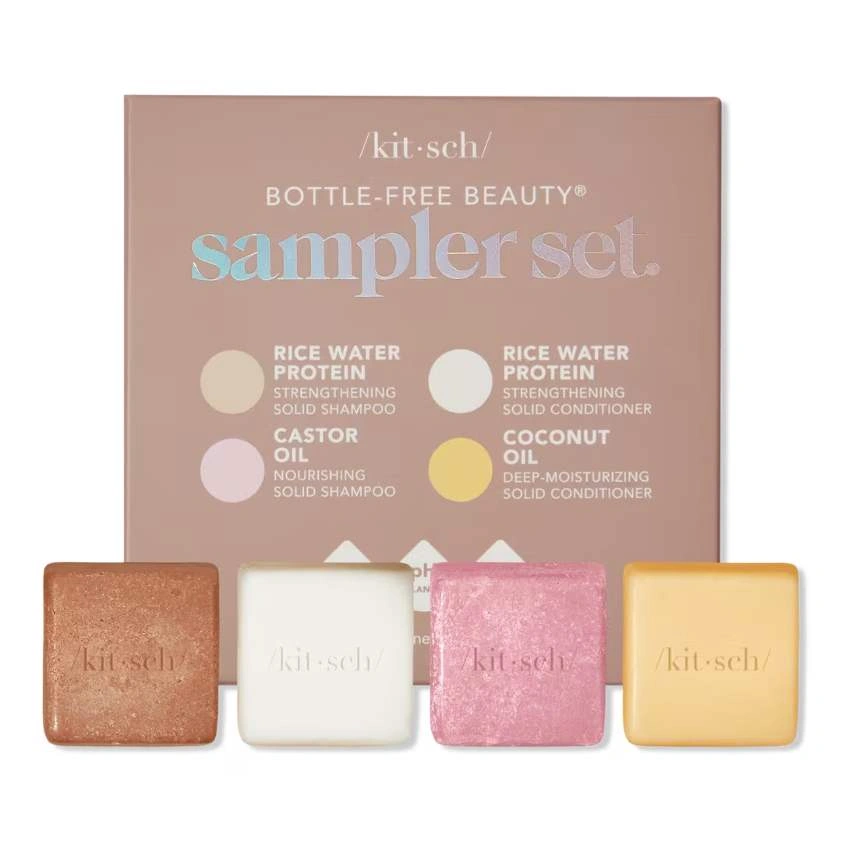
The Kitsch Bottle-Free Beauty 4pc Sampler Set is a compact introduction to solid shampoo and conditioner bars, combining four of the brand’s haircare formulas in one trial-size collection. The set includes the Rice Water Strengthening Shampoo, Rice Water Strengthening Conditioner, Castor Oil Nourishing Shampoo, and Coconut Oil Deep-Moisturizing Conditioner, allowing users to compare a strengthening-focused wash routine with a richer moisture-focused combination before moving to full-size bars.
Unlike conventional liquid shampoo and conditioner, none of these products depends on a plastic bottle to hold a water-heavy formula. Their concentrated solid format also makes the sampler particularly convenient for travel, gym bags, and anyone interested in testing bottle-free haircare without immediately committing to four full-size bars.
About Bottle-Free Beauty 4pc Sampler Set
Solid haircare can require more adjustment than simply replacing one bottle with another. A shampoo bar has to create cleansing lather when wet, while a conditioner bar needs enough contact with the hair to deposit conditioning ingredients without the easy visual cue of squeezing cream from a bottle.
The Bottle-Free Beauty 4pc Sampler Set makes that transition less of a commitment.
Rather than selecting one full-size shampoo and conditioner based only on a product description, the set lets users compare two different shampoo approaches and two different conditioner profiles. The Rice Water pair emphasizes hydrolyzed rice protein and strengthening, while the Castor Oil Shampoo and Coconut Oil Conditioner lean more heavily toward moisture, softness, and shine.
This also means the four bars do not have to remain in two fixed pairs. In current retailer Q&A, Kitsch says the products can be mixed and matched according to the way the hair feels. Someone might use Rice Water Shampoo followed by Coconut Oil Conditioner when stronger cleansing and richer conditioning are wanted, for example.
That flexibility is one of the more useful features of a sampler.
Bottle-Free Beauty 4pc Sampler Set Features
The set contains four distinct miniature formulas rather than four versions of the same product. Two are shampoos built around solid cleansing surfactants, while two are conditioners whose bases rely on fatty alcohols, conditioning agents, oils, and other strand-softening ingredients.
Kitsch currently describes the formulas as free from parabens, phthalates, silicones, sulfates, and artificial fragrance. The distinction between artificial-fragrance-free and fragrance-free matters because each published ingredient list still includes natural fragrance derived from plants.
The bars are also positioned as a bottle-reducing alternative to conventional liquid shampoo and conditioner. Kitsch says each full-size Bottle-Free Beauty bar can replace approximately two bottles of liquid product, although that is a manufacturer estimate and should not be automatically applied to these much smaller sampler pieces.
What Comes In The Four-Piece Set
The first pair is the Rice Water Strengthening Shampoo and Rice Water Strengthening Conditioner.
Both contain hydrolyzed rice protein. The shampoo combines that protein with solid cleansing agents, vegetable glycerin, hydrogenated castor oil, and a conditioning guar derivative. The matching conditioner instead uses cetearyl alcohol and behentrimonium chloride as its conditioning base, alongside coconut oil, sunflower seed oil, lauryl laurate, and hydrolyzed rice protein.
The second shampoo is Castor Oil Nourishing Shampoo.
Its currently published formula contains Sodium Cocoyl Isethionate, Sodium Methyl Cocoyl Taurate, vegetable glycerin, hydrogenated castor oil, Guar Hydroxypropyltrimonium Chloride, natural fragrance, and mineral-derived color ingredients.
The fourth bar is the Coconut Oil Deep-Moisturizing Conditioner. Its richer conditioning formula combines cetearyl alcohol, behentrimonium chloride, coconut oil, sunflower seed oil, cocoa seed butter, shea butter, lauryl laurate, conditioning guar, fragrance, and color ingredients.
Together, the four bars give the sampler a broader range than a simple shampoo-and-conditioner mini duo.
Rice Water Strengthening Shampoo
The Rice Water Strengthening Shampoo is the protein-focused cleanser in the set.
Its first two cleansing agents are Sodium Cocoyl Isethionate and Sodium Methyl Cocoyl Taurate. These ingredients allow the bar to function as a solid shampoo without relying on the traditional sulfates Kitsch excludes from the formulation. Vegetable glycerin and hydrogenated castor oil provide additional conditioning support, while hydrolyzed rice protein gives the product its defining strengthening story.
Kitsch currently markets the full-size Rice Water Shampoo around improved volume, shine, and the appearance of stronger hair. The company says its Rice Tein NPNF ingredient has been shown to increase hair volume by approximately 20% after five washes.
That claim needs context.
The published wording relates to the branded rice-protein ingredient and the manufacturer’s product marketing. It should not automatically be rewritten as an independent clinical trial proving that every person using the miniature sampler bar will achieve exactly 20% more hair volume.
A broader systematic review of rice-derived hair products found that research exists around rice-based materials and hair, while also showing that the evidence base includes different types of rice products and treatment approaches rather than one standardized shampoo formula.
For this bar, the safest expectation is protein-supported conditioning and cosmetic fullness rather than a guaranteed hair-growth percentage.
Hydrolyzed Rice Protein Versus Hair Growth Claims
The words “rice water” and “hair growth” are often used together online, but they should not be treated as interchangeable with clinically proven follicle treatment.
This Kitsch formula uses hydrolyzed rice protein, not simply homemade fermented rice water.
Hydrolysis breaks larger proteins into smaller fragments that can be more useful in cosmetic formulations. In a shampoo or conditioner, protein-derived ingredients may interact with the hair fiber and influence properties such as feel, surface condition, and apparent body.
That is different from creating new follicles or medically treating a form of hair loss.
Erothots would therefore describe the Rice Water pair as strengthening and volume-supporting haircare, not as a proven medication for hair loss.
If genuine shedding or noticeable changes in scalp density are a concern, the American Academy of Dermatology’s hair-loss guidance emphasizes gentle haircare while also recognizing that hair loss can have causes that need proper evaluation.
Rice Water Strengthening Conditioner
The matching conditioner changes the formula structure completely.
Instead of surfactants, its base begins with Cetearyl Alcohol and Behentrimonium Chloride. These ingredients are common in conditioner systems because they help give the product structure, reduce static, improve slip, and make wet hair easier to manage.
The formula then adds coconut oil, sunflower seed oil, lauryl laurate, conditioning guar, and hydrolyzed rice protein.
The presence of cetearyl alcohol should not be confused with a drying alcohol. Fatty alcohols are routinely used in conditioners to improve softness and texture.
This bar therefore complements the Rice Water Shampoo rather than simply repeating its strengthening ingredients.
The shampoo removes scalp oil and residue. The conditioner focuses more heavily on the lengths and ends, where friction and tangling matter.
Dermatologists similarly recommend using conditioner after shampoo. The American Academy of Dermatology’s healthy hair guidance notes that conditioner moisturizes and detangles hair and advises concentrating it on the ends for fine or straight hair while dry or curly hair may benefit from conditioning through more of the length.
Castor Oil Nourishing Shampoo
The Castor Oil Nourishing Shampoo removes hydrolyzed rice protein from the formula and puts more emphasis on a short, moisture-oriented cleansing composition.
Its current ingredient declaration is Sodium Cocoyl Isethionate, Sodium Methyl Cocoyl Taurate, Vegetable Glycerin, Hydrogenated Castor Oil, Guar Hydroxypropyltrimonium Chloride, Natural Fragrance, Iron Oxide, and Ultramarine.
The cleansing agents perform the main washing function.
Hydrogenated castor oil contributes to the emollient side of the bar, while glycerin and conditioning guar help balance its cleansing character.
Kitsch positions the Castor Oil bar around nourishment, shine, and dry or damaged-looking hair rather than around the protein-focused volume story of the Rice Water Shampoo.
That makes the sampler useful for comparing how the hair responds to two solid shampoos with similar cleansing architecture but different supporting ingredients.
Coconut Oil Deep-Moisturizing Conditioner
The richest formula in the set is the Coconut Oil Deep-Moisturizing Conditioner.
Its published formula contains coconut oil, sunflower seed oil, cocoa seed butter, and shea butter within a cetearyl-alcohol and behentrimonium-chloride conditioning base.
This creates a noticeably different ingredient profile from the Rice Water Conditioner.
The Rice Water version includes hydrolyzed rice protein and a simpler oil system. The Coconut Oil conditioner replaces that protein focus with a richer mixture of plant lipids and butters.
That may make it particularly appealing when the hair feels rough, dry, or difficult to detangle.
People with very fine hair may prefer to begin with a lighter application, especially near the roots. Rich conditioning ingredients can be useful without necessarily needing to be applied heavily over the entire scalp.
For curly or naturally dry hair, more conditioner may feel appropriate. The AAD’s curly-hair guidance notes that curly hair tends to be drier and often benefits from generous conditioning throughout the hair rather than only at the tips.
Coconut Oil In Haircare Has Useful Research Context
Coconut oil is more than a decorative ingredient name in haircare.
Research has investigated how coconut oil interacts with the hair fiber and why it behaves differently from some other oils. Its relatively high affinity for hair proteins has helped make it a common ingredient in products designed around dryness and damage.
That does not mean a small amount of coconut oil inside a conditioner bar will reproduce every result from studies using pure oil under controlled conditions.
The complete conditioner also contains fatty alcohols, conditioning agents, sunflower oil, cocoa butter, shea butter, fragrance, and other ingredients.
The more realistic expectation is improved slip, softness, and conditioned feel rather than permanent biological repair of damaged hair.
Color-Treated Hair Compatibility
Kitsch currently states that all four bars in the sampler are color-safe and gentle enough for color-treated hair.
That makes the set more practical for people who have dyed, highlighted, or otherwise color-treated hair but still want to experiment with solid formats.
Color-safe should not be interpreted as color-proof.
Wash frequency, water temperature, dye chemistry, hair porosity, UV exposure, heat styling, and the condition of the hair can all influence how quickly artificial color changes.
The claim is best read as compatibility with color-treated hair rather than a guarantee that every shade will retain exactly the same intensity for a set number of washes.
Natural Fragrance Does Not Mean Fragrance-Free
The set is currently marketed as being free from artificial fragrance, but all four published formulas contain Natural Fragrance derived from plants.
Kitsch also confirms in current product Q&A that the bars are lightly fragranced and directs people wanting an unscented option toward its separate fragrance-free sensitive bars.
This distinction matters for shoppers with fragrance sensitivities.
The FDA’s information on cosmetic fragrance explains that fragrance mixtures may be declared collectively as “fragrance” on cosmetic labels rather than listing every aromatic component separately.
Therefore:
Artificial-fragrance-free: Yes, according to Kitsch.
Fragrance-free: No.
Naturally fragranced: Yes.
That wording is considerably more precise than simply describing the set as unscented or fragrance-free.
Sulfate-Free Solid Shampoo Does Not Mean Soap
The two shampoo bars use Sodium Cocoyl Isethionate and Sodium Methyl Cocoyl Taurate as their primary cleansing agents.
That is useful because not every solid cleansing bar is traditional soap.
Solid shampoo can be created using cosmetic surfactants in a compressed bar format. The physical shape alone does not tell us how the product cleans.
Kitsch currently labels the sampler sulfate-free, and the published formulas do not list familiar sulfate surfactants such as Sodium Lauryl Sulfate or Sodium Laureth Sulfate.
Erothots would therefore describe these as solid shampoo bars, not ordinary soap bars being repurposed for hair.
Working The Bars Into A Wash Routine
The shampoo bars need water and friction before they can distribute effectively.
Kitsch recommends thoroughly wetting the hair and either rubbing the shampoo bar between wet hands to create lather or moving the bar carefully across the scalp before massaging with the fingertips. The shampoo is then rinsed away.
The important part is directing most of the shampoo toward the scalp rather than repeatedly dragging a concentrated cleansing bar through fragile ends.
That fits with dermatologist hair-washing advice, which recommends concentrating shampoo on the scalp so oil and buildup are removed while avoiding unnecessary drying of the lengths.
After shampooing, the conditioner bar can be warmed with water and worked mainly through the lengths and ends.
Kitsch suggests either distributing product from the hands or carefully moving the bar directly over the hair before finger-combing and rinsing.
Solid Conditioner Can Feel Different At First
Liquid conditioner immediately gives a visible amount in the palm. A solid conditioner works more gradually.
That can make first-time use confusing because a wet bar may not appear to release much product even though conditioning ingredients are being transferred onto the strands.
Starting with thoroughly wet hair helps.
The conditioner can be moved over the mid-lengths and ends several times before the hair is finger-combed to distribute the product more evenly.
Applying more pressure is not necessarily the answer. Roughly dragging a conditioner bar through tangled hair can create unnecessary mechanical stress.
The AAD’s guidance on habits that damage hair recommends gentle washing, regular conditioner use, and minimizing rough handling when hair is wet.
Why Bar Storage Matters
A solid haircare product should not remain sitting in pooled shower water between washes.
If the bar stays wet continuously, its outer surface can soften and product may be lost much faster than necessary.
Allowing air to circulate around the bar helps it dry between uses. Kitsch sells dedicated mesh storage products and says airflow can help keep its solid bars dry and extend their practical life.
The sampler itself does not need a specialized accessory to function, but some kind of well-draining soap dish or dry storage arrangement makes sense.
This becomes especially important when traveling. Placing a still-wet shampoo bar directly into an airtight container can leave it soft by the next use.
Bottle-Free Does Not Automatically Mean Zero-Waste
The strongest sustainability feature is easy to understand: the hair products themselves do not need individual liquid-shampoo or conditioner bottles.
Kitsch says its full-size bars reduce single-use plastic and estimates that one full bar can replace approximately two liquid bottles.
The broader waste-reduction principle is also consistent with U.S. EPA guidance on reducing plastic waste, which notes that preventing waste from being created in the first place can be preferable to dealing with it after disposal and recommends considering products with less packaging.
However, “bottle-free” should not automatically be rewritten as zero-waste, plastic-free in every component, or carbon neutral unless those separate claims are verified.
The most defensible claim is narrower: switching from individual bottled shampoo and conditioner to concentrated solid bars can reduce reliance on disposable liquid-product bottles.
Travel Practicality
Solid haircare has a natural travel advantage because the bars do not behave like bottles of liquid shampoo and conditioner.
The miniature format also lets someone pack four haircare options in considerably less space than four standard bottles.
That can be convenient for a short trip, gym bag, overnight stay, or simply trying solid haircare at home.
The sampler also reduces the cost and storage commitment involved in testing several formulas.
Someone who discovers that protein-focused haircare is not their preference may still find the Castor Oil Shampoo or Coconut Oil Conditioner better suited to their routine.
Conversely, hair that responds well to the Rice Water pair can move to the corresponding full-size bars later.
That trial function may be the strongest reason to choose the sampler rather than buying four individual full-size products immediately.
Current Ingredient Profile
The Castor Oil Nourishing Shampoo currently lists: Sodium Cocoyl Isethionate, Sodium Methyl Cocoyl Taurate, Vegetable Glycerin, Hydrogenated Castor Oil, Guar Hydroxypropyltrimonium Chloride, Natural Fragrance, Iron Oxide, and Ultramarine.
The Rice Water Protein Shampoo currently lists: Sodium Cocoyl Isethionate, Sodium Methyl Cocoyl Taurate, Vegetable Glycerin, Hydrogenated Castor Oil, Guar Hydroxypropyltrimonium Chloride, Hydrolyzed Rice Protein, Natural Fragrance, and Iron Oxide.
The Rice Water Protein Conditioner currently lists: Cetearyl Alcohol, Behentrimonium Chloride, Coconut Oil, Sunflower Seed Oil, Lauryl Laurate, Guar Hydroxypropyltrimonium Chloride, Hydrolyzed Rice Protein, and Natural Fragrance.
The Coconut Oil Deep-Moisturizing Conditioner currently lists: Cetearyl Alcohol, Behentrimonium Chloride, Coconut Oil, Sunflower Seed Oil, Cocoa Seed Butter, Shea Butter, Lauryl Laurate, Natural Fragrance, Guar Hydroxypropyltrimonium Chloride, Mica, Titanium Dioxide, Tin Dioxide, and Iron Oxide.
Cosmetic formulas can change. The ingredient information printed on the sampler being purchased should therefore remain the final reference, particularly for allergies or ingredient restrictions. The FDA cosmetics labeling guide explains the general U.S. framework for cosmetic ingredient declarations.
Who May Prefer Bottle-Free Beauty 4pc Sampler Set
The set makes the most sense for someone who is curious about solid shampoo and conditioner but has not yet determined which type suits their hair.
The Rice Water pair is the obvious starting point when strengthening, visible body, and protein-based conditioning are priorities.
The Castor Oil Shampoo may appeal more when a nourishing cleanse and shine are wanted without the rice-protein emphasis.
The Coconut Oil Deep-Moisturizing Conditioner is the richest choice in the set and may suit dry, rough, curly, or damaged-feeling lengths particularly well.
Because Kitsch currently describes all four bars as color-safe and suitable across hair types, the sampler is not restricted to one curl pattern or one type of color treatment.
Still, “all hair types” does not mean every formula will feel identical on everyone.
Fine hair may prefer less conditioner. Very dry or curly hair may want more. Hair that dislikes frequent protein-containing products may prefer rotating the Rice Water pair rather than using it at every wash.
The value of the sampler is being able to find that balance without starting with four full bars.
Erothots Take On Bottle-Free Beauty 4pc Sampler Set
The Kitsch Bottle-Free Beauty 4pc Sampler Set is strongest as a comparison kit rather than as one fixed haircare regimen.
It gives users two genuinely different shampoo experiences and two conditioner profiles. The Rice Water Shampoo and Conditioner introduce hydrolyzed rice protein for strengthening and visible body. Castor Oil Nourishing Shampoo removes that protein emphasis in favor of a compact moisture-focused cleansing formula. Coconut Oil Deep-Moisturizing Conditioner then adds the richest lipid blend of the four, including coconut oil, sunflower oil, cocoa butter, and shea butter.
The solid format is another practical advantage. There are no individual liquid-product bottles, and the smaller sampler pieces are easy to store or travel with. Kitsch’s broader claim that each full-size bar can replace approximately two bottles provides useful sustainability context, but that figure should not be incorrectly applied to each miniature sample.
The formula claims also benefit from careful wording. These bars contain natural fragrance, so artificial-fragrance-free does not mean fragrance-free. The Rice Water products contain hydrolyzed rice protein, but they should not be marketed as medical hair-growth treatments. Kitsch’s 20% volume claim relates to its Rice Tein ingredient and should remain in that testing context rather than becoming a guaranteed sampler-set result.
For someone new to bottle-free haircare, the biggest benefit is simple: four concentrated formulas provide enough variety to compare strengthening, nourishment, and deeper conditioning before committing to a full-size solid-hair routine.
Reviews
There are no reviews yet.