




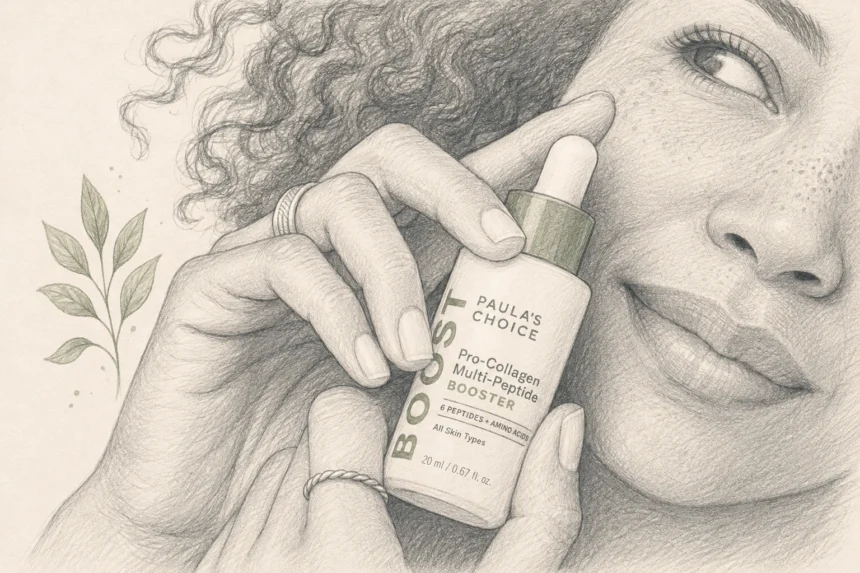
My first peptide skincare failed before I had even worked out what kind of peptide it contained.
I remember pressing the dropper against my palm one evening and thinking the product looked reassuringly scientific. The serum came in a heavy frosted bottle, the label mentioned multiple peptides and the product page used phrases about signalling, firmness and advanced skin communication.
I applied it after an exfoliating toner and before a fragranced night cream. Within twenty minutes, the skin beside my nose was red and itchy.
I blamed the peptides.
That conclusion felt sensible at the time, but it was not supported by anything beyond timing. I had introduced three unfamiliar formulas during the same week. I did not know whether the reaction came from the peptide complex, the preservative system, the fragrance, the toner or simply the total number of products.
My failure was not choosing the “wrong peptide.” It was treating the word peptide as though it described one predictable ingredient.
Peptide Is a Category, Not a Complete Explanation

Peptides are short chains of amino acids, but skincare formulas use many different peptide types for different intended purposes.
A recent review of peptides used in cosmetic formulations describes categories including signal peptides, carrier peptides, neurotransmitter-inhibiting peptides and enzyme-inhibiting peptides. Those names refer to proposed roles and mechanisms, not a guarantee that every finished serum will create a visible result.
That distinction changed the way I read labels.
At first, I thought “multi-peptide” automatically meant comprehensive. Later, I realised it could simply mean that several peptide ingredients were present, sometimes in undisclosed amounts and inside a formula whose overall performance depended on stability, delivery and supporting ingredients.
A systematic review of oral and topical peptides published in 2026 found encouraging results for some outcomes, but it also reported inconsistent effects for elasticity and skin density. The evidence was not a blank cheque for every peptide product on the market.
Sensitive Skin Made My Buying Mistake More Obvious
My skin was not reacting to a marketing category. It was reacting to a finished formulation.
That sounds obvious now, but I had been shopping as though the hero ingredient existed separately from everything surrounding it. I would search for a peptide name, see it on the ingredient list and stop investigating.
The FDA’s information on cosmetic ingredients helped correct another assumption. With limited exceptions such as certain colour additives, cosmetics and their ingredients are not individually approved by the FDA before sale. Companies remain responsible for ensuring product safety under labelled or customary conditions of use.
An impressive ingredient name therefore does not remove the need to assess the brand, formulation, packaging and claims.
This was where 1.Anchor gave me a better point of comparison. Instead of asking whether a serum sounded more advanced than another, I began comparing what was disclosed, how the product was meant to be used and whether the formula respected sensitive skin.
I Started Looking at the Evidence More Carefully

Peptide research is real, but it is uneven.
A 2025 review of commercially available cosmetic peptides identified more than one hundred peptide ingredients and examined laboratory and ex vivo evidence for their possible effects. That number impressed me, but it also showed why broad claims about “peptide skincare” can be misleading.
Different peptides should not be treated as interchangeable, and evidence involving isolated materials does not automatically predict how a particular retail serum will behave on a person’s face.
Delivery is another challenge. A study examining peptide interactions with the skin-cell surface noted that limited interaction can reduce the performance of functional cosmetic peptides. In practical terms, putting a promising peptide into a bottle is not the final step.
Even familiar ingredients deserve careful interpretation. A review of acetyl hexapeptide-8 found encouraging preclinical and clinical findings for hydration and wrinkle appearance, while also noting uncertainty about whether it reaches the deeper target sometimes implied by “Botox-like” marketing.
That was a useful lesson in reading claims. A cosmetic can improve how lines look without functioning like an injected prescription treatment.
The Routine Around the Serum Mattered More Than I Expected
When I tested a peptide product again, I changed the experiment.
I used one fragrance-free serum with a short routine. I did not apply it on an exfoliation night, and I did not begin a retinoid during the same month. I tested it on a small area first and watched for persistent itching, swelling or redness rather than assuming every sensation was normal.
This did not make the serum dramatic. It made the result interpretable.
Over time, my skin felt better hydrated and looked slightly smoother. I could not honestly attribute every change to peptides because I was also moisturising consistently and using sunscreen. That uncertainty is part of responsible skincare assessment.
It also prevented me from treating peptides as replacements for ingredients with stronger evidence for specific concerns. The AAD’s guidance on retinoids and retinol explains their established uses while warning that they can irritate dry, inflamed or sensitive skin. Peptides may feel easier for some people to tolerate, but “gentler” and “equally proven for every outcome” are not the same claim.
What I Now Expect From a Peptide Product

I expect modesty.
I trust a formula more when its claims match what a topical cosmetic might reasonably achieve. Phrases such as “supports smoother-looking skin” tell me less than clinical data, but they concern me less than claims suggesting that a serum rebuilds the face or duplicates a medical procedure.
I also look for airtight or otherwise protective packaging when the brand explains that stability matters. I check whether the company identifies the actual peptide ingredients rather than hiding behind “peptide technology.” I consider whether the product adds something useful to my routine or merely duplicates the moisturising function of products I already own.
For sensitive skin, I pay as much attention to fragrance, solvents, botanical extracts and the recommended frequency as I do to the peptide itself.
My first serum did not teach me that peptides were bad. It taught me that ingredient-led shopping can create false confidence.
A peptide name can begin the investigation. It should not end it.