



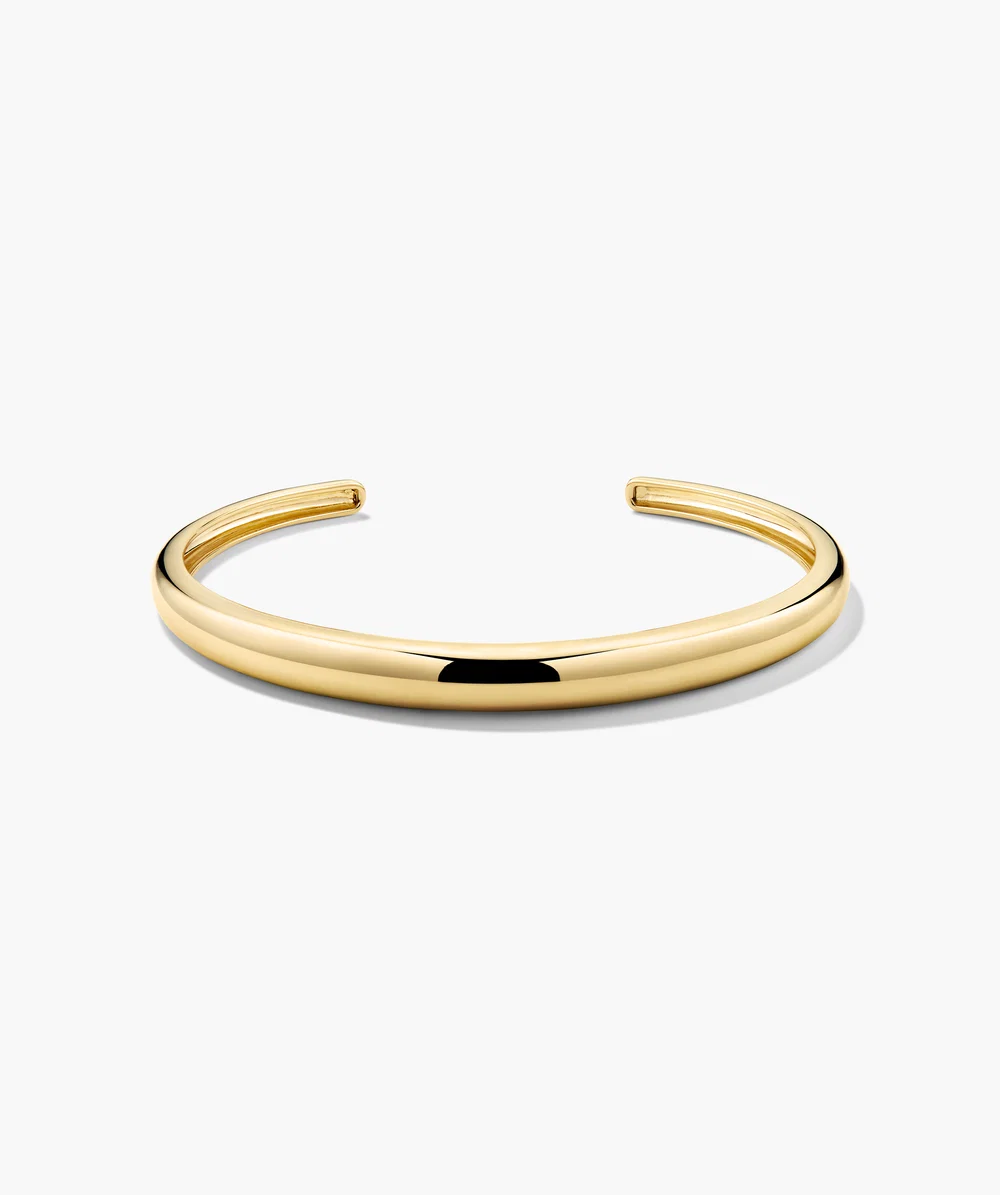
The Dôme Cuff Bracelet by Mejuri translates the rounded, sculptural look of the Dôme collection into a relatively slim 6.3 mm wrist silhouette. Rather than relying on gemstones, charms, or textured links, the design uses a smooth curved metal surface to create its visual impact. Current versions are offered in 18k gold vermeil over sterling silver and 925 sterling silver, with fixed 6.5-inch and 7-inch lengths. (Mejuri)
For Erothots shoppers, this is best understood as a polished sculptural bracelet rather than a flexible chain. Its clean surface works easily on its own, beside a watch, or as the structured element within a bracelet stack.
About Dôme Cuff Bracelet
The Dôme Cuff Bracelet follows Mejuri’s broader Dôme design language, where volume and rounded metal surfaces provide the main decoration. The standard cuff is considerably narrower than the brand’s separate 13 mm and 20 mm Dôme Cuff styles, making this 6.3 mm version the more restrained interpretation of the shape. (Mejuri)
Its design contains no gemstones in the current standard version. Instead, the polished surface produces changing reflections as the wrist moves.
The bracelet is also sold in fixed lengths rather than through an adjustable extender system. Mejuri currently advises sizing up when a looser fit is preferred. (Mejuri)
Dôme Cuff Bracelet Features
Current verified specifications include a 6.3 mm width, fixed 6.5-inch and 7-inch length options, an 18k gold-vermeil version, and a 925 sterling-silver version. Mejuri currently describes both material options as hypoallergenic and states that the sterling-silver material used is 91% recycled. (Mejuri)
The standard Dôme Cuff Bracelet has no published gemstone component and no adjustable length mechanism.
6.3 mm Sculptural Width
The bracelet measures 6.3 mm wide. (Mejuri)
That dimension creates an interesting middle ground.
It is wider and more visually substantial than a very fine chain bracelet, yet considerably narrower than Mejuri’s larger 13 mm and 20 mm Dôme cuffs. (Mejuri)
This makes the standard Dôme Cuff easier to combine with other wrist jewelry without giving up the rounded Dôme shape.
The smooth surface also means the full 6.3 mm width contributes to reflection rather than being interrupted by open links.
Dôme Cuff Bracelet Fit And Silhouette
The bracelet has a clean, structured silhouette that follows the wrist more closely than a loose chain bracelet.
Because the design is sold at fixed lengths, the selected size determines how much movement and space the cuff has around the wrist.
Mejuri currently offers:
| Size | Bracelet Length |
|---|---|
| 6.5 | 6.5 inches |
| 7 | 7 inches |
The manufacturer states that the bracelet cannot be adjusted and recommends choosing the larger size when a looser fit is preferred. (Mejuri)
Choosing Between 6.5 And 7 Inches
The half-inch difference can noticeably affect how the bracelet sits.
A closer fit keeps the cuff nearer the wrist and can make the sculptural surface feel more integrated with the arm.
A looser fit gives the bracelet more freedom to shift during movement.
Wrist circumference should therefore be considered before choosing between the two sizes rather than relying on clothing size or another unrelated bracelet measurement.
Because there is no published adjustable extender section, fit cannot simply be lengthened after purchase.
Fixed Length Rather Than Adjustable
Mejuri specifically identifies the Dôme Cuff Bracelet as fixed length. (Mejuri)
That distinguishes it from many chain bracelets that use several extension loops.
A fixed length contributes to the cleaner visual profile because there is no dangling extender section.
The trade-off is that choosing the appropriate length matters more.
For Erothots product copy, it is therefore useful to present sizing as part of the bracelet’s construction rather than treating it as a minor specification.
18k Gold Vermeil Version
The warm-toned version uses 18k gold vermeil over sterling silver.
Mejuri describes its vermeil as a thick layer of 18k gold plated onto a sterling-silver base and states that the underlying sterling silver contains 91% recycled material. (Mejuri)
This is not the same as a solid 18k gold bracelet.
The U.S. Federal Trade Commission explains that vermeil is a specific type of gold-plated jewelry using sterling silver as the base metal. (Consumer Advice)
FTC guide to gold, silver and vermeil jewelry
The accurate product description is therefore 18k gold vermeil over sterling silver.
Sterling Silver Version
The silver version uses 925 sterling silver.
Mejuri describes this material as 92.5% pure silver and currently states that its sterling-silver jewelry uses 91% recycled material. (Mejuri)
FTC consumer guidance independently explains that sterling silver contains 92.5% pure silver, which is why the number 925 is commonly associated with sterling jewelry. (Consumer Advice)
Two different percentages therefore appear in discussions of this bracelet:
92.5% refers to silver purity.
91% recycled material is Mejuri’s sourcing claim.
They should not be treated as the same measurement.
Gold Vermeil Or Sterling Silver
Both versions share the same current 6.3 mm width and fixed-length construction.
The main difference is visual and material.
18k gold vermeil creates a warmer appearance and coordinates naturally with yellow-gold rings, necklaces, earrings, and watch details.
Sterling silver produces a cooler, brighter surface that works especially well with silver jewelry, steel watches, and monochrome accessories.
Because the Dôme Cuff contains no gemstone, either version also adapts easily to mixed-metal styling.
What The 91% Recycled Claim Means
Mejuri currently states that its sterling silver is made using 91% recycled material, including the silver version of this bracelet and the sterling-silver base beneath the gold-vermeil version. (Mejuri)
That claim describes material sourcing, not precious-metal purity.
The Responsible Jewellery Council publishes Chain of Custody guidance for documenting responsibly sourced and recycled gold, silver, and platinum-group metals. Its framework explains how recycled material can be identified and tracked through a jewelry supply chain. (Responsible Jewellery Council)
Responsible Jewellery Council Chain of Custody guidance
This provides industry context for recycled-metal terminology but should not be treated as independent verification of Mejuri’s exact percentage unless product-specific certification is documented.
Smooth Dôme Surface
The visual identity of the bracelet comes from its polished curved surface.
A chain bracelet breaks reflected light into many separate links.
A textured cuff produces smaller highlights across engraved or brushed surfaces.
The Dôme Cuff instead presents one smooth, rounded strip of metal, creating larger reflections as the wrist changes angle.
This is why the design can remain visually noticeable despite having no gemstones.
Wearing Dôme Cuff Bracelet Alone
The bracelet has enough structure to work without additional wrist jewelry.
Worn alone, it creates one polished line around the wrist and keeps attention on the rounded metal form.
The gold-vermeil version can add warmth to simple black, cream, white, denim, brown, or navy outfits.
Sterling silver can create a sharper contrast with black, grey, blue, and other cooler clothing palettes.
Its moderate 6.3 mm width also helps it remain noticeable without becoming an oversized statement cuff.
Pairing It With A Watch
A watch and Dôme Cuff can create a simple two-piece wrist arrangement.
The sterling-silver version can coordinate naturally with many stainless-steel watch cases.
The gold-vermeil bracelet can work beside warm-tone or two-tone watch details.
If both pieces are worn closely together, some metal-on-metal contact may occur. Fine surface marks are a normal possibility when polished jewelry repeatedly rubs against other hard accessories.
Someone particularly concerned about preserving the finish can wear the cuff on the opposite wrist.
Stacking With A Chain Bracelet
One of the easiest ways to create contrast is to combine the smooth cuff with a flexible chain.
A cable chain introduces small links.
A rolo bracelet introduces visible circles.
A serpentine chain adds a flatter woven surface.
The Dôme Cuff then becomes the rigid, rounded component of the stack.
Different structures often create a more balanced wrist arrangement than wearing several cuffs of almost identical width and shape.
Pairing With A Tennis Bracelet
A fine tennis bracelet can add gemstone sparkle alongside the polished Dôme surface.
The cuff itself contains no stones, so it does not compete with a continuous diamond or sapphire line.
Leaving a small amount of space between the pieces can make both easier to see while reducing repeated contact.
The same approach can work with a gemstone station bracelet when a lighter amount of sparkle is preferred.
Mixed-Metal Styling
Dôme Cuff Bracelet does not need to match every other jewelry piece.
A sterling-silver cuff can sit beside yellow-gold rings.
The gold-vermeil version can be worn with silver earrings or a steel watch.
A mixed-metal necklace, ring, or watch can connect both tones elsewhere in the outfit, but even that is not essential.
The absence of colored stones makes this type of metal mixing especially straightforward.
Styling With Rings
The rounded Dôme surface pairs naturally with several ring shapes.
A domed ring repeats the curved metal theme.
A signet introduces a flatter, more geometric element.
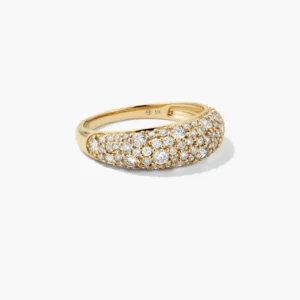
A pavé band adds sparkle.
A gemstone ring introduces color without competing with another gemstone on the wrist.
Repeating one design feature, such as rounded volume or polished metal, is often enough to make separate pieces feel connected.
Best Occasions For Dôme Cuff Bracelet
The standard Dôme Cuff is versatile because it falls between a delicate bracelet and an oversized sculptural cuff.
It can work with casual clothing, office tailoring, dinners, dresses, celebrations, travel wardrobes, and more polished evening outfits.
Wearing it alone creates a restrained look.
Adding a watch or another bracelet makes the wrist styling more noticeable.
The 6.3 mm width is especially useful for someone who likes the Dôme shape but finds the separate 13 mm or 20 mm versions too broad for everyday use. (Mejuri)
Understanding Precious-Metal Descriptions
Material wording matters because similar-looking jewelry can use very different construction.
For this bracelet:
18k gold vermeil means an 18k gold surface over sterling silver.
925 sterling silver means a silver alloy containing 92.5% pure silver.
Neither term should be replaced by a vague phrase such as “gold-tone” or “silver-tone” when exact manufacturer information is available.
UK hallmarking guidance similarly explains that gold and silver are usually alloyed for strength and that precious-metal fineness cannot reliably be judged simply by sight. (GOV.UK)
UK precious-metal hallmarking guidance
Hallmarking requirements vary by country and article weight, but the underlying principle supports accurate material descriptions.
Caring For Gold Vermeil
Gold vermeil deserves gentle care because the visible gold exists as a surface layer.
Avoid aggressive metal polishes, abrasive brushes, and repeated rubbing against rough surfaces.
GIA advises keeping fine jewelry away from household cleaners, chlorine, perfume, lotion, hairspray, and other chemicals that can affect precious-metal surfaces. (gia)
GIA guidance for caring for fine jewelry
Wiping the bracelet with a soft cloth after wear can remove ordinary fingerprints and skin oils without unnecessary abrasion.
Caring For Sterling Silver
Sterling silver can naturally tarnish over time.
That surface change does not automatically mean the bracelet is damaged.
A soft polishing cloth designed for sterling silver can help restore brightness.
The gold-vermeil version should not automatically be treated with the same aggressive silver-polishing products because its visible outer surface is gold.
Care should always match the actual material version.
Chemicals And Swimming Pools
GIA specifically advises removing fine jewelry before entering a chlorinated pool or using strong household cleaners. Chlorine bleach can damage gold alloys, while other chemicals can discolor or affect precious metals. (gia)
This remains sensible even when a jewelry brand describes a piece as durable.
Chemical resistance and ordinary everyday durability are not the same thing.
For long-term surface preservation, unnecessary exposure to chlorine and harsh cleaning products is best avoided.
Protecting The Polished Surface
A broad polished cuff can show fine scratches more visibly than a textured bracelet.
Normal contact with desks, door handles, watches, rings, and other hard surfaces may gradually create small marks.
Some wearers prefer a perfectly polished appearance and remove the bracelet during more physical activities.
Others are comfortable with the softer surface character that develops through regular use.
Either way, deep impacts and repeated scraping should be avoided.
Storing The Bracelet
Store the bracelet in a lined jewelry compartment or soft pouch rather than loose beneath heavier pieces.
Separate storage reduces scratches and helps protect the vermeil finish.
Because the bracelet is fixed length, it should not be sharply bent or compressed simply to fit a smaller storage container.
Keep its natural shape when placing it away.
Hypoallergenic Manufacturer Claim
Mejuri currently describes both Dôme Cuff Bracelet versions as hypoallergenic. (Mejuri)
That is a manufacturer description rather than a guarantee that every wearer will tolerate every metal alloy.
Anyone with a known metal sensitivity should consider their own allergy history and available material information rather than relying only on the word hypoallergenic.
No Gemstones In The Standard Version
The standard Dôme Cuff Bracelet contains no gemstones in Mejuri’s current specification. (Mejuri)
That differentiates it from gemstone bracelets and keeps the entire design focused on sculptural metal.
It also means there are no stone settings to maintain or gemstone treatments to consider during routine cleaning.
The metal construction remains the primary factor when choosing care methods.
Dôme Cuff Versus 13 mm And 20 mm Versions
Mejuri currently offers several Dôme cuff scales.
The standard bracelet discussed here measures 6.3 mm wide.
A separate 13 mm Dôme Cuff Bracelet creates roughly twice the width.
The separate 20 mm Dôme Cuff Bracelet is considerably broader and more statement oriented. (Mejuri)
For shoppers who like the same broad design language but want less wrist coverage, the standard 6.3 mm version is the most restrained of these currently surfaced Dôme cuff sizes.
What Makes Dôme Cuff Bracelet Different
The strongest feature is its use of volume rather than decoration.
At 6.3 mm wide, the bracelet is not particularly oversized, but the rounded Dôme surface gives the metal more visual depth than a flat band of similar width.
There are no stones, engraved motifs, charms, or visible chain links competing for attention.
That creates a bracelet that can be worn as one simple polished piece or used as a structural base for a more varied stack.
Final Note
The Dôme Cuff Bracelet combines a smooth 6.3 mm sculptural profile with fixed 6.5-inch and 7-inch lengths. Current Mejuri versions include 18k gold vermeil over sterling silver and 925 sterling silver, with Mejuri stating that the sterling-silver material contains 91% recycled content. (Mejuri)
For Erothots shoppers, the standard Dôme Cuff offers a useful balance between a fine bracelet and a much broader statement cuff. Its polished, gemstone-free design can work alone, beside a watch, or within a mixed bracelet stack while keeping the rounded Dôme form clearly visible.
Reviews
There are no reviews yet.