+1 571 662 8717 info.zerothots@gmail.com 10370 Festival Ln, Suite 109, Manassas, VA 20109
Erothots Massage And Body

Deep Tissue Massage By Erothots, Back, Neck, Shoulders

Slow, sustained pressure into the deeper layers of muscle and the tissue wrapped around it. Not an hour of drifting off, and not a Swedish massage done harder. Different technique, different intention, different result.

Deep tissue massage at the Erothots beauty salon
  • $95Sixty Minutes
  • Pressure Four To FiveAgreed Beforehand
  • Three ChecksDuring Every Session
  • Full Time On TableConsultation On Top
We Are Massage Therapists, Not Clinicians

We do not diagnose anything and we will never tell you what is wrong with your back. Deep tissue massage can do a great deal for tight, overworked muscle, and nothing at all for a structural problem that needs a doctor. If what you describe sounds like something we should not be treating, we will say so and suggest you see somebody qualified to look at it.

Tell us before booking if you have a history of blood clots or take anticoagulants, have uncontrolled high blood pressure, are recovering from surgery, have a fracture or an active infection, or are undergoing cancer treatment. Some of those mean we adapt the pressure and some mean we ask for your doctor's clearance first.

Section 01 / Honestly

What It Actually Does

Massage is sold with a great deal of language that does not survive scrutiny. We would rather tell you what the evidence actually supports, because it is genuinely useful and it does not need embellishing.

Muscle that has been working too hard for too long sits at a raised resting tone. It never fully switches off, even when you are not using it. Sustained pressure into that tissue reduces the tone, and the effect is partly mechanical and partly your nervous system deciding it can stop bracing.

The layers of tissue in your body are also supposed to glide over one another. When they stop moving freely, everything feels stiff and restricted well beyond the muscle itself. Slow sustained work restores some of that glide, which is why range of movement improves noticeably straight after a session.

And pain itself frequently drops for reasons that are not purely mechanical. Sustained pressure changes what the nervous system is doing, and a person who has been guarding an area for weeks often stops guarding it. That is a real effect and it is worth having.

The claims worth making are smaller than the usual ones, and they are actually true.
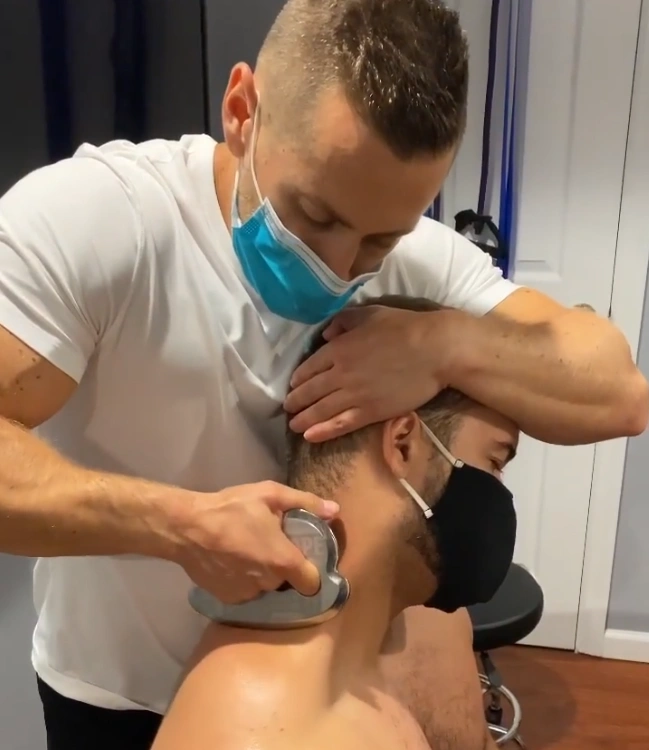
Deep tissue work on the shoulders at the Erothots salon

Slow, Sustained, And Aimed At One Thing At A Time

And What It Does Not Do
  • It does not release toxins. There are no toxins. Drink water afterward because hydrated tissue recovers more comfortably, not because anything is being flushed out of you.
  • It does not break down scar tissue. No hand generates enough force to do that. It can improve how tissue moves around an old injury, which is a different and more modest claim.
  • It does not permanently lengthen muscle. Muscle does not stay longer because it was pressed on. What changes is tone and tolerance, and that is why it needs repeating.
  • It does not fix structural problems. A disc issue, a nerve compression or a joint problem is not a massage problem. We can make you more comfortable around it and that is all.
  • It does not need to hurt to work. Harder is not better past a point, and past that point the muscle actively fights you.
Section 02 / Referred Pain

The Pain Is Rarely Where The Problem Is

This is the single most useful thing to understand about muscular pain, and almost nobody is ever told it. A tight muscle frequently produces pain somewhere else entirely, in a pattern that is consistent and well documented. Treating only the place that hurts is why so many people feel better for two days and then exactly the same again.

Upper TrapeziusTop Of The Shoulder
Refers To

Up the side of the neck, into the temple and behind the eye. A great many tension headaches begin as a knot in the shoulder, and no amount of pressing on your own forehead will touch it.

Levator ScapulaeSide Of The Neck
Refers To

The base of the skull and down the inside edge of the shoulder blade. This is the one that makes it hard to turn your head to one side, and it is almost always from holding a phone or looking at one screen off to the side.

Pectoralis MinorUpper Chest
Refers To

The front of the shoulder and down the arm. More importantly it pulls the shoulder forward, which leaves the upper back permanently overstretched and aching. If your upper back hurts, the cause is frequently in your chest.

Quadratus LumborumDeep In The Lower Back
Refers To

Across the lower back and into the hip and buttock. Frequently described simply as a bad back, and frequently one deep muscle on one side doing far more work than it should be.

Gluteus MediusSide Of The Hip
Refers To

Down the outside of the thigh, closely mimicking sciatica. People spend a long time treating a back that is not the problem. That said, genuine nerve pain needs a doctor, not us.

InfraspinatusBack Of The Shoulder Blade
Refers To

Deep into the front of the shoulder joint and down the arm. Commonly mistaken for a shoulder injury when it is a muscle on the back of the blade producing the sensation.

Which is why we ask where it hurts and then work somewhere else. If you come in with an aching upper back and we spend twenty minutes on your chest and the front of your shoulders, that is not us ignoring you. It is the only way that particular pattern ever changes.
Section 03 / Six Methods

The Techniques We Use

Deep tissue is not one thing done harder. It is a set of specific techniques, chosen for what the tissue is doing, and the choice is the skill rather than the pressure.

Method 01

Stripping

Slow gliding pressure along the length of the muscle fiber, usually with a forearm or thumb, moving at perhaps an inch every two seconds. The foundation of everything else and the reason deep tissue is unhurried.

Method 02

Trigger Point Holds

Sustained pressure on one specific point for twenty to forty seconds, until the referred sensation fades. This is the technique that produces the odd feeling of something easing somewhere else entirely.

Method 03

Cross Fiber Friction

Pressure applied across the direction of the fibers rather than along them, usually at the points where muscle attaches to bone. Uncomfortable in a very specific way and highly effective at attachments.

Method 04

Myofascial Release

Slow sustained stretch of the tissue layer that wraps the muscle, worked without oil so there is grip. Held for minutes rather than seconds, and it looks like almost nothing is happening.

Method 05

Active Engagement

You move the limb slowly while pressure is held on the muscle. It reaches considerably deeper than passive work and it is why we occasionally ask you to do something rather than lie still.

Method 06

Pin And Stretch

The muscle is held firmly at one point while the limb is taken through a stretch. Excellent for the forearms and hip flexors, and one of the fastest ways to change how a muscle feels.

Section 04 / The Usual Suspects

Where People Carry It

Six areas that account for the overwhelming majority of bookings, and what is usually causing each. Almost every one of them traces back to sitting still in one position for a very long time.

Area 01Most Booked

Neck And Upper Shoulders

Forward head position at a screen, and a phone held between ear and shoulder. The muscles at the base of the skull end up holding the weight of your head slightly ahead of where it should be, for eight hours a day.

Area 02

Between The Shoulder Blades

The constant ache people describe as a knot they cannot reach. Usually not a knot at all but muscle held permanently overstretched because the chest in front of it has shortened.

Area 03

Chest And Front Of Shoulder

Rarely booked and frequently the actual cause. Sitting rounds the shoulders forward and shortens the chest, and everything behind pays for it. We will ask to work here even when it is not what hurts.

Area 04

Lower Back And Hips

Hip flexors shorten from sitting and pull on the lower back all day. The glutes meanwhile switch off from disuse, so the lower back quietly takes on work it was never designed to do.

Area 05

Forearms And Hands

Mouse, keyboard and phone. Rarely thought of as a massage area and one of the most immediately satisfying, particularly for anyone whose grip aches by the end of the day.

Area 06

Calves And Feet

Running, standing all day, and anyone who wears heels regularly. Tight calves also pull on the back of the knee and the sole of the foot, which is why the ache is often lower than the cause.

Section 05 / The Rule

Four To Five, And Why Not Six

Deep tissue lives at four and five on our pressure scale. There is no six, and if there were, it would not be better.

The reason is simple and it is the thing most people get wrong. When pressure exceeds what you can comfortably breathe through, the muscle contracts against it. That is a protective reflex and you cannot override it by being tough about it. A contracting muscle releases nothing, so the harder the therapist pushes past that point, the less actually changes.

So the test is your breathing. If you are breathing normally, we are in the right place. If you are holding your breath, clenching your jaw or gripping the table, we are past it and we back off and come at the same tissue a different way.

Three, Medium

Comfortable and noticeable. Where we begin every session, always.

Four, Firm

Into the muscle rather than over it. Good discomfort, easy breathing.

Five, Deep

Sustained work on a specific point. Intense, never sharp, never past the breath.

Sustained trigger point pressure during deep tissue massage at Erothots

Held Until The Referral Fades, Not Until It Hurts

Say Something If
  • You are holding your breath. The clearest signal there is, and the one you will notice before we do.
  • The sensation is sharp or burning. Deep tissue should be dull and heavy. Sharp is a different message entirely and we want to hear it immediately.
  • Anything tingles or goes numb. Stop us straight away. That is a nerve, not a muscle, and it is not something to work through.
  • You have stopped being able to relax the area. If you are actively bracing, nothing useful is happening and we are wasting your hour.
Saying stop is not a complaint. It is information, it makes the treatment better, and no therapist worth booking takes it personally. Far more people regret staying quiet than regret speaking up.
Section 06 / How Long, How Many

Sixty Or Ninety Minutes

Deep tissue is slow by definition, so length matters more here than for any other treatment on the menu. Working at an inch every two seconds, an hour genuinely does not cover a whole body.

60Minutes On The Table

Two Or Three Areas, Properly

Enough to do real work on the neck, shoulders and upper back, or on the lower back and hips. Not a full body, and any therapist offering you deep tissue full body in an hour is doing neither part well.

$95
90Minutes On The Table

The Whole Pattern

The only length that lets us treat the cause as well as the complaint. Chest and shoulders as well as the upper back, or hips and glutes as well as the lower back. If you have a long standing problem, book this one.

$135
One Session Or Several

A single deep tissue massage will make you feel considerably better for somewhere between three days and two weeks. Then, if nothing else has changed, the tissue returns to what it was doing before, because the thing causing it is still there.

For something that has been building for months or years, three or four sessions two weeks apart will achieve far more than the same number spread across a year. Each session starts from where the last one finished rather than from the beginning again.

  • Session one. Mostly assessment and moderate work. We find out how your tissue responds and how much it tolerates, and you are usually sore for a day or two afterward.
  • Session two, two weeks later. Where the real progress happens. Your tissue is already softer, you know what to expect, and we can go straight to the areas that mattered.
  • Session three. Working on the cause rather than the symptom, and this is the point where most people notice the problem has genuinely changed rather than been temporarily quieted.
  • Then every four to six weeks. Maintenance, before the tightness comes back rather than after. Waiting until it hurts again means starting from the beginning each time.
Section 07 / A Sixty Minute Session

How The Appointment Runs

The clock on your sixty minutes starts when hands go on, not when you walk through the door. The consultation and changing time sit outside it.

Before

Consultation, Fully Dressed

What hurts, how long it has been there, what makes it worse, your job and how you sit, any medication or conditions, and your pressure number. We may also ask you to move your arm or turn your head so we can see what is restricted.

0 To 12

Warming The Tissue

Broader, firmer strokes at pressure three across the whole area. Cold tissue does not respond to deep work and going straight in is how people end up bruised. This part is not filler.

12 To 30

The Primary Area

Stripping along the fibers, then trigger point holds where we find them. Slow work, and the first pressure check comes early in this section rather than being asked once in passing.

30 To 34

Second Check, And Repositioning

A proper check now that we are into the deep work, with a genuine invitation to move up or down. Then repositioning for the next area, with the towel held so you stay covered.

34 To 52

The Related Area

Frequently not where it hurts. Chest if the complaint is the upper back, hip flexors if it is the lower back. This is the section that decides whether the result lasts a week or a month.

52 To 60

Settling And Finishing

Lighter work over everything treated, which helps the area settle rather than being left raw. Then you are left alone to get up slowly, because sitting up quickly after deep work makes people lightheaded.

After

What We Found

A short honest summary of what was tight, what we worked on and why, and one or two things you could change at a desk that would help. Not a lecture and not a diagnosis.

Section 08 / Price Guide

Deep Tissue Prices

Every price is for that many minutes of hands on treatment, with the consultation and changing time on top rather than deducted. Nothing is added at the desk that was not agreed at booking.

Deep Tissue And Related Treatments
TreatmentTimePriceBest For
Targeted Deep Tissue45 minutes$75One area, one specific problem
Deep Tissue Massage60 minutes$95Two or three related areas
Deep Tissue Massage90 minutes$135The complaint and its cause
Deep Tissue With Hot Stone Warm Up90 minutes$150Very tight or cold tissue
Course Of Three, 60 MinutesTwo weeks apart$270Saves $15, pay per session
Course Of Three, 90 MinutesTwo weeks apart$385Saves $20, pay per session
On the course price. You pay per session rather than upfront, and if after the second one you decide it is not helping, you simply do not book the third and you have lost nothing. We would rather price it honestly than take three payments for something that turned out not to suit you.
Section 09 / Afterward

The Next Forty Eight Hours

Soreness after deep tissue is normal and expected, particularly after a first session. It is closer to the day after a good workout than to an injury, and it settles.

  • Expect a dull ache for one to two days. Most noticeable the morning after rather than the same evening. It fades on its own and it gets less pronounced with each session you have.
  • Move gently rather than resting completely. A walk the following day does considerably more than a day on the sofa. Stiffness settles faster with movement than without it.
  • Drink more water than usual. Because hydrated tissue recovers more comfortably, not because anything is being flushed out. It genuinely helps regardless of the reason.
  • Skip the heavy gym session. For twenty four hours. The muscle has had a workout of its own and stacking another on top is how people end up genuinely sore rather than pleasantly stiff.
  • Warmth helps, cold does not. A warm bath or a heat pack on the treated area the following day. Ice is for acute injury and this is not that.
  • Get up slowly on the day. Deep work can leave people briefly lightheaded, which is why we leave you alone rather than rushing you off the table.
Warm compress used after deep tissue massage at Erothots
Section 10 / Honestly

When To See Someone Else

We would rather send you to a doctor and lose the booking than treat something that needs looking at properly. If any of these describe you, please see a medical professional first.

  • Numbness, tingling or pins and needles. Anywhere down an arm or leg. That is a nerve signal and it needs a proper assessment rather than pressure applied to it.
  • Weakness in a limb. If something has genuinely become weaker rather than just sorer, that is not a massage problem and we will not treat it as one.
  • Pain that wakes you at night, consistently. Muscular pain generally eases when you are still. Pain that reliably wakes you is worth having looked at.
  • Pain following a fall or an accident. Get it examined before anybody puts pressure on it. We will happily treat you afterward once it has been cleared.
  • Anything steadily worsening over weeks. Despite rest, despite treatment, despite everything. Getting gradually worse is the signal that most deserves attention.
  • Swelling, heat or redness in one leg. Do not book a massage. Seek medical advice the same day, because massage over a possible clot is genuinely dangerous.
And once you have been cleared. Come back. A great deal of what a physical therapist treats benefits enormously from soft tissue work alongside it, and we are happy to work in whatever way your clinician has advised.
Section 11 / Six Complaints

What Usually Goes Wrong Elsewhere

Six things people describe about deep tissue somewhere else. Most come down to treating pressure as the whole skill.

Straight In Cold

Deep pressure applied in the first two minutes with no warming. Cold tissue does not respond to it, and this is how people end up bruised rather than released.

Here InsteadTwelve minutes at pressure three before anything deep happens. That part is not filler.

Pain Treated As Progress

Pressure pushed past what the client can breathe through, on the theory that more hurts more so it must be doing more. The muscle contracts against it and releases nothing.

Here InsteadYour breathing is the test. Holding it means we back off and come at the tissue differently.

Only Where It Hurts

An hour on the upper back that never touches the chest pulling it forward. The client feels better for two days and then feels exactly the same again.

Here InsteadWe treat the pattern, which frequently means working somewhere other than the complaint.

Full Body Deep Tissue In An Hour

Sold as good value. At the speed deep tissue actually works, dividing sixty minutes across a whole body means nothing gets treated properly.

Here InsteadSixty minutes is two or three areas. If you want the whole pattern, book ninety and we will say so.

Claims That Do Not Hold Up

Toxins released, scar tissue broken down, muscles permanently lengthened. None of it is true, and it makes everything else the therapist says harder to believe.

Here InsteadSmaller claims that happen to be accurate, which are still worth the money.

Treating What Needs A Doctor

Numbness, weakness or nerve pain worked on regardless, because the client booked and the slot is filled. At best it wastes their money and at worst it delays something serious.

Here InsteadWe will tell you to see somebody qualified, and we would rather lose the booking than not.
Section 12 / The Team

Who Will Treat You

For ongoing work on a specific problem, book the same therapist each time. Progress is cumulative and it helps enormously that somebody remembers what your tissue did last visit.

Selin Kaya, massage therapist at the Erothots beauty salon
Massage Therapist

Selin Kaya

Selin does all the deep tissue work here. She introduced the pressure scale after years of clients telling her afterward that it had been too light, having said it was fine at the time. She is also the reason this page refuses to make claims about toxins, on the grounds that if one thing a therapist says turns out to be nonsense, a client is entitled to wonder about the rest of it.

  • Deep Tissue
  • Trigger Point
  • Myofascial
  • Sports
Tia McNamara, founder and CEO of Erothots
Founder And CEO

Tia McNamara

Tia founded Erothots seven years ago and is fully qualified and insured. She does not massage herself, but she set the standards on this page: the full booked time hands on, pressure agreed and checked three times, proper draping throughout, and a referral to a doctor whenever something is beyond what a massage therapist should be treating. If something is not right, she wants to hear it directly.

  • 7 Years In Business
  • Fully Qualified
  • Fully Insured
Section 13 / Twelve Answers

Deep Tissue Questions

What Is Deep Tissue Massage

Slow sustained pressure into the deeper layers of muscle and the tissue wrapped around it, aimed at specific areas rather than the whole body evenly. It reduces raised muscle tone, improves how the tissue layers glide over each other, and frequently reduces pain. It is a different technique from Swedish massage, not the same one done harder.

How Much Does It Cost

Sixty minutes is $95 and ninety minutes is $135. A targeted forty five minute session on one area is $75, and ninety minutes with a hot stone warm up is $150. A course of three sixty minute sessions is $270 and you pay per session rather than upfront.

Does Deep Tissue Massage Hurt

It should be intense in a way you can breathe through, and never sharp or burning. Your breathing is the test. If you are holding your breath or clenching your jaw, the pressure is too much, and at that point the muscle contracts against it and releases nothing. Harder genuinely is not better past that line.

Should I Book Sixty Or Ninety Minutes

Sixty covers two or three related areas properly. Ninety is the only length that lets us treat both the complaint and whatever is causing it, which frequently means working somewhere other than where it hurts. If the problem has been building for months, book ninety.

How Many Sessions Will I Need

For something long standing, three or four sessions two weeks apart achieve considerably more than the same number spread across a year, because each one starts from where the last finished. After that, every four to six weeks for maintenance. A single session helps for somewhere between three days and two weeks.

Will I Be Sore Afterward

Quite possibly, for one to two days, and most noticeably the following morning. It is closer to the day after a good workout than to an injury. Move gently, drink more water, use warmth rather than ice, and skip the heavy gym session for a day. Sharp or worsening pain is not normal and we want to hear about it.

Can Deep Tissue Fix My Back Pain Or Sciatica

If the pain is muscular, it can help a great deal. If it is a disc, a nerve compression or a joint problem, it cannot fix it and we will not pretend otherwise. Numbness, tingling or weakness down a limb needs a doctor rather than a massage therapist. Once you have been assessed, soft tissue work alongside clinical treatment is often genuinely useful.

Do You Break Down Scar Tissue Or Release Toxins

No to both, and anywhere that tells you otherwise is repeating marketing rather than fact. No hand generates the force to break down scar tissue, and there are no toxins to release. What deep tissue does do is real and worth paying for, and it does not need those claims attached to it.

Can I Have Deep Tissue While Pregnant

Not deep tissue, no. From the second trimester we offer a dedicated pregnancy massage worked side lying at gentle pressure with no deep work on the legs. Tell us your due date when you book, and please check with your doctor or midwife first if you have any complications.

How Often Should I Book

Every four to six weeks for maintenance, booked before the tightness returns rather than after. Waiting until it hurts again means starting from the beginning each time. If you are actively working on a problem, every two weeks until it has genuinely changed.

What Should I Do Before The Appointment

Leave an hour or two after a large meal, skip a heavy workout that morning, and arrive ten minutes early since the consultation sits outside your booked time. Come ready to say where it hurts, how long it has been there and what makes it worse, because that shapes the whole session.

Do I Need To Undress

To your own comfort level, and most people keep underwear on. Your therapist leaves the room while you change and knocks before returning. Only the area being worked on is uncovered at any moment, chest and glutes stay draped throughout, and the towels are tucked rather than laid loosely.

Get In Touch

Book Your Deep Tissue Session

Tell us what hurts, how long it has been there and what you do all day. We will suggest the right length and say plainly if it sounds like something a doctor should look at first.

  • Monday9:00 AM to 6:00 PM
  • TuesdayClosed
  • WednesdayClosed
  • Thursday9:00 AM to 6:00 PM
  • Friday8:00 AM to 6:00 PM
  • Saturday7:00 AM to 2:00 PM
  • Sunday1:30 PM to 6:00 PM