



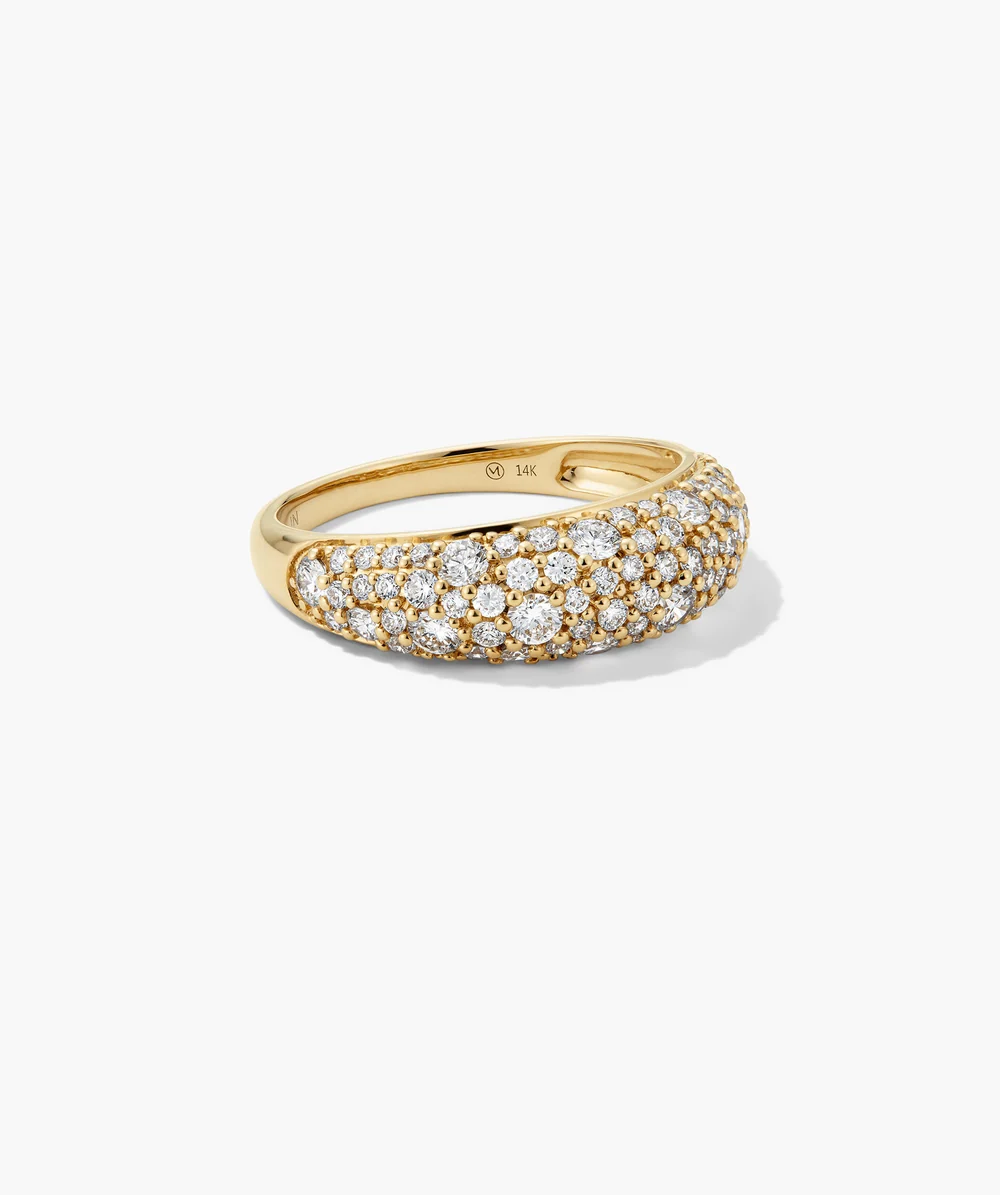
The Dôme Pavé Lab Grown Diamond Ring by Mejuri takes the rounded volume of the brand’s Dôme silhouette and covers its upper surface with differently sized lab-grown diamonds. Instead of centering the design around one solitaire, numerous smaller stones form a broad field of sparkle across the curved gold surface.
The current U.S. version is made in solid 14k yellow gold with a minimum total diamond weight of 1.06 ct. Mejuri lists FG diamond color, VS clarity, individual stone sizes from 1.1 mm to 2.4 mm, a 6 mm top width, and a 2 mm shank. Current sizes run from US 4 through 10.
About Dôme Pavé Lab Grown Diamond Ring
Dôme Pavé Lab Grown Diamond Ring is a statement ring, but its impact comes from surface coverage rather than one oversized center stone.
Mejuri describes the diamond arrangement as a cobblestone setting, using different stone sizes to create dense coverage across the rounded top of the ring. The variation from 1.1 mm to 2.4 mm allows the diamonds to follow the curved Dôme form more organically than a row of identical stones would.
That makes the ring visually different from a conventional pavé band. A standard pavé ring often carries small diamonds along a narrow strip of metal. Here, the pavé treatment spreads across a noticeably wider, sculptural upper surface.
Dôme Pavé Lab Grown Diamond Ring Features
The current verified specifications include a 1.06 ct minimum total lab-grown diamond weight, FG color, VS clarity, 1.1–2.4 mm individual stones, a 6 mm top width, 2 mm shank width, and solid 14k yellow-gold construction. Mejuri currently offers sizes 4 through 10.
Mejuri also currently describes the ring as water resistant and hypoallergenic, states that its U.S. 14k version uses 90% recycled gold, and makes manufacturer claims that its lab-grown diamonds are 100% traceable and associated with net-zero emissions. Those sustainability statements are Mejuri’s claims and should not be read as independent certification unless supporting documentation is provided.
Sculptural Dôme Shape
The Dôme collection is built around rounded volume and smooth, sculptural forms rather than flat bands.
On this ring, the upper section reaches 6 mm wide, giving the diamonds enough surface area to form a noticeable field of light. The band then narrows to a 2 mm shank, reducing visual weight around the underside of the finger.
This difference between top and shank width is important.
A ring measuring 6 mm around the entire finger would feel and look substantially broader. By concentrating the width at the upper surface, Dôme Pavé retains its statement character while keeping the lower band comparatively refined.
Cobblestone Pavé Diamond Setting
Mejuri uses the term cobblestone setting for this particular arrangement.
The design mixes diamonds measuring approximately 1.1 mm to 2.4 mm, filling the curved surface with different stone proportions.
That variation prevents the surface from looking like a standard mechanical row of equally sized pavé stones.
Larger and smaller diamonds can occupy different parts of the rounded form, allowing more of the visible upper area to be covered.
The effect is closer to a continuous diamond surface than a single line of stones across a band.
1.06 Carats Of Lab Grown Diamonds
Mejuri currently specifies a minimum carat weight of 1.06 ct.
This figure refers to the combined weight of the numerous lab-grown diamonds in the ring rather than one individual 1.06 ct stone.
That distinction matters when comparing it with a solitaire.
A one-carat solitaire concentrates nearly all of that weight into one central gemstone. Dôme Pavé distributes its total weight across many stones ranging from 1.1 mm to 2.4 mm, producing broad surface sparkle rather than one large focal diamond.
Understanding Lab Grown Diamonds
Laboratory-grown diamonds are diamonds produced through technological processes rather than geological formation underground.
GIA explains that laboratory-grown diamonds have essentially the same chemical composition, crystal structure, optical properties, and physical properties as natural diamonds. Their origin and growth history are different, and specialized gemological testing can distinguish them.
For useful independent background, see GIA’s laboratory-grown diamond guide.
The stones in this ring should therefore be described specifically as lab-grown diamonds, not simply as natural diamonds and not as diamond simulants.
FG Diamond Color
Mejuri lists the diamonds as FG color.
The GIA D-to-Z color grading system begins at D and progresses as visible body color increases. Within that system, D through F are classed as colorless, while G through J fall within the near-colorless category.
That means Mejuri’s FG specification sits around the transition between the upper colorless and near-colorless ranges.
For independent context, the GIA diamond color scale explains how the D-to-Z grading system works.
Because these are small pavé stones rather than one large solitaire, the collective brightness across the setting is likely to be more visually important than evaluating each tiny diamond separately with the unaided eye.
VS Diamond Clarity
The current ring specification lists VS clarity.
VS means Very Slightly Included within the GIA clarity terminology. GIA divides this category into VS1 and VS2 and explains that inclusions in these grades are minor when examined under 10× magnification.
Mejuri does not currently specify whether these stones are VS1 or VS2, so Erothots should retain the broader published VS description rather than assigning a more precise grade.
The GIA diamond clarity scale provides a useful explanation of how clarity grades are assessed.
Different Diamond Sizes Across The Surface
The stones range from 1.1 mm to 2.4 mm.
Using several sizes has both aesthetic and structural implications.
A rounded surface does not provide the same flat area at every point. Smaller diamonds can fit tighter areas of the curved top while larger stones create stronger flashes where more space is available.
This irregular rhythm distinguishes the ring from an eternity band built from identically sized diamonds.
It also reinforces the organic character of the broader Dôme collection.
Solid 14k Yellow Gold
The current U.S. Dôme Pavé Lab Grown Diamond Ring is made in solid 14k yellow gold.
This should not be confused with gold vermeil or gold plating.
The U.S. Federal Trade Commission explains that 14k gold contains 14 parts gold and 10 parts other metals out of 24 total parts. Pure 24k gold is comparatively soft, so gold used for jewelry is commonly alloyed with other metals.
For a clear explanation of karat terminology, see the FTC guide to buying gold jewelry.
The ring’s gold construction therefore extends throughout the piece rather than existing only as a decorative surface layer.
Recycled Gold Claim
Mejuri’s current U.S. product page states that the 14k gold used for this ring contains 90% recycled gold.
This percentage refers to material sourcing, not gold purity.
The ring remains a 14k gold alloy regardless of how much of the gold input was sourced from recycled material.
Responsible precious-metal sourcing systems are a separate subject from karat fineness. The Responsible Jewellery Council Chain of Custody standard provides broader industry context for tracing eligible recycled and responsibly sourced precious metals through jewelry supply chains.
That framework should not be treated as verification of Mejuri’s specific 90% claim unless the exact supply chain is certified under it.
6 mm Top Width
The top of the ring measures 6 mm wide.
This gives Dôme Pavé substantially more visual presence than a fine 1–2 mm stacking band.
The width also provides the area required for the cobblestone-style diamond arrangement.
On the hand, a 6 mm upper section can function as the main ring rather than simply disappearing into a stack of several similar bands.
Someone who usually wears very fine jewelry should expect this piece to feel visually stronger even though its lower shank narrows considerably.
2 mm Shank Width
The shank measures 2 mm wide.
That narrowing helps balance the substantial diamond-covered top.
It also creates more room around neighboring rings if Dôme Pavé is stacked, although the wide upper surface still deserves space so that the diamond setting does not constantly rub against another ring.
The contrast between a 6 mm top and 2 mm shank is one of the design details that makes the ring appear sculptural rather than simply broad.
Dôme Pavé Lab Grown Diamond Ring Fit And Sizing
Current U.S. sizes are 4, 5, 6, 7, 8, 9, and 10.
Because the ring carries a substantial 6 mm upper section and a pavé surface, accurate sizing matters.
GIA recommends professional measurement with proper finger gauges as one of the most reliable methods for determining ring size. It also notes that finger dimensions can change with temperature, time of day, and other factors.
The GIA ring sizing guide also explains why string and paper measurements can be less accurate.
GIA specifically notes that pavé-set rings can be more difficult to resize than plain bands, so getting the intended size right before purchase is worthwhile.
Wearing The Ring Alone
Dôme Pavé has enough width and diamond coverage to work easily as a standalone ring.
Wearing it alone gives the rounded shape and cobblestone diamond surface maximum visual space.
This approach can be especially effective when earrings or necklaces are kept simpler.
A fine gold chain, small hoop, or uncomplicated stud can complement the ring without competing with its broad diamond surface.
Building A Ring Stack
The ring can also be stacked, but surrounding bands should be selected with its 6 mm upper width in mind.
A narrow plain-gold band can provide contrast against the pavé.
A slim curved or nesting ring may interact more naturally with the Dôme profile than another equally wide statement ring.
A fine diamond band can increase sparkle, although placing two dense pavé surfaces directly against each other can create more visual and physical contact than necessary.
Leaving some separation can help each ring retain its own shape.
Pairing Pavé With Plain Gold
One of the cleanest combinations is diamond pavé beside smooth yellow gold.
The plain band creates a visual break, which makes the changing diamond sizes across Dôme Pavé easier to appreciate.
It also prevents the entire stack from becoming one continuous area of sparkle.
A polished signet or sculptural solid-gold ring on another finger can repeat the metal while keeping the pavé ring as the main gemstone piece.
Pairing With Other Dôme Rings
Mejuri positions Dôme Pavé within its wider Dôme collection, where rounded and sculptural silhouettes appear across several rings.
Combining related Dôme shapes can create a coordinated stack while allowing different finishes to provide contrast.
For example, a smooth Dôme ring can sit on another finger while Dôme Pavé provides the diamond-covered version of the same broader design language.
This can look more intentional than simply combining several unrelated statement rings.
Styling With Other Diamond Jewelry
Because the ring already contains at least 1.06 ct total diamond weight, other diamond jewelry does not need to be large.
Small diamond studs can repeat the sparkle near the face.
A fine diamond pendant can create another point of light without competing directly with the hand.
A simple tennis-style piece can work for more formal styling, although reducing other large gemstone pieces often allows Dôme Pavé’s textured surface to remain the main statement.
Styling With Colored Gemstones
The clear diamonds and yellow-gold setting also pair easily with colored gemstones.
Black onyx creates a strong dark contrast.
Green sapphire or emerald adds saturated color.
Pearl provides a softer organic surface.
Blue sapphire introduces cooler color beside the warm yellow gold.
Since the Dôme ring contains no colored stone of its own, another gemstone can be introduced elsewhere without creating a difficult color match.
Best Occasions For This Style
Dôme Pavé Lab Grown Diamond Ring is more visually substantial than a basic everyday stacking band, but it does not have to be reserved exclusively for formal events.
It can suit:
- Polished everyday jewelry
- Dinner styling
- Celebrations
- Milestone gifts
- Formal events
- Evening outfits
- Statement ring stacks
- Alternative bridal or commitment styling based on personal preference
Its broad pavé surface naturally becomes more noticeable in directional evening light, while the solid-gold construction keeps the underlying design simple enough to work beyond occasion wear.
Pavé Settings Need Thoughtful Care
Diamond is extremely hard, but a pavé ring includes many small settings that deserve attention.
The diamond itself can resist scratching very well, while tiny metal sections responsible for holding individual stones can still be affected by impact.
Avoid striking the ring against hard surfaces or wearing it during activities where repeated pressure falls directly on the diamond-covered top.
If one stone appears tilted, loose, or missing, stop wearing the ring until it can be professionally inspected.
Cleaning Lab Grown Diamonds
Laboratory-grown diamonds have essentially the same material properties as natural diamonds, so ordinary diamond-care principles apply to the stones themselves.
For a pavé ring, however, cleaning should consider the numerous small settings as well as the gemstones.
Use a gentle jewelry-cleaning approach rather than sharp tools around the individual stones.
A soft brush can help remove residue from spaces between diamonds, but aggressive pressure is unnecessary.
Periodic professional inspection can also be useful for a frequently worn pavé ring.
Lotions And Diamond Sparkle
Diamonds attract oils and can appear less bright when lotion, skincare, soap residue, or natural skin oils accumulate across the surface.
A ring with more than a carat of small pavé diamonds provides many tiny areas where residue can collect.
Removing the ring before applying thick hand creams can reduce buildup.
Regular gentle cleaning can restore much of the visible sparkle without needing abrasive products.
Protecting The 14k Gold
Fourteen-karat gold is suitable for fine jewelry, but the polished areas can still develop scratches.
Avoid exposing the ring unnecessarily to chlorine, strong household chemicals, or heavy impact.
Normal fine surface marks can develop with repeated wear and are different from structural damage.
Because the upper surface is dominated by pavé diamonds, the 2 mm lower shank is likely to show everyday metal wear more visibly than the stone-covered top.
What FG And VS Mean Together
The combination of FG color and VS clarity gives useful technical context, but those grades should not be treated as the entire story of the ring.
FG describes the manufacturer’s stated color range.
VS describes the stated clarity category.
Carat weight describes the total weight of all the lab-grown diamonds.
None of those figures alone explains the ring’s most visible characteristic, which is the way numerous differently sized stones are arranged over the curved 6 mm top.
That layout is what turns the individual specifications into the broader Dôme Pavé appearance.
Why The Different Stone Sizes Matter
If every stone were identical in diameter, maintaining dense coverage across a strongly curved surface would create a more uniform and mechanical pattern.
The 1.1-to-2.4 mm range gives the setting more flexibility.
Smaller stones can occupy narrow spaces between larger diamonds, while larger stones create stronger reflections across prominent portions of the dome.
The final effect is therefore more about continuous texture than about identifying each separate diamond.
Lab Grown Diamond Disclosure Matters
Laboratory-grown and natural diamonds may share essentially the same material properties, but their origins are different and should be disclosed accurately. GIA uses specialized testing to distinguish laboratory-grown diamonds from natural stones.
For Erothots, the complete product name should therefore retain Lab Grown Diamond rather than shortening the item simply to Dôme Pavé Diamond Ring.
Clear material disclosure helps shoppers compare jewelry based on what it actually contains rather than relying on appearance alone.
Final Note
The Dôme Pavé Lab Grown Diamond Ring combines the volume of a sculptural gold band with a dense field of differently sized laboratory-grown diamonds. Its current specifications include a minimum 1.06 ct total diamond weight, FG color, VS clarity, 1.1–2.4 mm stones, a 6 mm top, and a 2 mm shank, all set in solid 14k yellow gold.
For Erothots shoppers, its strongest quality is the way those specifications work together. This is not simply a narrow pavé band with more diamonds added. The rounded Dôme profile and mixed stone sizes create a broad, textured diamond surface that makes the ring suitable as a standalone statement or the focal piece of a carefully spaced ring stack.
Reviews
There are no reviews yet.