



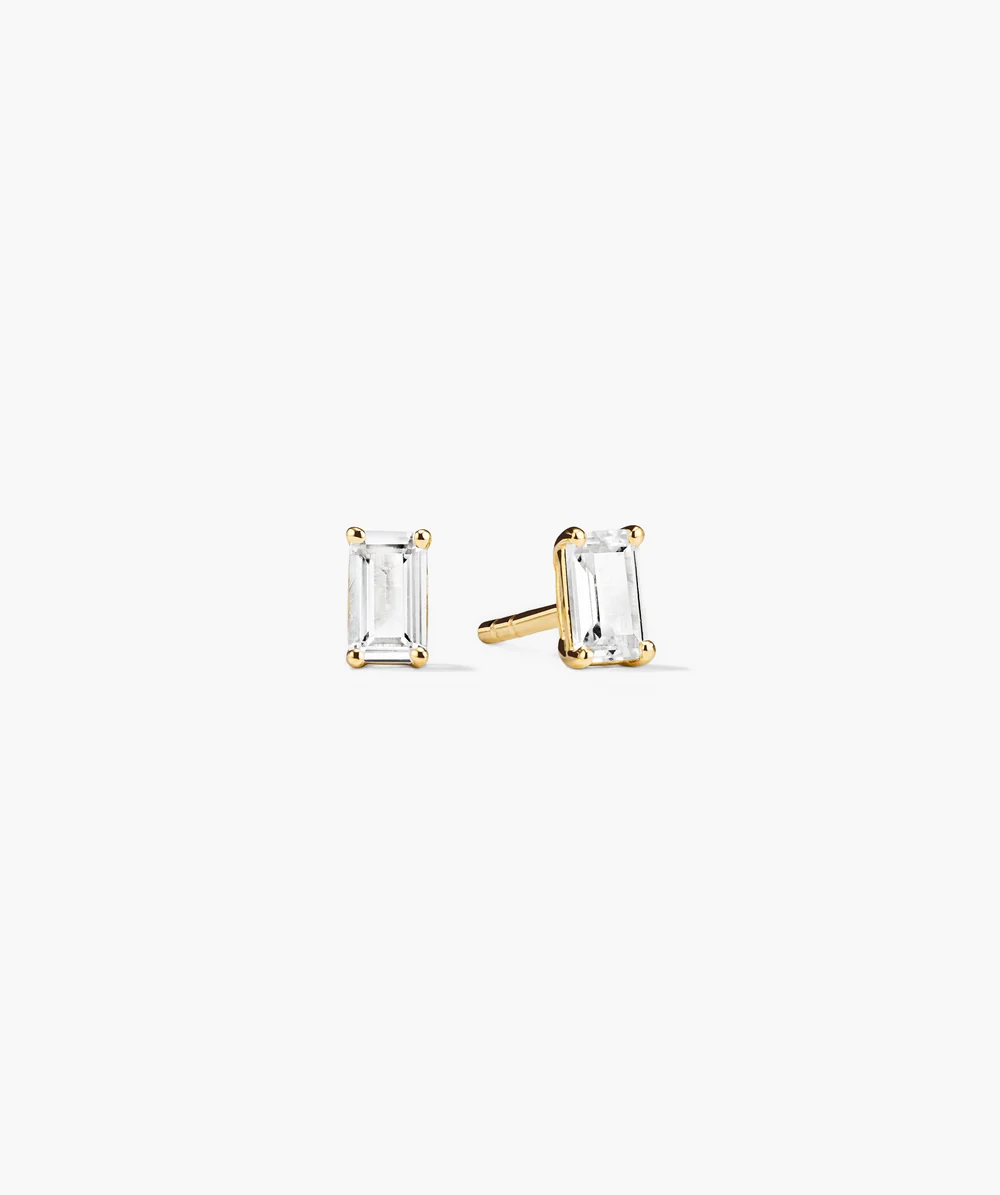
Lab Grown Sapphire Emerald Cut Studs by Mejuri bring the clean geometry of a rectangular step-cut gemstone into a compact everyday earring. Each design centers on a 5 × 3 mm lab-grown white sapphire, framed in warm 18k gold vermeil over sterling silver. The current earrings measure approximately 3.45 mm wide and 3.80 mm thick, giving the gemstone enough presence to stand alone while remaining easy to combine with an ear stack.
The white sapphire keeps the color palette neutral, while the elongated shape creates a sharper, more architectural look than a traditional round stud. Mejuri currently describes the earrings as hypoallergenic and states that the sterling-silver base used beneath the vermeil contains 91% recycled material.
About Lab Grown Sapphire Emerald Cut Studs
These studs are built around proportion rather than oversized sparkle.
A 5 × 3 mm rectangular gemstone gives the earring enough length to make the emerald-cut shape recognizable without covering a large part of the lobe. The warm gold frame provides contrast against the clear white sapphire, helping the geometry of the stone remain visible even from a distance.
Mejuri positions the design both as a polished standalone stud and as a piece that can be combined with other earrings in a multi-piercing arrangement.
That flexibility is one of the strongest qualities of this style. It is refined enough to wear with tailored or occasion clothing but simple enough to remain useful with everyday outfits.
Lab Grown Sapphire Emerald Cut Studs Features
The current construction combines a 5 × 3 mm lab-grown white sapphire, 18k gold vermeil, a sterling-silver base, a 3.45 mm overall width, and 3.80 mm thickness. Mejuri describes its lab-grown gemstones as sharing the same physical and chemical properties as corresponding natural gemstones.
The manufacturer also describes the earrings as hypoallergenic and uses thick 18k gold plating over its sterling-silver base rather than ordinary base-metal gold plating.
The result is a small gemstone earring whose interest comes mainly from the sharp rectangular shape, transparent stone, and warm metal border.
Emerald Cut Design
The words emerald cut describe a cutting style rather than the type of gemstone.
Although the cut is strongly associated with green emeralds, other gemstones can also be shaped with the same general step-cut approach. The GIA guide to gemstone cutting styles explains that the emerald cut is one of the classic examples of a step cut, where elongated facets are arranged in rows rather than using the triangular and kite-shaped pattern associated with many brilliant cuts.
That difference produces a distinct visual character.
Instead of creating countless tiny flashes, step-cut stones often show broader reflections and cleaner geometric lines. On a small white sapphire stud, this can look crisp and controlled rather than overly glittery.
5 × 3 mm Lab Grown White Sapphire
Mejuri currently lists the gemstone at 5 × 3 mm. Its specification table labels this measurement as the baguette stone size, while the product itself is sold under the Emerald Cut Studs name.
For Erothots shoppers, the practical point is the dimension rather than the terminology used within the manufacturer’s specification field.
A 5 mm length creates enough vertical or horizontal presence to distinguish the stone from a tiny round accent. The 3 mm width keeps it slim, which helps maintain the elegant proportions associated with rectangular step-cut jewelry.
The earrings can also be rotated visually depending on the way they naturally sit on the lobe, giving the shape more character than a perfectly symmetrical round stone.
Understanding Lab Grown Sapphire
Lab-grown sapphire should not be confused with glass, plastic, or a sapphire-colored imitation.
Sapphire is a variety of the mineral corundum. The GIA sapphire reference identifies sapphire as aluminum oxide and notes that it ranks 9 on the Mohs hardness scale. GIA also explains that synthetic counterparts can have essentially the same chemical, physical, and optical properties as natural gemstones while being produced in a laboratory.
The broader GIA guide to synthetic gemstones makes the distinction even clearer: a synthetic gemstone is laboratory-made but shares virtually all of the important chemical, optical, and physical characteristics of its natural mineral counterpart.
The term lab grown therefore describes origin rather than saying that the material is simply an imitation of sapphire.
Why The White Sapphire Looks Different From Blue Sapphire
Sapphire can occur in more colors than the deep blue most people immediately associate with the name.
GIA notes that corundum can appear in many colors, with red corundum classified separately as ruby.
For these studs, Mejuri uses lab-grown white sapphire.
The absence of a strong gemstone color gives the earrings much of their versatility. White sapphire can sit beside yellow gold, diamonds, pearls, clear stones, colored gemstones, or plain metal jewelry without forcing the rest of an outfit into one color family.
Its neutral appearance also keeps attention on the emerald-cut geometry.
18k Gold Vermeil Construction
These earrings are made with 18k gold vermeil, not solid 18k gold.
Mejuri currently describes its vermeil as a thick layer of 18k gold applied over sterling silver. The present product page states that the underlying sterling-silver material contains 91% recycled content.
That distinction matters when comparing vermeil with ordinary gold-tone fashion jewelry.
The FTC guide to gold and silver jewelry explains that vermeil is a specific type of gold-plated product in which the underlying base is sterling silver rather than an ordinary base metal.
For these studs, the most accurate material description is therefore:
18k gold vermeil over sterling silver with lab-grown white sapphire.
They should not be described as solid 18k gold earrings.
Sterling Silver Beneath The Gold
Sterling silver forms the structural metal underneath the vermeil finish.
The FTC explains that jewelry described as sterling silver contains 92.5% pure silver and may carry the familiar 925 marking.
That is different from Mejuri’s recycled-content percentage.
When Mejuri says that the current earrings use a 91% recycled sterling-silver base metal, the 91% refers to how much of that material comes from recycled sources. It does not mean the alloy itself contains only 91% silver.
Keeping those figures separate gives shoppers a clearer picture of what the material claims actually mean.
Compact 3.45 mm Width
The current earrings measure approximately 3.45 mm wide.
That narrow profile reinforces the vertical character of the rectangular gemstone.
It is also useful for ear stacking because the stud does not spread widely across the lobe. A neighboring piercing can therefore hold another small earring without the two pieces immediately touching or visually overlapping.
Exact spacing will naturally depend on individual ear anatomy and piercing placement.
3.80 mm Thickness
Mejuri lists the current design at approximately 3.80 mm thick.
Thickness helps give the setting enough dimension to hold and frame the stone rather than making the entire earring appear completely flat.
From the front, the gemstone remains the focus. From an angle, the setting adds enough depth for the earring to maintain its shape.
This is a small specification, but it can influence how substantial a stud feels once it is actually worn.
Sapphire Durability For Everyday Earrings
Sapphire is particularly practical for earrings because corundum is one of the harder gemstone materials used in jewelry.
The GIA sapphire care guide gives sapphire a hardness of 9 on the Mohs scale and describes it as having excellent toughness and no cleavage.
That makes sapphire suitable for regular jewelry wear.
It does not make the entire earring indestructible, however. The gemstone may be hard, but the gold-vermeil surface can still scratch or gradually wear, and the setting can be affected by a hard impact.
The complete earring should therefore be cared for according to its most delicate components rather than gemstone hardness alone.
Wearing The Studs On Their Own
The elongated stone provides enough shape to make the earrings interesting without additional jewelry.
Worn on their own, they work well with simple shirts, knitwear, dresses, tailoring, or everyday basics.
Because the sapphire is white rather than strongly colored, there is little need to coordinate clothing around the gemstone.
The rectangular cut also gives the earring a slightly more structured appearance than a small round crystal or ball stud, making it especially easy to pair with clean, minimal clothing.
Building An Ear Stack
The emerald-cut shape is particularly useful in a multi-piercing arrangement because it introduces a geometric form that contrasts with round hoops and huggies.
One approach is to make these studs the clearest gemstone element and keep neighboring earrings in plain gold.
A small huggie introduces a curved form beside the rectangle.
A round white-sapphire stud creates shape contrast while keeping the gemstone family coordinated.
A delicate chain stud introduces movement against the fixed emerald-cut stone.
The studs can also sit beside colored gemstones when more contrast is wanted because white sapphire does not compete strongly with green, blue, pink, or black stones.
Pairing With Other Gold Jewelry
The warm vermeil frame makes the studs easy to connect with yellow-gold necklaces, rings, and bracelets.
The jewelry does not need to come from the same collection to look intentional. Repeating the warm metal color is usually enough to create continuity.
For a simple everyday combination, the studs can be worn with a thin gold chain and one understated ring.
For dressier styling, white gemstone pieces can be repeated elsewhere to build more shine without introducing another color.
Mixing With Silver Jewelry
Even though the visible finish is predominantly warm gold, mixed-metal styling does not need to be avoided.
A silver watch, ring, or bracelet can still work when other accessories help bridge the metals.
The clear white sapphire is useful here because it acts as a neutral visual element rather than reinforcing only the gold tone.
Someone who regularly mixes metals can therefore treat these earrings as a warm accent rather than a rule that every other piece must also be yellow gold.
Best Occasions For This Style
The proportions make these studs easy to wear across a broad range of settings.
They can work for everyday outfits, workwear, dinners, celebrations, travel, formal occasions, and more polished evening styling.
Their relatively compact size prevents them from becoming overly formal, while the lab-grown white sapphire still provides enough reflection to feel more finished than a plain metal stud.
This makes them particularly practical for someone who prefers jewelry that does not need to be reserved for one event.
Understanding The Hypoallergenic Claim
Mejuri currently describes Lab Grown Sapphire Emerald Cut Studs as hypoallergenic.
That is a manufacturer claim and should not be interpreted as a guarantee that every wearer will have zero reaction.
Metal allergies and sensitivities vary between individuals.
The FTC’s broader Jewelry Guides and material standards provide useful background on accurate representation of precious metals, coatings, gemstones, and other jewelry characteristics.
Anyone who repeatedly develops redness, itching, swelling, or soreness after wearing a particular earring should discontinue use rather than assuming irritation is part of normal wear.
Protecting The Gold Vermeil Finish
The sapphire itself is highly durable, but the gold-vermeil surface deserves more careful treatment.
Avoid unnecessary contact with chlorine, strong household cleaners, perfume, hairspray, and other chemicals.
It is also sensible to put earrings on after skincare, fragrance, and hair products have dried rather than applying sprays directly onto the jewelry.
Because the gold is a plated layer over sterling silver, gradual wear can occur through repeated friction.
Removing the earrings before swimming, intensive exercise, or situations where they are likely to be repeatedly rubbed can help preserve the appearance of the finish.
Cleaning The White Sapphire
The GIA sapphire cleaning guidance states that warm, soapy water is always a safe cleaning choice for sapphire.
For these earrings, a conservative cleaning method also helps protect the vermeil.
Use lukewarm water, a small amount of mild soap, and a very soft cloth or brush where necessary. Avoid aggressive scrubbing around the gold-plated surface.
Rinse carefully and dry the earrings completely with a soft, lint-free cloth before storing them.
There is little reason to use harsh jewelry chemicals when simple cleaning can remove ordinary skin oils and cosmetic residue.
Storage Between Wears
Store the studs separately from heavier jewelry whenever possible.
A small lined compartment or soft pouch helps prevent rings, bracelets, or harder gemstones from rubbing repeatedly against the vermeil surface.
Separate storage also makes small studs easier to find and reduces the chance of losing one among larger pieces.
Keeping jewelry clean and dry before storage is useful as well, particularly when cosmetic products or skin oils have collected around the setting.
Why The Emerald Cut Changes The Look
Round studs create a soft, symmetrical point of sparkle.
The emerald-cut shape feels different because its rectangular outline gives the earring a clearer direction. It can visually lengthen the design and create more contrast against rounded earrings elsewhere in an ear stack.
Step-cut faceting also produces a different light pattern than a traditional brilliant cut. The GIA’s gemstone-cutting reference explains how the long, nearly parallel facets used in step cuts create the structured appearance associated with emerald-cut gems.
That geometry is the real reason these studs stand apart from a basic white gemstone earring.
Final Note
Lab Grown Sapphire Emerald Cut Studs combine a 5 × 3 mm lab-grown white sapphire with 18k gold vermeil over sterling silver, creating a compact geometric earring that can work just as comfortably alone as it does beside other pieces in an ear stack. The current design measures approximately 3.45 mm wide and 3.80 mm thick.
The white sapphire provides a neutral gemstone look, while the emerald-cut silhouette brings more structure than a conventional round stud. Sapphire’s strong everyday durability adds practical value, although the vermeil surface still deserves thoughtful care.
For Erothots shoppers, the strongest appeal is the combination of clean geometry, neutral sparkle, compact proportions, and flexible styling. It offers an easy way to add a more architectural gemstone shape without moving into a large or occasion-only earring.
Reviews
There are no reviews yet.