



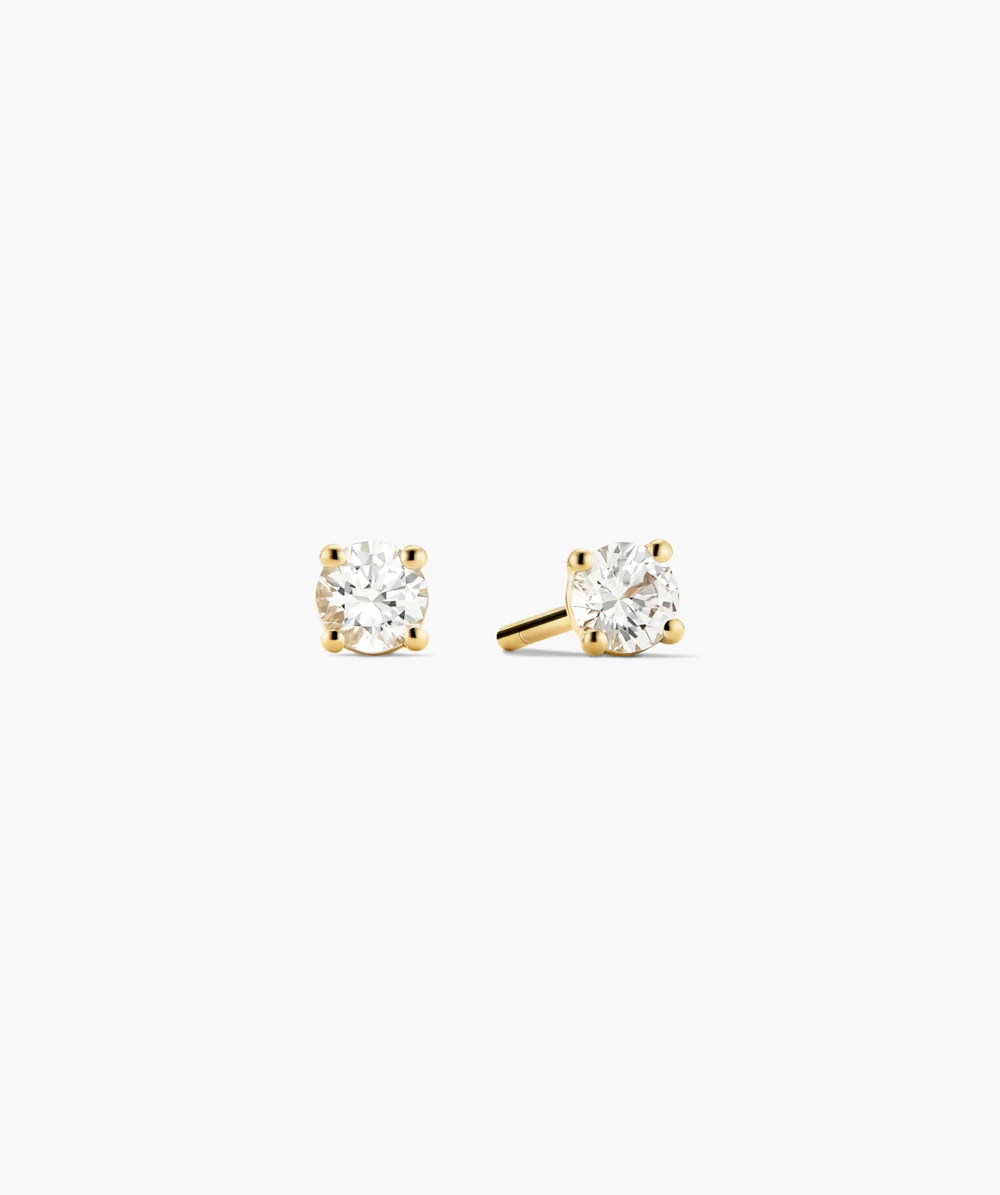
Round Lab Grown Sapphire Studs by Mejuri pair a clean 4 mm lab-grown sapphire with warm 18k gold vermeil over sterling silver. The design is deliberately minimal, giving the gemstone enough presence for everyday wear while remaining easy to combine with hoops, huggies, chain studs, and other earrings.
One buying detail is especially important: despite the plural product name, Mejuri’s current listing states that the stud is sold individually. Shoppers creating a matching pair would therefore need two individual studs. Mejuri also describes the current design as hypoallergenic and uses a sterling-silver base containing 91% recycled material.
About Round Lab Grown Sapphire Studs
Round Lab Grown Sapphire Studs are made for simple gemstone styling rather than an oversized statement.
The round gemstone measures 4 mm, providing enough surface area for noticeable light reflection without taking over the entire earlobe. That size works particularly well in a first or second piercing and can also become the brighter focal point of a more detailed ear stack.
The current material combination is 18k gold vermeil with lab-grown sapphire. Mejuri describes its vermeil as a thick layer of 18k gold applied over sterling silver and states that the silver base is 91% recycled.
The result sits between costume-style plated jewelry and solid-gold fine jewelry, offering a precious-metal base underneath the gold finish rather than an unspecified base metal.
Round Lab Grown Sapphire Studs Features
The appeal of these studs comes from a small number of well-defined details:
- 4 mm round lab-grown sapphire
- 18k gold vermeil
- Sterling-silver base
- 91% recycled sterling-silver base material, according to Mejuri
- Manufacturer-described hypoallergenic construction
- Compact everyday stud silhouette
- Suitable for solo wear or an ear stack
- Sold individually
The individual-sale format also gives the design more flexibility. Someone building an asymmetrical ear arrangement can purchase one without needing an unused matching stud.
4 mm Round Gemstone Design
A round gemstone is one of the easiest shapes to integrate into an existing jewelry collection.
Unlike elongated pear, marquise, or rectangular stones, a round stone does not introduce a strong directional line. This gives the stud a balanced appearance from almost every viewing angle.
At 4 mm, the sapphire is intentionally compact.
The scale is large enough to show the gemstone clearly but small enough to sit naturally beside other earrings. That makes this style useful for someone who wants noticeable sparkle without moving into a larger cocktail-style or statement earring.
Understanding The Lab-Grown Sapphire
The gemstone is laboratory grown rather than mined.
That does not mean it should be treated as ordinary imitation glass. The Gemological Institute of America explains that synthetic, or laboratory-grown, counterparts of gemstones can have essentially the same chemical, physical, and optical properties as their natural equivalents while being produced in a laboratory rather than forming naturally underground.
Sapphire belongs to the corundum mineral family, with a chemical composition based on aluminum oxide.
The term lab-grown sapphire therefore describes the gemstone’s origin. It is different from calling a material sapphire-colored or sapphire-inspired.
Sapphire Durability For Everyday Jewelry
Sapphire is particularly well suited to frequently worn jewelry because corundum ranks 9 on the Mohs hardness scale.
GIA also describes sapphire as having excellent toughness and no cleavage, making the gemstone comparatively durable under normal wearing conditions.
Hardness mainly describes resistance to scratching. It does not mean jewelry is impossible to damage.
Strong impact can still affect a setting, while the gold-vermeil surface requires more care than the sapphire itself. Everyday durability should therefore be viewed as a combination of gemstone strength and sensible jewelry handling.
18k Gold Vermeil Construction
The gold-colored metal surrounding the sapphire is 18k gold vermeil, not solid 18k gold.
This distinction is useful when comparing jewelry prices and materials.
Gold vermeil uses sterling silver as its underlying precious-metal base with gold applied over the surface. The Federal Trade Commission describes vermeil as a special form of gold-plated jewelry with a sterling-silver base. U.S. jewelry rules also set requirements for gold fineness and minimum plating thickness before a piece can properly be described using the term.
For these studs, Mejuri specifies 18k gold for the outer vermeil layer.
Sterling Silver Beneath The Gold
The underlying structure is sterling silver.
FTC consumer guidance explains that jewelry described as sterling silver contains at least 92.5% pure silver, which is why sterling pieces are commonly associated with a 925 marking.
Mejuri separately states that 91% of the sterling-silver base material is recycled.
Those percentages describe different things.
The sterling designation concerns the metal’s silver purity, while 91% refers to Mejuri’s recycled-content claim for the material used to make the base. It would therefore be inaccurate to describe the earring as only 91% silver.
A Simple Stud For Everyday Styling
The understated proportions give Round Lab Grown Sapphire Studs considerable styling flexibility.
Worn alone in the first lobe, the gemstone provides a clean point of light without requiring additional jewelry.
With multiple piercings, the 4 mm stone can become the largest element in a gradual stack. A small gold ball stud, slim huggie, or delicate chain earring can sit beside it without making the arrangement feel crowded.
The warm gold-vermeil frame also gives the stud an easy connection to yellow-gold necklaces, rings, bracelets, and other earrings.
Building A Mixed Ear Stack
The individual-sale format becomes especially useful for ear stacking.
One Round Lab Grown Sapphire Stud can be worn beside a plain gold huggie for a restrained combination. Pairing it with another gemstone shape creates more contrast, while adding a chain stud introduces movement against the fixed round stone.
For a more symmetrical appearance, two can be purchased and worn as a conventional matching pair.
For a contemporary asymmetrical arrangement, one stud can become a deliberate standalone element on only one ear.
This flexibility is one of the strongest advantages of the individual format, provided shoppers notice the quantity information before purchasing.
Pairing Round And Shaped Gemstones
Round gemstones are also easy to combine with more directional cuts.
For example, a pear-shaped earring introduces length while the round sapphire keeps the neighboring piercing visually simple. A marquise gemstone creates a narrow vertical line, while the round stud provides contrast without adding another angle.
Using one clear geometric shape as the quieter piece can stop an ear stack from becoming visually cluttered.
The 4 mm scale makes this particular stud especially suitable for that supporting role.
Day And Evening Wear
These studs do not depend on one type of outfit.
For everyday clothing, their compact scale works with knitwear, denim, tailoring, casual dresses, or simple workwear.
For evening styling, the sapphire provides more reflection under directional lighting while the round shape remains understated enough to coexist with a stronger necklace or dress.
Someone who prefers minimal jewelry could also skip other earrings entirely and allow a matching pair of Round Lab Grown Sapphire Studs to provide the only gemstone detail.
Hypoallergenic Positioning
Mejuri currently describes the studs as hypoallergenic.
That wording should not be interpreted as a promise that absolutely everyone will tolerate the earrings.
Metal sensitivities vary from person to person. Nickel, in particular, is a common cause of allergic contact dermatitis associated with jewelry. The American Academy of Dermatology recommends choosing jewelry carefully when someone already has a known nickel allergy and stopping exposure to materials that repeatedly cause a reaction.
If earrings repeatedly produce redness, itching, swelling, or soreness, discontinue wear rather than assuming discomfort is normal.
Caring For The Sapphire
Sapphire itself is relatively straightforward to maintain.
GIA states that warm, soapy water is always a safe cleaning choice for sapphire.
For this particular earring, however, cleaning should also account for the gold-vermeil surface.
Use a gentle method rather than aggressive scrubbing. A soft cloth and mild cleaning approach can remove skin oils and cosmetic residue without unnecessarily wearing the plated finish.
The gemstone may be exceptionally hard, but the entire piece of jewelry is only as durable as its most delicate component.
Protecting The Gold Vermeil Finish
Gold vermeil will generally require more careful treatment than solid gold because the gold is a surface layer.
Repeated friction and exposure to chemicals can gradually change the appearance of plated jewelry.
It is sensible to remove the stud before swimming, showering for long periods, or using strong cleaning products. Perfume, hairspray, skincare, and makeup should ideally be given time to dry before the earring is put on.
FTC consumer guidance notes that gold plating eventually wears depending on factors such as how the jewelry is worn and the thickness of the gold layer.
Good care can therefore help maintain the appearance of the vermeil for longer.
Storing The Stud
Small gemstone earrings are easy to lose, particularly when they are stored loosely with larger jewelry.
A dedicated earring compartment or soft jewelry pouch provides a better home than dropping the stud into a container with necklaces and rings.
Keeping it separate also reduces repeated metal-on-metal rubbing against the vermeil surface.
If two individual studs are purchased as a pair, storing them together in the same small compartment makes them easier to keep track of without allowing them to become mixed into larger jewelry pieces.
Sold Individually Rather Than As A Pair
This is the specification shoppers should check most carefully.
Mejuri currently states Sold Individually beneath the product specifications.
The plural product title can easily suggest that two earrings are included, so Erothots shoppers should not assume that one product quantity automatically creates a matching pair.
Buying one gives flexibility for an asymmetrical ear stack.
Buying two creates the conventional matched-stud look.
Making that distinction clear before purchase avoids one of the most likely sources of confusion with this design.
Who May Like This Style
Round Lab Grown Sapphire Studs make the most sense for someone who likes jewelry that remains useful beyond a single outfit or occasion.
The 4 mm size is neither micro-small nor oversized, the round shape is easy to coordinate, and the warm vermeil construction blends naturally with other yellow-gold jewelry.
They are particularly suited to someone building an ear stack one piece at a time because the individual-sale format lets each piercing be planned separately.
Someone who specifically wants solid-gold earrings should note that these are gold vermeil over sterling silver rather than solid 18k gold.
Final Note
Round Lab Grown Sapphire Studs keep the design intentionally simple: a 4 mm laboratory-grown sapphire framed in 18k gold vermeil over a sterling-silver base. Mejuri currently states that the silver base contains 91% recycled material and describes the design as hypoallergenic.
Sapphire’s 9-on-the-Mohs-scale hardness gives the gemstone useful durability for jewelry, while the classic round shape makes it easy to style with everything from a plain huggie to a more elaborate multi-piercing arrangement.
For Erothots shoppers, the most important detail remains the quantity: each stud is sold individually. That makes it equally suitable for a deliberately asymmetrical ear stack or a matching pair when two individual pieces are purchased.
Reviews
There are no reviews yet.