



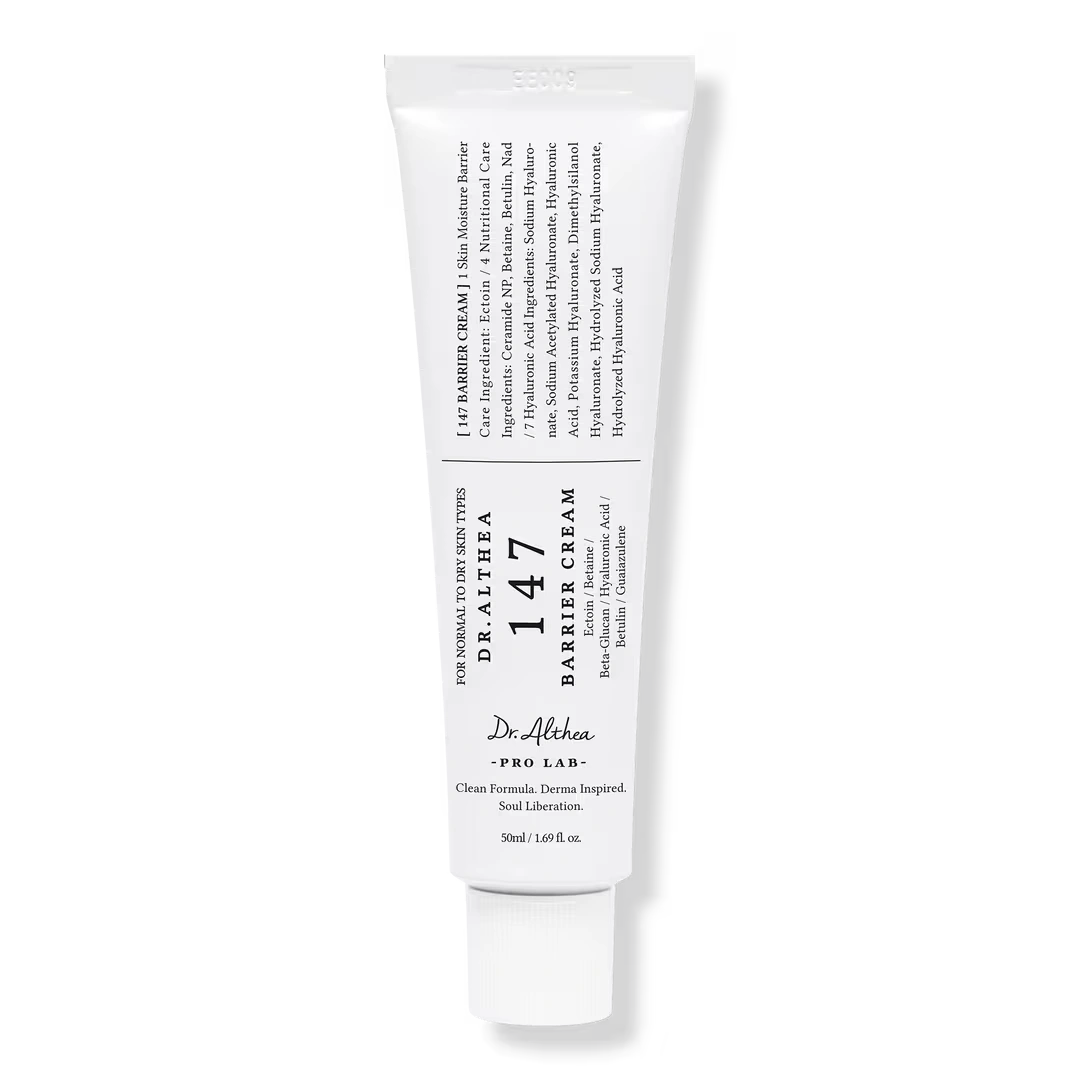
Dr. Althea 147 Barrier Cream is a 1.69 oz / 50 mL Korean facial moisturizer developed for dry, dehydrated, sensitive-feeling skin and weakened moisture-barrier concerns. The current formula combines ectoin, Ceramide NP, betaine, betulin, nicotinamide adenine dinucleotide (NAD), squalane, glycerin, aloe leaf water, beta-glucan, Centella asiatica, and multiple forms of hyaluronic acid in a rich cream designed to provide substantial hydration without a heavy or greasy finish.
Dr. Althea organizes the formula around its “1-4-7” concept: one primary barrier-care ingredient, four nutritional-care ingredients, and a seven-type hyaluronic-acid hydration system. The brand identifies ectoin as the barrier-focused ingredient and Ceramide NP, betaine, betulin, and NAD as its four nourishing ingredients.
About 147 Barrier Cream
The current 147 Barrier Cream is primarily a deep-hydration and moisture-barrier moisturizer. Dr. Althea says it is designed to strengthen the skin barrier, provide lasting nourishment for dry skin, and leave a silky finish without noticeable residue. Ulta additionally lists the current formula as non-comedogenic tested and sensitive-skin safety tested.
It is worth checking the version when researching this product. Older 147 Barrier Cream descriptions online may mention ingredients such as peony flower extract, avocado extract, argan oil, or camellia seed oil. The current U.S. formula sold by Dr. Althea and Ulta is different and instead begins with water, aloe leaf water, butylene glycol, glycerin, hydrogenated polydecene, fatty alcohols, squalane, and ectoin.
147 Barrier Cream Features
The cream brings together several different types of moisturization instead of depending on one headline ingredient. Glycerin and the hyaluronic-acid derivatives work mainly on hydration, while squalane, hydrogenated polydecene, fatty alcohols, Ceramide NP, and lecithin contribute emollience and a smoother surface feel. Ectoin, betaine, beta-glucan, and botanical extracts support the product’s soothing and barrier-care positioning.
This type of formulation is well suited to dry-skin care. The American Academy of Dermatology recommends creams and ointments for persistent dryness and specifically identifies ingredients such as glycerin and hyaluronic acid as useful moisturizing components. Dermatologists also commonly recommend ceramide-containing moisturizers when supporting dry skin and its outer barrier.
What The 1-4-7 Name Means
The product name is connected to Dr. Althea’s ingredient framework rather than being a percentage or strength rating.
The “1” refers to ectoin, which the brand identifies as its main skin-barrier-care ingredient.
The “4” refers to Ceramide NP, betaine, betulin, and NAD, which Dr. Althea groups as four nutritional-care ingredients.
The “7” refers to the brand’s seven-type hyaluronic-acid hydration complex.
The current ingredient declaration actually contains numerous hyaluronic-acid and hyaluronate-related INCI names. Dr. Althea groups these into its proprietary seven-type hydration concept, so it is more accurate to describe the technology using the manufacturer’s “seven-type complex” wording than to assume every hyaluronate name in the INCI represents a separate marketing category.
Ectoin For Barrier-Focused Care
Ectoin is the central ingredient in Dr. Althea’s 1-4-7 concept and appears relatively high in the current formula, immediately after squalane.
Dr. Althea describes ectoin as helping protect skin from environmental stress while maintaining a healthier moisture barrier. In this cream, it is combined with a substantial moisturizing base rather than being presented as a standalone treatment.
“Environmental protection” should not be interpreted as sunscreen protection. The product has no stated SPF, and ectoin does not replace an appropriately labeled broad-spectrum sunscreen during daytime use.
Ceramide NP
Ceramide NP is one of the four nourishing ingredients highlighted by Dr. Althea. It appears alongside hydrogenated lecithin and other lipid-compatible ingredients in the current formula.
Ceramides are naturally present in the skin’s outer layer and are frequently incorporated into moisturizers intended for dryness and barrier support. The AAD recommends looking for ceramide-containing moisturizers in several dry-skin situations because these lipids can help support moisture retention and the outer skin barrier.
Ceramide NP does not make 147 Barrier Cream a medication for eczema or dermatitis. Its role here remains cosmetic moisturizing and barrier support.
Betaine For Moisture Balance
Betaine is another member of Dr. Althea’s four-part nourishing group. The brand positions it around hydration and moisture balance.
Within the complete formula, betaine complements more familiar humectants such as glycerin and hyaluronic-acid derivatives. This creates a moisturizer that addresses dry surface feel through several water-binding and emollient systems instead of expecting one ingredient to provide the entire result.
Betulin
The current cream also includes betulin, which Dr. Althea classifies as a soothing and skin-conditioning ingredient within its four nutritional-care components.
Betulin appears relatively late in the ingredient declaration, so it should not be described as the dominant base of the formula. Its role is better understood as supportive within a cream whose largest components are water, aloe water, glycols, glycerin, emollients, fatty alcohols, squalane, and ectoin.
NAD Is Not The Same As Niacinamide
A particularly interesting ingredient is Nicotinamide Adenine Dinucleotide, abbreviated NAD.
Dr. Althea places NAD among the four nourishing ingredients and associates it with skin-vitality support.
NAD should not be confused with niacinamide simply because both names contain “nicotinamide.” The current ingredient list specifically names nicotinamide adenine dinucleotide and does not list niacinamide as a separate ingredient.
For that reason, 147 Barrier Cream should not be promoted as a niacinamide moisturizer unless a future reformulation actually adds niacinamide to the declared formula.
Multi-Form Hyaluronic Acid Complex
Hydration is the “7” portion of the product concept.
Dr. Althea describes the formula as using seven forms of hyaluronic acid with different molecular characteristics to provide sustained moisture and a plumper-looking skin surface.
The current INCI includes forms such as hydrolyzed hyaluronic acid, hydrolyzed sodium hyaluronate, sodium hyaluronate, hyaluronic acid, potassium hyaluronate, sodium hyaluronate crosspolymer, hydroxypropyltrimonium hyaluronate, sodium acetylated hyaluronate, and other modified hyaluronates.
These ingredients are best understood as part of a sophisticated humectant system. The AAD identifies hyaluronic acid as a useful moisturizing ingredient for dry skin because it helps support hydration.
Topical hyaluronic acid should not be confused with injectable filler. Moisturization can make skin look smoother and temporarily plumper, but a face cream does not create the structural volume associated with an injectable procedure.
Glycerin High In The Formula
Glycerin appears fourth in the current ingredient list, making it one of the more substantial moisturizing ingredients in 147 Barrier Cream.
Glycerin is a humectant commonly used to help the outer skin retain water. The AAD recommends glycerin-containing creams for dry skin and groups it with hyaluronic acid among useful hydrating ingredients.
Its high placement is useful context because the cream’s hydration does not depend entirely on the smaller quantities of specialized hyaluronate ingredients near the end of the formula.
Aloe Leaf Water
The second ingredient is Aloe Barbadensis Leaf Water.
Aloe helps form the water-rich base of the cream and adds to its soothing, moisturizing positioning. The AAD also recognizes aloe as a lightweight moisturizing and soothing ingredient in appropriate skincare formulas.
As with every individual ingredient here, the finished cream matters more than aloe alone. It is the combination of humectants, emollients, lipids, soothing ingredients, and formulation structure that determines how the moisturizer behaves on skin.
Squalane And Emollient Support
Squalane appears within the first ten ingredients. The formula also contains hydrogenated polydecene, cetyl ethylhexanoate, dicaprylyl ether, and several fatty alcohols.
These ingredients contribute softness and slip while helping reduce the rough or tight feeling associated with dryness.
They also explain why the cream can feel richer than a watery gel moisturizer even though Dr. Althea describes the finish as silky and residue-free.
Centella Asiatica And Botanical Extracts
The current 147 Barrier Cream contains Centella asiatica extract, along with Coptis japonica root extract, fig fruit extract, and hydrolyzed gardenia extract.
These plant extracts complement the soothing and conditioning character of the formula, but no concentration is published for them on the current Ulta listing.
It would therefore be misleading to market 147 Barrier Cream as a high-percentage Centella treatment. Centella is present, but the formula is principally a moisturizer built around ectoin, humectants, emollients, ceramide, and the brand’s 1-4-7 system.
Guaiazulene
The cream also contains guaiazulene, a cosmetic ingredient related to azulene chemistry and commonly associated with calming skincare formulations.
Its presence is also worth noting when reading the brand’s “color-free” language. Dr. Althea and Ulta specifically state that the cream has no added artificial colorants. That is different from saying every ingredient in the formula is naturally colorless.
Beta-Glucan
Beta-glucan appears alongside betulin and the hyaluronic-acid components toward the end of the current formula.
Its role fits the cream’s moisturizing and soothing profile, but again, Dr. Althea does not publish its concentration. It should be treated as a supporting ingredient rather than promoted as the cream’s primary active.
Rich Texture Without A Greasy Finish
Dr. Althea describes 147 Barrier Cream as deeply nourishing while leaving a silky finish without residue. Ulta similarly characterizes the product as rich but clean-finishing, designed to absorb without excessive heaviness or greasiness.
That positioning makes it especially relevant for people who want more substance than a lightweight gel cream but dislike the heavy occlusive sensation associated with some barrier balms.
Texture remains personal. Someone with very oily skin may experience the cream differently from someone whose skin is severely dry.
Current Clinical And Testing Claims
Ulta’s current product page lists several manufacturer research results for 147 Barrier Cream. These include non-comedogenic testing, sensitive-skin safety testing, clinically tested skin soothing and elasticity improvement, and a reported +71.98% improvement in skin-barrier strength.
The current listing does not provide detailed study methodology, sample size, measurement device, comparison group, or test duration alongside those figures. For that reason, the 71.98% number should remain presented as a brand testing result, not as a promise that everyone’s barrier will improve by precisely that amount.
It also should not be rewritten as “repairs 72% of damaged skin.” That would be a different and much stronger medical-style claim than what the retailer actually publishes.
Non-Comedogenic Tested
Ulta identifies the cream as non-comedogenic tested.
That can make it relevant to someone who wants richer hydration but is cautious about pore-clogging products.
Non-comedogenic does not mean the cream treats acne or guarantees that no individual user will experience a breakout. The FDA distinguishes cosmetic moisturizing claims from drug claims that involve treating conditions such as acne.
147 Barrier Cream is a moisturizer, not an acne medication.
Suitable For Dry And Sensitive-Feeling Skin
Dr. Althea emphasizes deep hydration and nourishment for dry skin, while Ulta notes sensitive-skin safety testing.
The fragrance-free formula may be another useful characteristic for reactive skin. Dermatologists commonly recommend fragrance-free skincare when dryness and sensitivity are concerns.
Sensitive skin remains individual, however. A formula can pass sensitive-skin testing and still be incompatible with a particular person’s skin.
Fragrance-Free And No Artificial Colorants
The current formula does not list parfum or fragrance, and Ulta specifically states that the product has no added fragrance or artificial colorants.
This is useful for people who intentionally keep fragranced products out of their facial routine.
Fragrance-free should not be interpreted as allergen-free. Botanical extracts, preservatives, emollients, or other ingredients can still cause an individual reaction.
The Current Formula Contains Silicone
147 Barrier Cream should not be described as silicone-free.
The current INCI includes Vinyl Dimethicone, a silicone ingredient.
This ingredient contributes to texture, spreadability, and the smooth cosmetic finish of the cream. Its presence is particularly worth mentioning because some shoppers filter moisturizers according to whether or not they contain silicones.
Current Formula Versus Older 147 Barrier Cream
Older online descriptions of Dr. Althea 147 Barrier Cream can cause confusion because they describe a different ingredient profile, including ingredients such as peony flower extract and several nourishing plant oils.
The current 2026/U.S. formula instead uses ectoin as its central barrier ingredient and follows the new 1-4-7 structure built around Ceramide NP, betaine, betulin, NAD, and the multi-form hyaluronic-acid system. The current ingredient list published by Ulta matches listings describing the 2026 reformulation.
For an Erothots product page, the current formula should take priority so shoppers do not expect ingredients that are no longer present.
Application And Routine
Dr. Althea recommends using 147 Barrier Cream after cleansing and after lighter products such as toner. The cream can be placed at the final or semi-final step of the skincare routine, with an adequate amount spread evenly over the face and gently patted in.
A simple routine could therefore place a cleanser first, followed by toner or serum if used, then 147 Barrier Cream.
During the daytime, sunscreen should remain a separate final skincare step because the cream has no stated SPF.
Morning And Evening Use
Nothing in the current formula limits it to nighttime use. Its main functions are moisturization and barrier support, so it can fit into either an AM or PM routine depending on skin needs. Dr. Althea identifies it as the final or near-final moisturizing step rather than an overnight-only treatment.
Someone with drier skin may appreciate it twice daily, while someone whose skin becomes oilier during the day may prefer the richer cream primarily at night.
The AAD recommends using moisturizer consistently and choosing a texture comfortable enough to use regularly.
Using It After Stronger Skincare
A richer moisturizer is often useful when a routine contains products that leave skin feeling temporarily dry, but 147 Barrier Cream should not be expected to make every irritating skincare routine acceptable.
If another product repeatedly causes significant burning, swelling, cracking, or worsening irritation, adding more barrier cream is not a substitute for reassessing the product causing the reaction.
The AAD advises professional evaluation when dryness becomes painful, cracked, bleeding, stinging, or persistently irritating.
Barrier Support Is Not Medical Treatment
“Barrier Cream” describes the cosmetic purpose of this moisturizer, but the product should not be promoted as curing eczema, dermatitis, psoriasis, rosacea, or another skin disease.
FDA guidance distinguishes normal cosmetic claims such as moisturizing and skin softening from claims that a product treats or prevents disease or alters body structure or function.
For Erothots, terms such as supports the moisture barrier, helps reduce dry tightness, improves hydration, and promotes smoother-looking skin are appropriate. Medical cure or disease-treatment language is not.
Sunscreen Remains A Separate Step
Ectoin and antioxidant-oriented ingredients do not make 147 Barrier Cream an SPF product.
The AAD recommends broad-spectrum, water-resistant sunscreen with SPF 30 or higher as part of protecting exposed skin from UV radiation.
A morning routine can therefore use 147 Barrier Cream for hydration and follow with a separate sunscreen rather than assuming the moisturizer’s environmental-stress positioning provides UV protection.
Current 147 Barrier Cream Ingredients
The current U.S. formula is:
Aqua (Water), Aloe Barbadensis Leaf Water, Butylene Glycol, Glycerin, Hydrogenated Polydecene, C14-22 Alcohols, 1,2-Hexanediol, Cetyl Alcohol, Cetyl Ethylhexanoate, Squalane, Ectoin, Dicaprylyl Ether, Arachidyl Alcohol, Behenyl Alcohol, Vinyl Dimethicone, C12-20 Alkyl Glucoside, Sodium Polyacrylate, Hydroxyacetophenone, Arachidyl Glucoside, Ethylhexylglycerin, Sodium Stearoyl Glutamate, Carbomer, Xanthan Gum, Tromethamine, Disodium EDTA, Hydrogenated Lecithin, Coptis Japonica Root Extract, Centella Asiatica Extract, Ficus Carica (Fig) Fruit Extract, Ceramide NP, Maltodextrin, Hydrolyzed Gardenia Florida Extract, Tocopherol, Betaine, Guaiazulene, Nicotinamide Adenine Dinucleotide, Betulin, Beta-Glucan, Dimethylsilanol Hyaluronate, Hydrolyzed Hyaluronic Acid, Hydrolyzed Sodium Hyaluronate, Sodium Hyaluronate, Hyaluronic Acid, Potassium Hyaluronate, Sodium Hyaluronate Crosspolymer, Hydroxypropyltrimonium Hyaluronate, Sodium Hyaluronate Dimethylsilanol, and Sodium Acetylated Hyaluronate.
Anyone checking a known allergy or sensitivity should use the ingredient declaration printed on the package received as the final reference because skincare formulas can be reformulated.
Who May Appreciate 147 Barrier Cream
147 Barrier Cream makes the strongest case for someone who wants a substantial but clean-finishing moisturizer for dry, dehydrated, sensitive-feeling, or temporarily stressed skin.
Its combination of glycerin, squalane, ectoin, Ceramide NP, betaine, beta-glucan, aloe water, botanical extracts, and multiple forms of hyaluronic acid provides several complementary approaches to moisture retention and surface comfort. The current formula is also fragrance-free and non-comedogenic tested according to Ulta.
Someone specifically looking for an oil-free or silicone-free moisturizer should note that this is not either of those categories. The formula contains several emollient materials plus vinyl dimethicone.
What Makes 147 Barrier Cream Different
The defining feature of Dr. Althea 147 Barrier Cream is its current 1-4-7 formulation strategy.
Ectoin represents the single primary barrier-care ingredient. Ceramide NP, betaine, betulin, and NAD form the four nourishing components, while the seven-type hyaluronic-acid system provides the hydration-focused portion of the concept. The formula then adds glycerin, squalane, aloe water, beta-glucan, Centella asiatica, guaiazulene, and other moisturizing and soothing-support ingredients.
The current product also comes with manufacturer testing claims that include +71.98% improvement in skin-barrier strength, sensitive-skin safety testing, non-comedogenic testing, clinically tested soothing, and improved skin elasticity. Because the current retailer listing does not provide full study methodology beside those results, they are best presented as Dr. Althea’s finished-product testing claims rather than guaranteed individual outcomes.
For Erothots, 147 Barrier Cream is best positioned as a 50 mL fragrance-free Dr. Althea moisturizer for deep hydration and moisture-barrier support, featuring ectoin, Ceramide NP, betaine, betulin, NAD, squalane, and a multi-form hyaluronic-acid complex, with the current reformulated ingredient list clearly distinguished from older versions and without turning cosmetic barrier support into a medical skin-treatment claim.
Reviews
There are no reviews yet.