



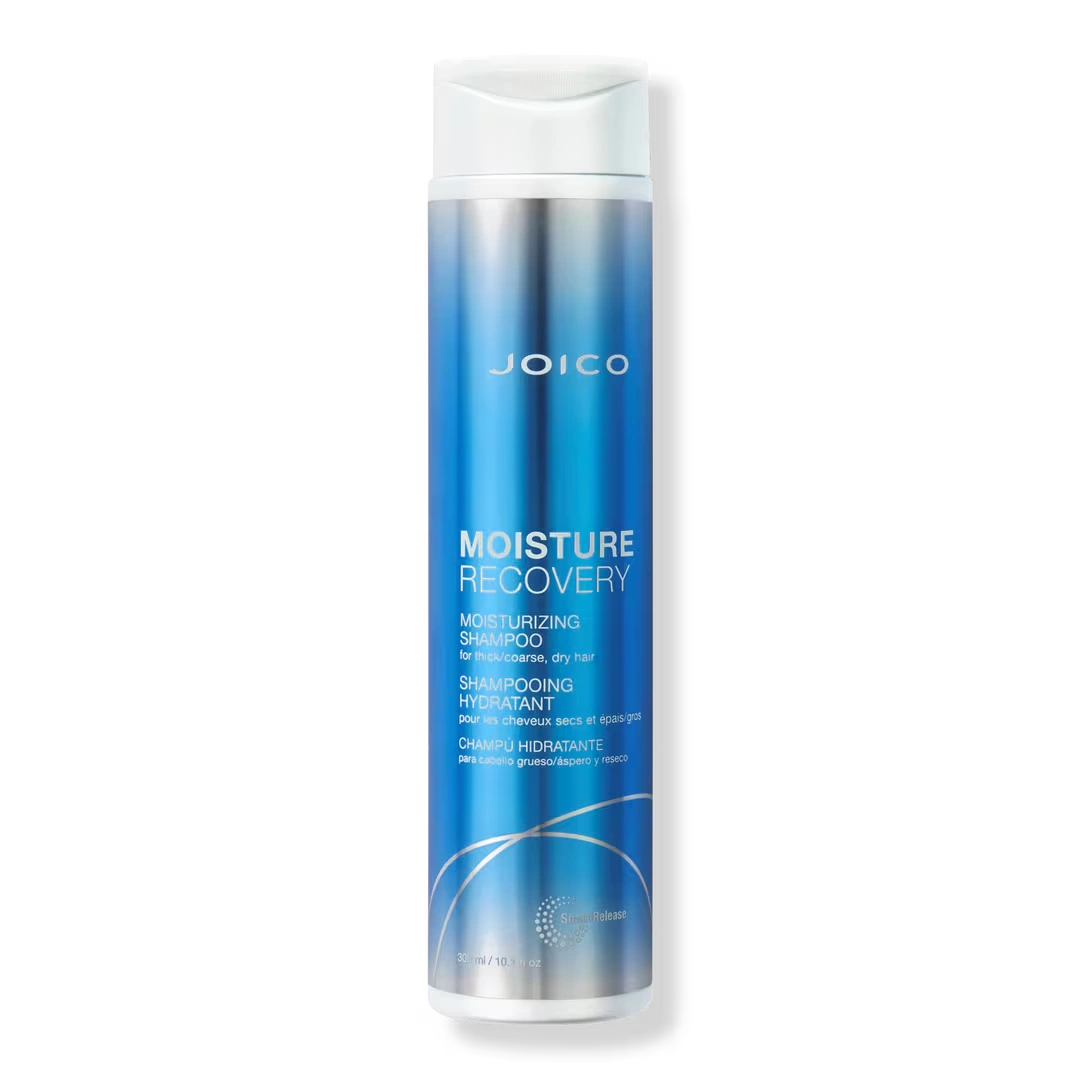
Joico Moisture Recovery Moisturizing Shampoo for Thick/Coarse Hair, Dry Hair is a rich cleansing shampoo developed specifically for thick, coarse, curly, and dehydrated hair that needs more conditioning support than a lightweight everyday cleanser. Joico builds the formula around its Hydramine Sea Complex, jojoba oil, and SmartRelease Technology, while a multi-surfactant cleansing system removes scalp oil and styling residue.
The shampoo is currently sold at Ulta in 10.1 oz and 33.8 oz sizes. Joico positions it around restoring lost moisture, softness, smoothness, elasticity, and shine without treating the product as a fine-hair volumizing cleanser.
About Moisture Recovery Moisturizing Shampoo for Thick/Coarse Hair, Dry Hair
Dry hair and oily hair do not always require the same cleansing strategy.
A shampoo designed primarily for oily, fine hair may prioritize removing as much surface oil and residue as possible while leaving very little conditioning material behind. Thick, coarse, curly, or highly porous hair often presents a different challenge. These hair types can still accumulate scalp oil and styling products, but the lengths may already feel dry, rough, frizzy, or difficult to manage.
Joico Moisture Recovery Shampoo is intended to clean that type of hair without making dryness the dominant after-wash sensation. Joico describes the formula as a rich cleanser that replenishes lost moisture and restores smoothness and elasticity to dehydrated strands.
That positioning is consistent with dermatologist guidance around textured hair. The American Academy of Dermatology notes that curly hair tends to be drier than straight hair and often benefits from more intensive conditioning and gentler handling.
The useful expectation, however, is better cleansing balance and improved cosmetic condition, not biological “healing” of dead hair fiber.
Moisture Recovery Moisturizing Shampoo Features
Joico currently highlights several interconnected benefits rather than one single hero ingredient.
The shampoo is designed to cleanse without intentionally stripping away all surface moisture, restore softness and elasticity, and prepare thick or coarse hair for the Moisture Recovery conditioner or treatment products that follow. Joico’s own comparison chart identifies the collection with thick, coarse, curly hair and concerns including dryness, frizz, and breakage.
Current highlighted features include:
- Hydramine Sea Complex with marine-derived moisturizing ingredients.
- Jojoba seed oil for emollient support and shine.
- SmartRelease Technology featuring rosehip oil, arginine, and keratin.
- Multi-surfactant cleansing system instead of a conditioner-like cleansing formula.
- Conditioning polymers and silicone derivative to help reduce a stripped feel.
- 24-hour moisture positioning when used within the specified Moisture Recovery regimen.
- Double-softness claim when the shampoo and conditioner are used together compared with a non-conditioning shampoo.
- Three-times-lower breakage susceptibility claim when the shampoo and Treatment Balm are used together under Joico’s stated damaged-hair combing test.
Those regimen details matter because the performance percentages should not be assigned to the shampoo alone.
Why This Shampoo Is Specifically Aimed At Thick And Coarse Hair
The phrase “for thick/coarse hair” is not simply a marketing decoration.
Thick or coarse strands can often tolerate and benefit from richer conditioning systems that may make very fine hair feel flat or coated. Joico’s own product guidance differentiates Moisture Recovery from its HydraSplash line, which is positioned more toward fine-to-medium dry hair.
The current Moisture Recovery shampoo contains multiple conditioning materials in addition to its surfactants, including jojoba oil, Silicone Quaternium-16, Guar Hydroxypropyltrimonium Chloride, keratin derivatives, and other conditioning ingredients.
That makes sense for a formula intended to leave substantial, dry-feeling strands more manageable.
Someone with very fine, easily weighed-down hair can still technically wash with the product, but Joico itself directs that hair profile toward a lighter hydration range instead.
For Erothots, that makes hair diameter and dryness more useful buying considerations than simply labeling this shampoo “for everyone.”
The Cleansing System Is Stronger Than The Moisturizing Name May Suggest
Despite its moisturizing positioning, this is still a conventional foaming shampoo.
Joico’s current professional formula begins with Water, Sodium Laureth Sulfate, Cocamidopropyl Betaine, Propylene Glycol, Glycol Distearate, Sodium Methyl Cocoyl Taurate, and Cocamide MEA.
That combination gives the shampoo a mixed surfactant system.
Sodium Laureth Sulfate provides strong cleansing and lather.
Cocamidopropyl Betaine is an amphoteric surfactant frequently paired with stronger anionic surfactants.
Sodium Methyl Cocoyl Taurate adds another cleansing agent with a different sensory profile.
This multi-surfactant approach is common in modern shampoos. A scientific overview of shampoo formulation explains that products commonly combine several surfactants to adjust cleansing strength, foaming, mildness, and hair feel.
The moisturizing character therefore comes from how the complete formula balances cleansing with conditioning, not because the shampoo avoids detergents.
This Is Not A Sulfate-Free Shampoo
One of the most important formula details is worth stating plainly:
Joico Moisture Recovery Moisturizing Shampoo is not currently sulfate-free.
The current Joico professional ingredient declaration lists Sodium Laureth Sulfate immediately after water.
This distinction is particularly important because another product in the Moisture Recovery collection, 24Hr Moisture Recharge Leave-In, is specifically described by Joico as SLS/SLES-free. That free-from statement applies to the leave-in, not automatically to the shampoo.
Erothots therefore would not copy “sulfate-free” from another Moisture Recovery product onto this cleanser.
That does not automatically make the shampoo harsh or unsuitable.
Surfactant performance depends on concentration, supporting surfactants, conditioning ingredients, contact time, water hardness, wash frequency, and hair condition. A review of hair-care physicochemistry notes that strong anionic cleansing can remove lipids and proteinaceous material from hair, which is one reason manufacturers balance cleansing agents with conditioning systems.
For very dry hair, the practical question is how the finished formula and washing routine affect the hair rather than whether one ingredient category appears on a trend-based exclusion list.
Hydramine Sea Complex
Joico describes its Hydramine Sea Complex as a combination of natural moisturizing elements from the ocean, including sea kelp, seawater nutrients, and brown-algae-related ingredients. The brand says this system is intended to hydrate hair and support what it calls the hair’s hydrolipidic barrier.
The current ingredient declaration supports the marine theme through ingredients such as:
Hydrolyzed Algin
Sea Water/Maris Aqua
Chlorella Vulgaris Extract.
That is more useful than simply calling the shampoo “sea mineral infused.”
The marine ingredients sit inside a broader shampoo formula and should not be described as if seaweed alone performs the cleansing or moisturizing function.
The main wash performance still comes from the surfactant system, while conditioners, humectants, oils, marine ingredients, polymers, and proteins influence the way the hair feels after rinsing.
Sea Kelp And Hair Moisture
Joico specifically highlights Sea Kelp as a moisture-supporting ingredient and connects it with vitamins, minerals, and healthier-looking hair.
There is a useful wording distinction here.
Seaweed-derived ingredients can contribute polysaccharides, minerals, and conditioning properties to cosmetic formulas, but using the phrase “packed with nutrients” should not be transformed into a claim that shampoo nutritionally feeds living hair from the outside.
The visible hair shaft is nonliving tissue.
A rinse-off cosmetic can change the way the fiber feels, reduce friction, improve shine, and leave conditioning materials on its surface. It does not nourish the hair shaft in the same biological sense that nutrients in the bloodstream support a growing follicle.
For Erothots, “helps condition and moisturize dry hair” is a more technically accurate interpretation of the marine complex than claiming that the shampoo feeds the hair.
Jojoba Oil And Shine
Simmondsia Chinensis Jojoba Seed Oil appears in the current formula and is one of Joico’s highlighted ingredients.
Joico associates jojoba oil with essential fatty acids, moisture, and shine.
From a formulation perspective, its value is primarily emollient.
Oils and oil-like materials can influence lubrication and surface feel, helping rough hair appear smoother and reflect light more evenly.
A small amount of jojoba oil in shampoo should not be confused with applying pure jojoba oil to the hair.
The shampoo is rinsed off, and jojoba sits within a cleanser containing surfactants, polymers, keratin ingredients, fragrance, and numerous other components.
Its role is part of the overall conditioning system.
SmartRelease Technology
Joico’s second major technology is SmartRelease.
The company describes it as a liposome delivery system that gradually releases Rosehip Oil, Arginine, and Keratin to help repair, strengthen, and protect hair from cumulative styling damage.
The current professional ingredient declaration includes ingredients consistent with this system, including Rosa Canina Fruit Oil, Arginine HCl, Laurdimonium Hydroxypropyl Hydrolyzed Keratin, and Phosphatidylcholine.
Liposome-based cosmetic delivery systems use lipid structures to carry ingredients within a formulation.
That does not mean the ingredients remain inside hair indefinitely or that every wash permanently rebuilds damaged strands.
The strongest interpretation is that SmartRelease is Joico’s proprietary conditioning and damage-care delivery system incorporated into the product.
Keratin And Hydrolyzed Keratin Ingredients
Keratin-related ingredients are particularly relevant to damaged hair because the hair fiber itself is largely composed of keratin proteins.
The official current Joico professional formula lists Laurdimonium Hydroxypropyl Hydrolyzed Keratin, while Ulta currently displays a somewhat different ingredient declaration containing Hydrolyzed Keratin and Cocodimonium Hydroxypropyl Hydrolyzed Keratin.
These are cosmetic conditioning protein derivatives.
They may help alter the feel and surface properties of damaged hair, but the word “keratin” should not be interpreted as meaning shampoo permanently replaces all protein lost from severe bleaching or chemical damage.
A review of hair cosmetics explains that conditioners and protein-containing formulations can improve fiber properties and reduce friction, but hair that has been physically damaged does not biologically heal itself.
That makes temporary cosmetic repair and strengthening support more accurate wording than “restores hair to its original undamaged state.”
Arginine In The Formula
Arginine is an amino acid and appears as part of Joico’s SmartRelease story.
The current official professional formula lists Arginine HCl, while another current Joico/Ulta presentation lists Arginine among the shampoo ingredients.
Its presence fits a formula built around protein-related conditioning and damaged-hair support.
However, an amino acid being present in shampoo does not mean the product medically increases hair growth or treats follicle-related hair loss.
Joico’s claims relate to the existing hair fiber, softness, elasticity, and resistance to styling damage.
That is the correct scope for this ingredient in the product.
Rosehip Oil
Rosa Canina Fruit Oil, commonly called rosehip oil, appears in Joico’s current professional ingredient declaration and is one of the ingredients associated with SmartRelease Technology.
Like jojoba oil, its most straightforward cosmetic role is as an emollient component within the broader formula.
Because the shampoo is a rinse-off product, rosehip oil should not be described as if it functions exactly like a leave-on facial oil or intensive overnight hair oil.
Its contribution occurs inside a complete shampoo architecture designed to cleanse and condition simultaneously.
Silicone Quaternium-16 Means The Formula Is Not Silicone-Free
Another important formula distinction is the presence of Silicone Quaternium-16.
That means the current shampoo should not be labeled silicone-free.
Silicone Quaternium-16 is a conditioning silicone derivative used to improve slip, smoothness, and manageability.
For thick, coarse, dry hair, that function is consistent with the purpose of the product.
Someone intentionally following a strict silicone-free routine may therefore prefer another shampoo.
For everyone else, its presence helps explain how a sulfate-containing cleanser can still be formulated to leave substantial hair feeling less rough after washing.
24-Hour Moisture Is A Regimen Claim
Ulta currently lists 24-hour moisture replenishment among the shampoo benefits, but the footnote is essential.
The claim applies when Moisture Recovery Shampoo is used with Moisture Recovery Treatment Balm.
It is therefore inaccurate to write:
“Moisture Recovery Shampoo clinically provides 24 hours of hydration by itself.”
The correct interpretation is:
Joico reports 24-hour moisture replenishment for the specified Moisture Recovery Shampoo + Treatment Balm regimen.
That distinction follows the same principle used with other multi-product performance testing. If several products were involved in the test, one item should not receive full credit for the entire measured result.
Double The Softness Also Comes From A Two-Product Routine
The same care is required with Joico’s softness claim.
Ulta currently states double the softness, but the footnote explains that the comparison involves Moisture Recovery Shampoo plus Moisture Recovery Conditioner versus a non-conditioning shampoo.
This is useful information because it shows how Joico wants the collection used.
The shampoo cleanses.
The conditioner supplies additional lubrication and conditioning.
Together, they create the measured softness comparison.
This is more realistic than expecting a rinse-off cleanser to perform the entire job of both shampoo and conditioner.
The Three-Times Breakage Claim Is Not Shampoo Alone
Ulta also states that hair is 3x less prone to breakage.
Again, the footnote changes the meaning.
The comparison is for Moisture Recovery Shampoo used with Moisture Recovery Treatment Balm, measured against combing breakage on damaged hair compared with a non-conditioning shampoo.
That is a controlled hair-fiber performance claim.
It does not mean every person who uses the shampoo alone will experience exactly one-third of their previous everyday breakage.
Combing technique, chemical history, heat exposure, hair length, porosity, brushing, protective styling, and tension all influence real-world breakage.
The AAD’s advice on preventing hair damage recommends using conditioner, limiting excessive heat, and avoiding rough brushing because the routine surrounding shampoo matters as much as the cleanser itself.
Restoring Elasticity Does Not Mean Hair Becomes New Again
Joico repeatedly uses the phrase restores elasticity.
That should be understood as a cosmetic hair-fiber property.
Healthy-feeling hair can bend and flex more readily than severely dry, brittle strands. Conditioning, moisture balance, protein-derived ingredients, and reduced friction may all improve how the strand behaves.
They do not make heavily damaged hair biologically regenerate.
This is particularly relevant for bleached or heavily processed hair. Once significant structural damage has occurred, cosmetic products can improve manageability and temporarily reinforce the fiber, but severely split or degraded sections may eventually need trimming.
Fragrance Profile
Moisture Recovery Shampoo is not fragrance-free.
The current ingredient declarations include Fragrance/Parfum, along with fragrance-related ingredients such as Limonene and Benzyl Benzoate.
Joico’s current retailer Q&A describes the scent structure as:
Top: Melon, orange, ozone, peach
Middle: Hyacinth, muguet
Base: Musk, vanilla.
That creates a fresh fruity-floral profile with a softer warm base.
For someone who likes scented salon shampoo, this may contribute positively to the experience.
For someone specifically seeking fragrance-free haircare or who has previously reacted to fragranced scalp products, this is a meaningful ingredient detail.
Who May Prefer Moisture Recovery Shampoo
This shampoo has the clearest fit for hair that combines substantial strand diameter with dryness.
That includes:
- thick hair that feels rough after cleansing;
- coarse strands that become difficult to manage;
- curly hair needing a richer shampoo base;
- dry hair affected by repeated heat styling;
- long hair whose ends have accumulated considerable weathering;
- hair that needs stronger cleansing than a co-wash but feels uncomfortable after very basic clarifying shampoos.
Joico specifically positions Moisture Recovery for thick, coarse, and curly hair, while its HydraSplash range is the lighter option for fine-to-medium dry hair.
That is one of the most useful distinctions when choosing between the brand’s hydration ranges.
Dry Hair Can Still Need Proper Cleansing
A common mistake is assuming that dry hair should be washed as little or as weakly as possible regardless of scalp condition.
The scalp still produces sebum and collects sweat, dead skin, styling products, and environmental residue.
The American Academy of Dermatology’s healthy hair guidance recommends adjusting shampoo frequency according to hair and scalp needs rather than following one universal schedule. It also recommends concentrating shampoo on the scalp rather than repeatedly scrubbing the lengths.
That technique is particularly relevant with Moisture Recovery.
The product can be worked mainly through the scalp and root area, then allowed to travel through the lengths during rinsing.
That provides cleansing where it is most needed without unnecessarily manipulating already-dry ends.
Working It Into A Wash Routine
Joico’s current directions are simple: apply the shampoo to wet hair, lather, rinse, and follow with Moisture Recovery Conditioner.
For thick or dense hair, sectioning can make scalp cleansing more consistent.
Water should first thoroughly saturate the hair. A moderate amount of shampoo can then be distributed across several scalp areas rather than placing one large amount in a single spot.
Massage the scalp with the fingertips without aggressively rubbing the lengths together.
During rinsing, the foam can move through the rest of the hair.
Follow with conditioner, particularly through the lengths and ends.
The AAD recommends conditioning the entire length when hair is dry or curly and notes that thick or curly hair can be detangled while conditioner is still present. (AAD healthy hair tips)
How Often It Fits Into A Routine
Joico does not impose one universal washing frequency because that depends on scalp oil, styling habits, curl pattern, exercise, and buildup.
The AAD similarly recommends washing according to how quickly the hair and scalp become dirty or oily. Thick, textured, curly, or dry hair generally needs a different schedule from straight hair with a very oily scalp. (AAD hair guidance)
If the hair begins feeling heavy or coated despite washing, buildup may be present.
If it becomes progressively rough, tangled, or brittle after every wash, frequency, water temperature, styling habits, and the complete product routine may need adjustment.
The correct schedule is the one that keeps the scalp adequately clean without repeatedly leaving the lengths uncomfortable.
Current Official Ingredient Profile
Joico’s current professional Moisture Recovery page lists the shampoo as:
Water/Aqua/Eau, Sodium Laureth Sulfate, Cocamidopropyl Betaine, Propylene Glycol, Glycol Distearate, Sodium Methyl Cocoyl Taurate, Cocamide MEA, Sorbitol, Rosa Canina Fruit Oil, Arginine HCl, Laurdimonium Hydroxypropyl Hydrolyzed Keratin, Phosphatidylcholine, Simmondsia Chinensis (Jojoba) Seed Oil, Hydrolyzed Algin, Sea Water/Maris Aqua/Eau De Mer, Chlorella Vulgaris Extract, Sodium Cocoamphoacetate, Silicone Quaternium-16, Citric Acid, Guar Hydroxypropyltrimonium Chloride, Undeceth-11, Sodium Citrate, Butyloctanol, Undeceth-5, PEG-150 Pentaerythrityl Tetrastearate, PEG-6 Caprylic/Capric Glycerides, Stearyl Dihydroxypropyldimonium Oligosaccharides, Benzyl Alcohol, Sodium Gluconate, Sodium Benzoate, Phenoxyethanol, Iodopropynyl Butylcarbamate, Sodium Chloride, Sodium Hydroxide, Benzyl Benzoate, Limonene, Fragrance/Parfum, Ext.
This official formula is the strongest current online reference for Erothots.
Why The Ulta Ingredient List Does Not Perfectly Match
There is a current retailer/manufacturer discrepancy worth recording.
Ulta’s present ingredient section lists a version containing several different protein-related ingredients and also includes DMDM Hydantoin and Methylparaben.
Joico’s current professional page instead lists Rosa Canina Fruit Oil, Arginine HCl, Laurdimonium Hydroxypropyl Hydrolyzed Keratin, Sodium Benzoate, Phenoxyethanol, and Iodopropynyl Butylcarbamate, without Methylparaben or DMDM Hydantoin in the published list.
This could reflect reformulation timing, retailer catalog lag, or different inventory versions. The available pages do not establish the exact reason.
For that reason, Erothots would not make an unconditional current “paraben-free” claim for every unit in circulation based only on one web page.
The most reliable approach is to use Joico’s current manufacturer declaration for general product content and check the ingredient panel on the exact bottle when avoiding a specific preservative matters.
What The Current Formula Clearly Contains
Regardless of the retailer/manufacturer difference, several characteristics are consistent enough to describe confidently.
The shampoo contains a conventional cleansing system.
It contains Sodium Laureth Sulfate, so it is not a sulfate-free shampoo.
It contains Silicone Quaternium-16, so it is not silicone-free.
It contains added fragrance.
It contains jojoba seed oil, marine-derived ingredients, keratin-related conditioning ingredients, and amino-acid-related ingredients.
Those straightforward facts tell a shopper more than applying a broad “clean” or “free-from” label that does not accurately describe the formula.
Does A Moisturizing Shampoo Replace Conditioner?
For this product, clearly no.
Joico itself recommends following the shampoo with Moisture Recovery Conditioner.
The strongest softness testing also uses shampoo plus conditioner, which reinforces the idea that both products serve different functions.
Shampoo removes oils and residue.
Conditioner then deposits a more substantial conditioning layer that reduces friction and improves detangling.
A scientific review of hair conditioners notes that conditioning after shampooing can reduce inter-fiber friction and the force required during combing.
For thick, coarse, dry hair, that second step can be especially important.
Protecting Dry Hair Outside The Shower
Even an appropriate moisturizing shampoo cannot compensate for continuous mechanical or thermal damage.
The American Academy of Dermatology recommends limiting excessive heat, avoiding rough towel drying, detangling gently, and reducing hairstyles that place constant tension on hair.
That matters because dryness and breakage often have more than one cause.
Repeated bleaching, high-temperature tools, UV exposure, brushing, long hair length, friction during sleep, and chemical treatments can all change the condition of the fiber.
Moisture Recovery works best as one component of a damage-conscious routine rather than as an excuse to keep creating new damage.
Scalp Sensitivity And Product Reactions
A shampoo can suit the hair lengths while still not agreeing with every scalp.
Moisture Recovery contains surfactants, fragrance, preservatives, and multiple botanical or protein-derived components.
If it repeatedly causes persistent itching, burning, rash, or another unexpected reaction, stop using it rather than assuming irritation is evidence that the product is deeply cleansing.
The FDA’s hair-cleansing guidance notes that adverse events reported with hair-cleansing products can include itching, rash, breakage, and hair-loss complaints and advises consumers to report significant problems appropriately.
That guidance relates to hair-cleansing products generally, not specifically to Joico Moisture Recovery.
Shampoo Is A Cosmetic, Not A Hair-Loss Treatment
Moisture Recovery Shampoo is intended to cleanse and cosmetically improve dry hair.
It is not an FDA-approved treatment for alopecia, scalp disease, or another medical condition.
The FDA’s cosmetics guidance explains that ordinary cosmetics generally do not receive FDA premarket approval, with limited exceptions such as color additives.
Terms such as strengthening, repairing, elasticity, or breakage protection should therefore remain tied to the existing hair fiber and cosmetic performance.
They should not be rewritten as claims that the shampoo increases follicle count, reverses hereditary thinning, or medically treats shedding.
Erothots Take On Moisture Recovery Moisturizing Shampoo for Thick/Coarse Hair, Dry Hair
Joico Moisture Recovery Moisturizing Shampoo is a genuinely rich shampoo, but not because it avoids strong cleansing ingredients.
Its formula does the opposite: it uses a conventional multi-surfactant system led by Sodium Laureth Sulfate, then surrounds that cleansing system with jojoba oil, marine-derived ingredients, conditioning polymers, keratin-related ingredients, amino acids, Silicone Quaternium-16, humectants, and Joico’s SmartRelease technology.
That makes it a logical formula for thick, coarse, curly, dry, or dehydrated hair that still needs effective cleansing.
Joico’s Hydramine Sea Complex gives the product its sea-derived moisture story, while SmartRelease adds rosehip oil, arginine, and keratin-focused conditioning. The shampoo is also fragranced and contains a conditioning silicone derivative, so Erothots would not describe it as fragrance-free, sulfate-free, or silicone-free.
Its strongest performance claims also need the regimen context preserved. 24-hour moisture replenishment is tied to Shampoo + Treatment Balm. Double softness is tied to Shampoo + Conditioner. Three-times-lower breakage susceptibility is tied to Shampoo + Treatment Balm in damaged-hair combing testing.
The current manufacturer and Ulta ingredient declarations are not completely identical either. Joico’s professional page appears to show a newer or different preservative/protein system than the retailer listing, so the bottle being purchased remains the final reference when a particular ingredient must be avoided.
For the right hair type, the product’s value is straightforward: effective cleansing with considerably more conditioning support than a basic shampoo, helping coarse and thirsty strands feel softer, smoother, shinier, and easier to manage without pretending that shampoo alone permanently repairs every form of hair damage.
Reviews
There are no reviews yet.