




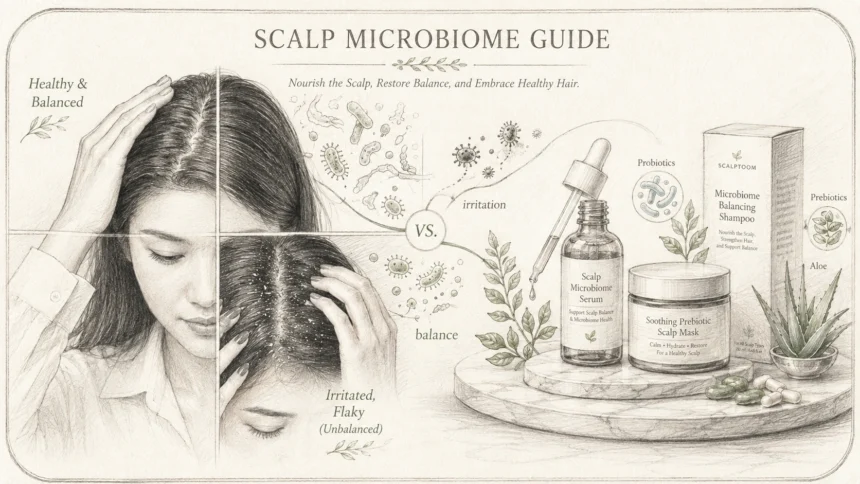
The worst my dandruff ever looked was the week I was trying hardest to “heal my scalp microbiome.”
Understanding the link between the scalp microbiome Guide and dandruff can help you make better choices about cleansing, product buildup, oil control, and scalp care. Dandruff is not always caused by one simple problem, so the goal should be to reduce flakes and irritation while supporting a healthier scalp environment.
I noticed it in the mirror at work. I was wearing a black top, and the shoulders were covered with small white flakes. That morning I had used a microbiome scalp serum, skipped shampoo because I thought frequent washing was destroying my “good bacteria,” and massaged a little oil into the dry-looking areas near my hairline.
By lunchtime, my scalp felt greasy and itchy at the same time.
I remember going into the bathroom, brushing the flakes from my shoulders and wondering how a routine marketed around scalp balance had made my scalp look less balanced than before.
My mistake was believing that dandruff was mainly evidence of a damaged microbiome that I could permanently reset with gentler products.
The scalp microbiome is part of the story. It is not the whole story, and treating dandruff effectively turned out to be much less fashionable than I expected.
I Had to Stop Chasing a Permanent Cure

The phrase “stop dandruff for good” sounds appealing because dandruff feels like a problem that should have a finishing point.
I eventually learned that this expectation was making my decisions worse.
According to the Mayo Clinic’s overview of dandruff, dandruff can usually be controlled, but there is no permanent cure and symptoms can return after treatment stops.
That changed my goal.
Instead of searching for the one shampoo, oil, probiotic or scalp treatment that would permanently eliminate flakes, I started thinking about control and maintenance.
That sounds less exciting. It was also the first approach that produced consistent results.
The How theScalp Microbiome Guide Affects Dandruff Was Real, but I Had Oversimplified It
The scalp is home to bacteria and fungi, just like other areas of skin.
Research comparing healthy and dandruff-prone scalps has identified differences in microbial communities. One well-known study of healthy and dandruff scalp microbiomes found associations involving both bacterial and fungal populations, along with scalp factors such as oil and water content.
Other research has similarly found that dandruff and non-dandruff scalps can contain different bacterial and fungal community patterns. A study examining fungi and bacteria on dandruff-prone scalps found Malassezia to be a major fungal inhabitant while also identifying bacterial differences.
That evidence made the microbiome interesting.
What it did not prove was the claim I had quietly accepted: that dandruff simply meant I lacked enough “good bacteria.”
The scalp microbiome is an ecosystem. Dandruff seems to involve interaction between microbes, scalp oil, the skin barrier and an individual’s inflammatory response rather than one missing microorganism that can simply be replaced.
That distinction made me much more skeptical of products promising to “reset” the scalp after a few applications.
Malassezia Was Not an Infection I Needed to Eradicate
I initially became slightly obsessed with Malassezia.
Once I learned that this yeast was associated with dandruff and seborrheic dermatitis, I started thinking about it as something foreign living on my scalp.
That was inaccurate.
The American Academy of Dermatology explains that yeast naturally lives on people’s skin. In seborrheic dermatitis, dermatologists believe both this yeast and sebum play important roles, and some people appear to develop an inflammatory reaction related to the yeast. The AAD’s explanation of what contributes to seborrheic dermatitis helped me understand why “kill every fungus” was the wrong mental model.
Malassezia can exist on healthy scalps too.
The issue is not simply whether it is present. The relationship between microorganisms, oil and the person’s skin response matters.
That made antifungal dandruff shampoo easier for me to understand. The goal was not sterilizing my scalp. It was controlling a condition in which yeast activity can be part of the problem.
I Had Mistaken Dandruff for Dry Scalp
This was probably my most damaging practical mistake.
I saw flakes and assumed dryness.
Because I thought my scalp needed moisture, I reduced washing and added oils. The scalp looked less flaky for several hours because the oil made loose scale less visible.
Then the itching became worse.
Dandruff and dry scalp can look similar, but they are not always the same problem. The AAD’s guide to distinguishing dandruff from a dry scalp explains that dandruff often improves with an anti-dandruff shampoo, while truly dry scalp may improve by switching to a gentler non-medicated cleanser.
That was important because my approach had been almost exactly backwards.
If irritation came from harsh washing, more antifungal shampoo might not be the answer. But if oily dandruff or seborrheic dermatitis was driving the flakes, repeatedly coating my scalp with cosmetic oils was not necessarily addressing the cause.
I had to identify the problem before trying to moisturize it away.
Medicated Shampoo Was Less Exciting and Much More Effective
I resisted anti-dandruff shampoo because I associated it with harsh formulas and an old-fashioned approach to scalp care.
The microbiome serum sounded more sophisticated.
Eventually I stopped judging treatments by how modern their packaging looked.
The American Academy of Dermatology’s dandruff treatment guidance recommends shampoos containing established anti-dandruff ingredients such as ketoconazole, selenium sulfide, zinc pyrithione, salicylic acid, sulfur or coal tar, depending on the product and person’s needs. The AAD also notes that people sometimes need to alternate products containing different active ingredients when one shampoo is not providing enough control.
That was very different from the way I had been shopping.
I had been reading the botanical extracts on the back label while barely noticing the active ingredient on the front.
Once I reversed those priorities, shopping became easier.
Contact Time Was the Detail I Had Been Missing
My first medicated shampoo did not appear to work.
I applied it the same way I used ordinary shampoo: massage, rinse, done.
I later realized the directions required the product to remain on the scalp for a specific period before rinsing.
That made me reconsider what I had called product failure.
An active ingredient cannot do much if I do not use the product according to its instructions.
The Mayo Clinic’s dandruff treatment guidance explains that medicated shampoos differ in how often they should be used and how long some formulas need to remain on the scalp. It also notes that frequency may need to be adjusted for curly, coiled or textured hair.
From then on, I read the bottle each time I changed products.
I stopped assuming every dandruff shampoo worked the same way.
The Evidence Made Antifungal Treatment Harder for Me to Dismiss
I wanted the microbiome conversation to lead to a completely new treatment.
Instead, it helped explain why an older treatment category worked.
A Cochrane review examining topical antifungal treatments for seborrheic dermatitis found evidence supporting antifungal therapies such as ketoconazole and ciclopirox for controlling symptoms.
That does not mean everyone with a few flakes should automatically use the strongest antifungal product available.
It means there is a meaningful evidence base behind antifungal treatment when dandruff or seborrheic dermatitis is the actual condition.
That distinction mattered to me because I had been treating proven treatment and “microbiome-friendly” treatment as opposites.
They do not necessarily have to be.
Reducing a dandruff-associated microbial imbalance may itself change the scalp ecosystem.
“Microbiome Friendly” Became a Claim I Needed to Question
Once I started noticing the word microbiome, I saw it everywhere.
Scalp masks promised balance. Serums mentioned prebiotics. Shampoos advertised microbiome support. Some formulas were perfectly reasonable products.
My problem was assuming the marketing term automatically indicated superior dandruff treatment.
Research into probiotics and microbiome-focused approaches is developing. A 2024 systematic review looking at probiotics and dandruff found promising signals, but the evidence base is still much less established than decades of work on conventional anti-dandruff treatments.
That changed how I evaluate microbiome products.
I do not automatically dismiss a prebiotic, probiotic or postbiotic scalp formula. I simply do not let the microbiome language replace the question that matters most: what evidence shows that this finished product improves dandruff?
This was where 1.Anchor became relevant to the way I compared scalp products. I stopped comparing the number of microbiome-related terms on the packaging and started comparing the active treatment, instructions, evidence, scalp tolerance and intended use.
I Had Also Been Using Dry Shampoo as Real Shampoo
My scalp routine had another weak point.
On busy weeks, I used dry shampoo several days in a row. My hair looked less oily, so I mentally counted that as cleansing.
It was not.
Dry shampoo absorbs oil. It does not wash the scalp in the same way shampoo and water do.
The AAD’s advice on using dry shampoo without neglecting scalp cleansing specifically warns that relying on dry shampoo instead of regular washing can contribute to scalp problems, including seborrheic dermatitis.
I still use dry shampoo occasionally.
I no longer use it to postpone actual scalp cleansing indefinitely.
That simple change made more difference than several specialized scalp tonics I had purchased.
Conditioner Belonged on My Hair More Than My Scalp
When dandruff shampoo made my hair lengths feel dry, I compensated by applying rich conditioner all the way to the roots.
My scalp became coated again.
The better solution was separating scalp treatment from hair conditioning.
The medicated shampoo needed to reach the scalp. Conditioner could protect the hair lengths without necessarily being massaged heavily into scalp skin.
This was especially helpful when I used a dandruff shampoo that felt less cosmetic than my normal cleanser. I could address the scalp without accepting dry, tangled ends as part of the deal.
The AAD similarly recommends applying many leave-in conditioning products from the mid-lengths toward the ends rather than automatically coating the scalp, because buildup can irritate some scalps.
Once I stopped expecting one product to treat both scalp disease and hair texture, the routine became easier to manage.
Scratching Was Making the Situation Harder to Judge
I had a habit of scratching the same area near my crown when it became itchy.
That created tenderness, which I then interpreted as worsening dandruff.
It was impossible to separate the original irritation from the irritation I was causing mechanically.
I stopped using my fingernails to lift flakes and stopped aggressive scalp scrubbing.
The goal became loosening buildup through appropriate washing rather than scraping every visible scale from the skin.
That also made it easier to notice whether treatment was genuinely working.
A scalp does not have to feel squeaky or freshly exfoliated to be clean.
I Learned That Not Every Flaky Scalp Is Dandruff
There was another reason my “dandruff cure” mentality was risky.
Several scalp conditions can produce itching and scale.
Seborrheic dermatitis can cause visible inflammation and may affect areas beyond the scalp, including the eyebrows, ears and sides of the nose. The AAD describes dandruff as a milder condition on the same general spectrum, while seborrheic dermatitis involves inflammation and can appear elsewhere on the body.
Psoriasis, eczema, allergic reactions to hair products and fungal infections can also affect the scalp.
The AAD’s broader discussion of different causes of an itchy, flaky scalp explains why persistent symptoms deserve more than repeatedly changing shampoos.
That became my stopping rule.
If ordinary dandruff treatment was not helping, the next purchase was not automatically another stronger shampoo.
Sometimes the useful next step was getting the diagnosis checked.
Maintenance Was the Part I Used to Skip
Once my flakes improved, I would stop treatment completely.
Several weeks later they returned, and I would conclude that the shampoo had stopped working.
The problem was often my expectation rather than the shampoo.
Seborrheic dermatitis in particular can require ongoing management. The AAD notes that medicated shampoos may continue to be used to prevent flare-ups according to a dermatologist’s recommendations.
My routine eventually moved from treatment mode into maintenance mode.
That did not mean using medicated shampoo constantly without regard to directions. It meant following the product or clinician’s recommended schedule instead of abandoning everything the moment my shoulders looked clear.
That was the closest I came to stopping dandruff “for good.”
Not permanently eliminating the tendency, but keeping it controlled enough that it stopped controlling my routine.
What I Now Expect From a Scalp Microbiome Product
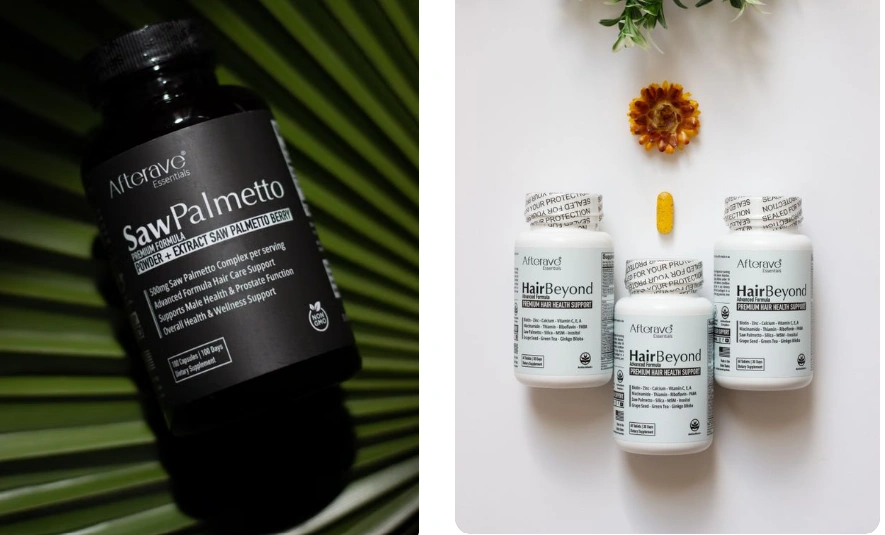
I expect less.
That has made me a better buyer.
I do not need a shampoo to promise to rebuild my entire scalp ecosystem. If it contains an appropriate anti-dandruff active, comes with clear directions and leaves my scalp comfortable enough for consistent use, that is more valuable to me than a vague microbiome claim.
If a cosmetic serum helps my scalp feel comfortable between medicated washes without creating buildup or irritation, I can appreciate it for that role.
I simply do not ask the serum to replace treatment.
The microbiome research has made scalp care more interesting, but it has also made the biology look more complicated, not less. Healthy scalps and dandruff-prone scalps involve communities of organisms interacting with oil production, the skin barrier and immune responses.
A single bottle promising “balance” cannot reduce that system to one ingredient.
The Routine That Finally Made My Dandruff Boring
My scalp routine now feels almost disappointingly ordinary.
I cleanse it regularly instead of repeatedly hiding oil with dry shampoo. When dandruff becomes active, I use an appropriate medicated shampoo according to its instructions and give it the required contact time. I condition the hair lengths so that treating the scalp does not make the rest of my hair miserable.
I do not scratch flakes off, flood my roots with oils or begin three microbiome products at once.
Most importantly, I no longer panic when a small flare returns.
Dandruff coming back does not necessarily mean every treatment has failed. It can be the nature of a recurring condition.
That was the lesson underneath my black-shirt incident.
I had been trying to create a perfect scalp ecosystem I could permanently lock into place.
What actually worked was much less dramatic: understand what dandruff is, treat the active problem properly, keep the scalp clean in a way that suits the hair, and maintain the improvement rather than declaring the condition cured after one good week.
My scalp microbiome did not need me to become its manager.
It needed me to stop letting microbiome marketing distract me from dandruff treatment that had evidence behind it.