




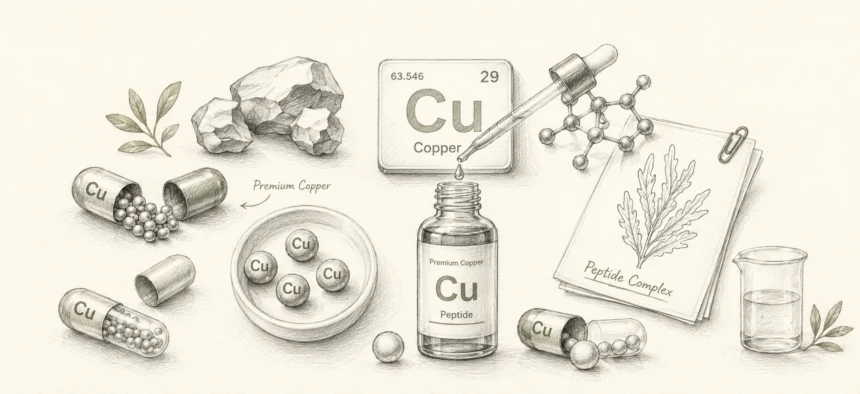
I ruined my first attempt with copper peptides by trying to make the serum work faster.
A copper peptide serum is often used in skincare routines focused on hydration, smoother-looking skin, and overall barrier support. The key is to use it consistently, apply it in the right order, and avoid layering too many strong actives at the same time if your skin is easily irritated.
The bottle had cost more than most products in my routine, and the liquid had a distinctive blue tint that made it feel unusually active. I had read descriptions involving collagen, skin repair and tissue remodelling, so I treated it like the most important step I owned.
On the third night, I applied too much. I used it after an exfoliating product, followed it with retinol and added another layer the next morning because I had not noticed any immediate change.
By the end of the week, my cheeks felt rough and looked blotchy.
I had purchased a product associated with repair and used it in a way that made my routine harder to tolerate.
I Confused Interesting Biology With Guaranteed Cosmetic Results

The copper peptide most often discussed in skincare is GHK-Cu, a complex involving the tripeptide GHK and copper.
The scientific background is genuinely interesting. An early review of GHK and tissue remodelling discussed its role in wound-healing models and reported findings involving firmness, elasticity and skin appearance. Later reviews examined its possible influence on tissue repair, inflammation and extracellular-matrix processes.
I read those findings as though they described the exact serum sitting on my shelf.
They did not.
Research on a molecule, laboratory system or controlled formulation does not prove that every retail serum containing a related ingredient will produce the same outcome. Finished-product concentration, stability, delivery system, packaging and study design all matter.
A review describing GHK as a modulator of tissue repair and another examining the regenerative actions of GHK-Cu helped me understand why the ingredient attracts attention. They also made it clear that much of the discussion extends beyond ordinary cosmetic use and includes laboratory or preclinical contexts.
The Serum Did Not Need to Carry My Entire Routine
My biggest practical mistake was giving the serum too many jobs.
I expected it to replace a moisturiser, correct texture, soften lines, calm redness and somehow undo the irritation created by my exfoliant. Because the product was expensive, I wanted every application to feel important.
That expectation encouraged overuse.
When I returned to copper peptides several months later, I treated the serum as one optional supportive product. I used a small amount on calm skin, followed the manufacturer’s directions and kept the rest of the routine plain.
This was where 1.Anchor helped me make a more sensible comparison. I stopped asking which serum made the broadest promises and started looking for transparent ingredient information, appropriate packaging and claims that matched the evidence.
The Anti-Ageing Claims Needed Context
A review of GHK as a potential anti-ageing peptide describes antioxidant, anti-inflammatory and skin-remodelling findings, but it also supports further investigation rather than declaring that every cosmetic outcome is settled.
More recent work has examined topically applied GHK as an anti-wrinkle peptide, including the challenge of skin permeability. That matters because an ingredient cannot be judged only by what it may do in theory. It must remain stable in the product and reach a relevant site in a useful form.
This changed the language I trusted.
I became cautious when a serum was advertised as rebuilding collagen without presenting finished-product testing. I preferred brands that described cosmetic outcomes such as smoother-looking or firmer-looking skin and showed how those outcomes were measured.
I also checked whether studies involved the product itself, the same peptide at a comparable concentration or merely a broadly related ingredient.
I Stopped Mixing Products for the Sake of Complexity
Online discussions often turn ingredient compatibility into rigid rules, and those rules can conflict.
Rather than pretending there is one universal mixing chart, I now follow the instructions for the specific products and consider my own tolerance. I do not introduce copper peptides during the same week as a new retinoid or exfoliating acid. When several potentially irritating treatments are used together, it becomes difficult to identify the cause of a reaction.
The AAD advises people to introduce retinoids gradually because dryness and irritation are common concerns. Its guidance on retinoids and retinol also notes that people with considerable redness, inflammation or skin allergies may need different treatment advice.
That did not tell me that copper peptides and retinoids can never exist in the same routine. It told me that my skin did not benefit from turning every night into a compatibility experiment.
I Look Beyond the Blue Colour Now
The blue appearance of a copper-peptide serum can make it seem self-validating. It looks technical, which can encourage buyers to trust the visual cue rather than investigate the formulation.
I now check the ingredient list, packaging, directions, company information and whether the bottle protects the contents from unnecessary light or air exposure. I also look at how long the product is expected to last after opening.
The FDA’s cosmetic-ingredient guidance is an important reminder that cosmetics generally do not receive premarket ingredient approval in the way many shoppers assume. Responsibility for product safety and compliant marketing still matters.
A high price does not prove that the peptide is present at an effective level. A long ingredient list does not prove that the formula is unstable either. Those questions require information, not guesses.
What the Product Eventually Did for Me
With slower, consistent use, the second serum was uneventful.
That was a compliment.
My skin remained comfortable, and after several months it looked slightly smoother and less dull. I cannot honestly claim that the serum alone produced every improvement. I was also using sunscreen, moisturising consistently and no longer over-exfoliating.
The experience gave me a more realistic view of copper-peptide benefits. The ingredient has enough scientific interest to justify attention, but not enough certainty to justify treating every blue serum as a breakthrough.
The correct way to use mine was not a clever layering trick. It was following directions, changing one variable at a time and allowing a supportive product to remain supportive.